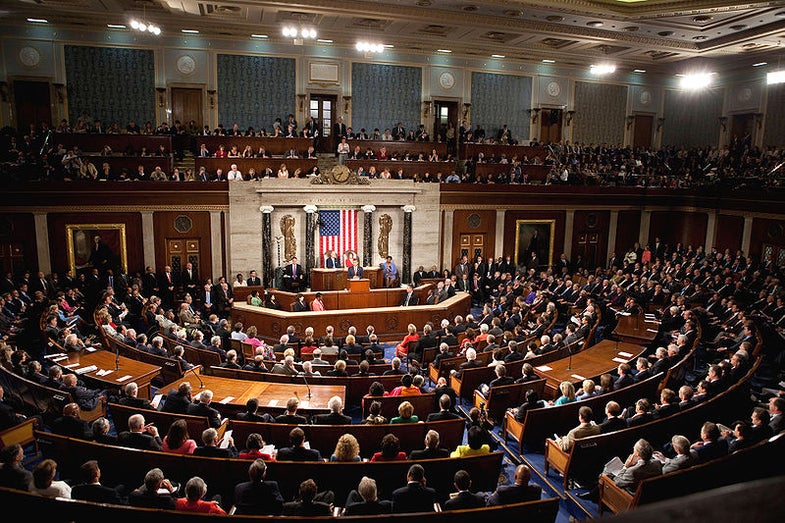
Congress In Session Whitehouse.gov

When it comes to the physics of climate change, no one year is more important than any other. But for the politics of climate, 2012 will be a big one, less about what officials may do than what they may block or undo.

Legislative efforts to address rising CO2 emissions have not yet completely expired. Washington has expressed little interest in reducing the nation’s carbon footprint, but it has made a lot of noise about saving money. Recognizing the opportunity, 14 senators and 38 representatives have signed letters urging the Congressional “supercommittee” charged with reducing the deficit to save as much as $122 billion over the next decade by ending oil and gas subsidies. House Democrats also reintroduced a carbon-tax bill that would reduce the deficit by $437 billion over the next decade.

Such legislative measures are unlikely to get far, but there is plenty of action to be found on the regulatory side. The Environmental Protection Agency will finalize two new rules that directly restrict CO2 emissions, along with a suite of updated air, water and solid-waste regulations aimed at cleaning up (or shutting down) coal power plants. New federal fuel-economy rules for light-duty vehicles will take effect in 2014, and rules for heavy-duty vehicles will be finalized to start in 2017. This regulatory agenda will represent the Obama administration’s most substantial action on climate change by far—if it survives.

Which brings us to the most significant climate event of the year: the elections. Since 2010, the Republican majority in the House of Representatives has held 170 votes on efforts to block or undo environmental protections. Those efforts have largely failed in the face of presidential veto threats and opposition in the Democrat-controlled Senate. But if Republicans win both houses of Congress and the presidency, the House GOP agenda will proceed into law. New regulations will be rolled back, the EPA’s power will be sharply curtailed, and new legislation will be even less likely to grapple with the gathering climate crisis.

2012: THE YEAR IN SCIENCE

6 Comments

Come on david roberts!!!!! In your article about Congress fiddling, you state; ".......less likely to grapple with the gathering climate crisis"???? Seriously??? what gathering climate crisis??? You still believe that junk science??? After all the models have been discredited and as the emails of the con-artists at the east anglia climate research unit have been exposed, why are you still perpetuating these lies???

I have long since concluded that climate change (i.e. Global Warming) is more of a religion and less of a science. Viewed in that light and since we do have freedom of religion in this country, it follows that Roberts is merely submitting his version of reality - in this case ... religion. Bless him as he obviously doesn't want to hear (or read) any thoughts to the contrary.

you're both idiots.

Ah roguezone, you are obviously a liberal, without a pertinent thought but nevertheless religiously opinionated and using typical liberal debate techniques, i.e., having no relevant facts you resort to personal attacks.

The EPA is regulating jobs straight to China at a faster pace than ever before, and Congress is doing everything they can to slow them down because they respect the people’s demands. Do you think China is even partially responsible about the environment?

"House Democrats also reintroduced a carbon-tax bill".
Are you kidding me?? This is simply government run amuck, yet another way to tax Americans to death. Thank God the Republicans (despite their imperfections) are there to combat the enviro-nazi idealists.

Maybe before we think about shutting down the already over-worked coal-fired plants we should first find and bring online a replacement for that power. I'd be fine with a replacement but we have to be realistic. Is that such a hard idea to grasp?? We are already experiencing rolling blackouts during peak usage.

China is the largest emitter of pollution yet it is exempt from the Kyoto Protocal because it is considered a developing country. That should speak volumes to anyone paying attention.


138 years of Popular Science at your fingertips.

Innovation Challenges


Popular Science+ For iPad

Each issue has been completely reimagined for your iPad. See our amazing new vision for magazines that goes far beyond the printed page


Download Our App

Stay up to date on the latest news of the future of science and technology from your iPhone or Android phone with full articles, images and offline viewing


Follow Us On Twitter

Featuring every article from the magazine and website, plus links from around the Web. Also see our PopSci DIY feed


March 2012: The Future of Medicine

A 10,000-rpm, no-pulse heart is completely revolutionizing how we think about transplants. Plus: rapid-response virus hunters, a shocking cure for migraines, the world's youngest person to have achieved nuclear fusion (in his parents' garage!), and much more.


circ-top-header.gif
circ-cover.gif
bmxmag-ps