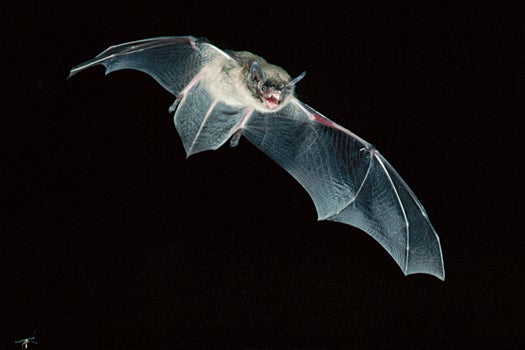
Hang Time Bats spend much of their time flying, making them difficult to study. Some have been clocked at 20 mph. Joe McDonald/Corbis

The hundreds of millions of bats in the U.S. are in serious trouble, threatened by such hazards as wind turbines and a fungal infection called white-nose syndrome, all while facing the uncertainty of a changing climate. Most bats hide in caves during the day and live in the air at night, making them notoriously difficult to study. But if scientists are going to help them, they need to be able to track them.

To that end, biologists Winifred Frick of the University of California at Santa Cruz and Tom Kunz of Boston University have teamed up with some unexpected allies: weather researchers Phillip Chilson, an atmospheric physicist at the University of Oklahoma, and radar scientist Ken Howard of the U.S. National Severe Storms Laboratory.

The U.S. National Weather Service’s 156 Nexrad Doppler radar stations gather a tremendous amount of data. They scan the country in five- to 10-minute intervals, 24 hours a day, from 0.5 degrees above the horizon to 19.5 degrees. And in doing so, they detect much more than weather. Anything in the air bounces a signal back—insects, birds, wind turbines, low-flying planes, forest-fire smoke, falling meteors, debris from NASA disasters, and bats. Radar scientists call the signal from flying animals bioclutter. “From a meteorological standpoint, it’s noise,” Howard says. “It contaminates all our algorithms. It misleads people. We have examples that look like severe storms, but it’s actually bats coming out of the ground.”
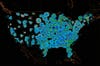
Raw Signal: Radar picks up both weather patterns and flying animals. The National Oceanic and Atmospheric Administration uses special algorithms to filter the raw signal, pictured here, to produce a weather map (pictured below).  Courtesy Philip Chilson/University of Oklahoma

The weather-radar images shown on TV broadcasts have mostly been scrubbed of such clutter. But unscrubbed maps are far more complex. Clear, cloudless nights are filled with flocks of animals on the wing, which appear on radar maps as a thick cloud of fuzzy green dots, similar to raindrops. If a cloud of bat-size objects appears at dusk at the location of a known bat cave, they’re probably bats, which means that the Weather Service’s 20-year-old, 1.2-petabyte raw radar archive is also an archive of two decades of bats in flight.

The Nexrad archive has already generated several new observations and even a new field of science: aeroecology, a term Kunz coined last year. Frick has noticed that in a dry year (when insects are less abundant), Brazilian free-tailed bats in a certain Texas cave emerged from their daytime slumber earlier in the evening to get a head start on mealtime. During a wet year, they slept in. Using the archive, Frick also spotted insects pooled along a storm front, where winds shepherded them together. On several nights, the bats gathered to feed on the wind-formed buffet line—clear evidence that weather influences foraging activities. She says she wants to study the entire two-decade archive, including looking at whether the free-tailed bats are starting to spend the winter in Texas rather than heading farther south, which would be an indication that a warming climate is changing migration patterns.

Eventually, the scientists aim to use the data to count population numbers at each cave. The algorithms that determine the identity of objects in the sky are not yet nuanced enough for a census. But they could be improved, helping both meteorologists and biologists better determine, for example, what’s a cloud, what’s a bat-cloud and what’s an insect-cloud. (Bioclutter still sometimes contaminates weather-only maps, looking like a storm.)
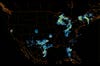
Weather Map: The colors represent radar reflectivity, ranging from grey (lowest reflectivity) to blue, green, yellow, and red (highest reflectivity). In the raw image (the bubbly map of America above) produced on September 30th at 11 p.m. ET, the blue and green are most likely migrating birds, flying at night when winds are calmer.  Courtesy Philip Chilson/University of Oklahoma

Radar scientists are working to make the archive more useful for researchers. One of their goals is to produce animal-only maps and animal counts, much as they produce weather maps and rainfall counts today. In order to accurately screen for various life-forms, though, the scientists need to know more about how individual animals appear on radar. Last summer, Chilson and Frick scanned live bat swarms in west Texas with a mobile radar device (designed for tornado chasing) while also using infrared cameras to identify individuals. Chilson even put a dead bat in an anechoic chamber to precisely map its radar signature.

Howard says that the animal-tracking project could also help biologists studying insects and birds, particularly those observing nocturnal airborne behavior. The aerosphere is a habitat just like the land or the ocean, “but we never stop to look at it,” he says. “Most of these things happen at night. There’s a whole richness of life that’s going on that is not visible, unless you are a biologist with night-vision glasses—or if you are using radars.”

12 Comments

I can imagine this could also be used in better border control of illegal immigrants as the weather radars monitor weather and with the development of better software to distinguish animals, one of those animals would be humans, too.

WOWzers, this is cool!

@GeeWillikers...just stop trolling your off topic crap, doppler weather radar does not pick up humans, if this is an attempt to be funny you failed with your racist joke, negative cheers

Dear Chuck,
You wish to be antagonist I see. You do not read above I type the words 'illegal immigrants'.

To the company of POPSCI, I be happy to fill out an employee application to verify all I am about to see as factual.

I am a veteran. I am a patriot. It says on my diver’s license I am safe and excellent driver. I am a born USA citizen and have broken no laws. My dear wife just receives her green card today. I am father of two adult girls who finish college and I am so proud of them.

Chuck, you have education maybe, you have no knowledge.
You being a narcissist is all about insecurity. Sure you may achieve high in life, not for confidence, but for an inferiority complex. You insult others often, because you must feel taller than them and put other down.

Take care, I forgive you and tomorrow is a new day!

.......................................
This article is wonderful and I look forward to reading more about it. Nice!

It is a ridiculous statement that wind turbines are a hazard to a bat. A bat can pick out a tiny insect on the wing, and they can't detect a BIG slow moving wind turbine? Give me a break!

they actually find bats that are killed by wind turbines (and birds), cheers

In my life time, I have worked with and maintain various different types of RADAR down to the single component level. I currently now work with R&D engineers on certain types of RADAR. This article is promoting the development of the EXTRA data that is brought in from typical Radars to make good use of for detecting various types of animals. Humans are animals.

The southern borders of USA have extreme much patrols and expensive fences for the purpose of "Illegal aliens or Illegal immigrants", (Illegal being something against our USA laws-not a good thing).

In the long run, this type of technology can help to reduce the cost of patrolling the USA borders and increase the security for the USA. It can also help to protect our solders in their camps overseas against the enemy, (Enemy is a bad thing and someone against the USA).

Most people understand the word illegal and the word enemy. I only added clarity for those who do not.

Bats are an extremely important part of our ecology. It is a shame so many people are afraid of them and kill them. Not only are they the best "pesticide" available for crops, many of them are important in pollination. For example, we would have no tequila without bats, which pollinate the cactus from which it is derived. Bat Conservation International has loads more information, check it out.

I like Bats! Bats are beautiful!
The interesting things about animals and birds as they travel, they all tend to be motivated in similar fashions, going to food, running from becoming food, going to sex, running away from sex. They tend not to go in straight lines. The various types of animals and birds do have patterns of movement typical to each animal too.

But humans over a certain distance tend to travel in straight lines with much more purpose. There are various different types of detections systems that specifically pick up on "human type movement via its software and data base of typical human type movement".

I hope this helps to save and protect all types of animals!
This article is very cool!

.............................
Science sees no further than what it can sense.
Religion sees beyond the senses.

the last i knew radar was not used to track objects on the ground, cheers

http://en.wikipedia.org/wiki/Radar_configurations_and_types

There are 100s of different types of Radar for a variety of purpose. On Aircraft carries, those little R2D2 defensive devices when first invented have a guidance detection system that can detect something as small as a bullet.
In the initial testing of these devices did not shut off and what appeared to be a wild gun. After further investigation, they found the unit was tracking it's own bullets in the distance and attempting to shoot them down.

Boats use ground surface radar, many military land devices use this type of radar too.

......................
SPOOKY!...... Life is

a former tanker buddy of mine set me straight about Ground Surveillance Radar, so it appears this new tech the article refers to is good for bats flying (and other flying animals) and the military already has radar for moving objects on the ground, cheers


138 years of Popular Science at your fingertips.

Innovation Challenges


Popular Science+ For iPad

Each issue has been completely reimagined for your iPad. See our amazing new vision for magazines that goes far beyond the printed page


Download Our App

Stay up to date on the latest news of the future of science and technology from your iPhone or Android phone with full articles, images and offline viewing


Follow Us On Twitter

Featuring every article from the magazine and website, plus links from around the Web. Also see our PopSci DIY feed


March 2012: The Future of Medicine

A 10,000-rpm, no-pulse heart is completely revolutionizing how we think about transplants. Plus: rapid-response virus hunters, a shocking cure for migraines, the world's youngest person to have achieved nuclear fusion (in his parents' garage!), and much more.


circ-top-header.gif
circ-cover.gif
bmxmag-ps