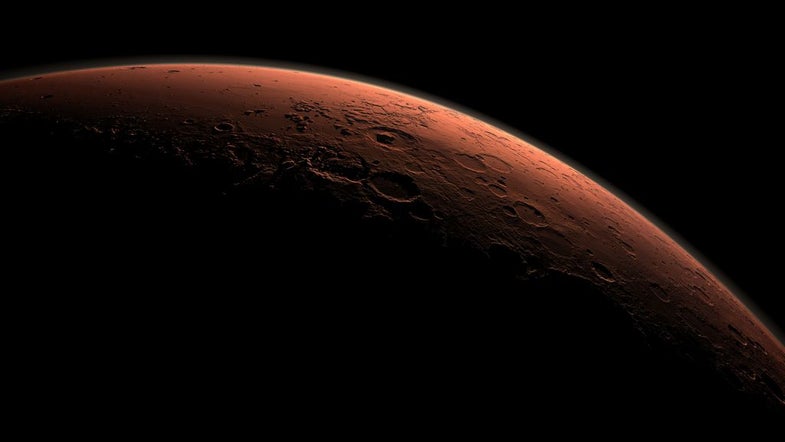
Sunrise at Gale Crater Gale Crater, future home of the Mars Science Laboratory, looms in the distance, distinguished from adjacent craters by its central mountain. Gale Crater straddles the dichotomy boundary of Mars, which separates the broad, flat, and young northern plains from the much older and rougher southern highlands. Water may have flowed across this topographic boundary, from highland to lowland. Last week, the Opportunity rover team found slam-dunk evidence of liquid water on the surface of Mars, an intriguing find for astrobiology. NASA/JPL-Caltech

Now that we have slam-dunk evidence that Mars was once a wet and likely temperate place, astrobiologists are pondering the implications for ancient Martian life. One new study says the Red Planet has even more habitable space than Earth — albeit underground.

Led by Charley Lineweaver at the Australian National University, researchers compared models of temperature and pressure conditions on Earth with those on Mars, extrapolating how much of Mars might be amenable to hosting Earth-like organisms. Life occupies just one percent of Earth, if you consider the entire planet’s volume from the core to the stratosphere. But apparently three percent of Mars could be habitable, Lineweaver said. Most of this comfortable space is underground, where there would be sufficient pressure and warmth to hold liquid water and perhaps some toasty microbes.

Although the Phoenix lander found ice at the north pole, modern Mars’ surface is too low-pressure to hold on to liquid water, and it’s too cold (average about -81 °F) for water or life as we know it. But nestled underneath the planet’s crust, the habitat could be much more friendly, Lineweaver told AFP.

Lineweaver said his study uses decades of data from a host of Mars missions and compiles information about several sites, rather than just one or two areas. “There are large regions of Mars that are compatible with terrestrial life,” he said.

The Mars Science Laboratory, en route to the planet for an August arrival, is designed to help answer some of these questions. It has several instruments for examining the chemical composition of rocks inside Gale Crater, a region believed to once host flowing water. The Curiosity rover also has some instruments designed to look for the chemical ingredients of life.

The Australian study was published in the journal Astrobiology.

[AFP]

22 Comments

the problem with mars is that it's geologically dead. even if we did all this, and terraformed it (it's underground or it's surface) it wouldn't last very long at all.

--------------------------------------------------------------------------
why learn from your own mistakes, when you could learn from the mistakes of others?
“The most incomprehensible thing about the universe is that it is comprehensible” -Albert Ein

Life is throughout the universe, we just gotta get our hands dirty digging for em or getting off our rock to look for it.

" Science without religion is lame, religion without science is blind." Albert Einstein

If we lost out magnetic shielding and lost most of your atmosphere in the way Mars has, there are still plenty of life forms that would continue to exist and thrive underground. Might just be insects, microbes or single celled organisms but it would still be life.

And if the plan is to drill and create underground habitats, then Mars being a "geographically dead" planet is exactly what you would want, nothing shifting around due to techtonic convection.

Playing Devil's Advocate since 1978

"The only constant in the universe is change"
-Heraclitus of Ephesus 535 BC - 475 BC

True, but it would also be very, very cold.

--------------------------------------------------------------------------
why learn from your own mistakes, when you could learn from the mistakes of others?
“The most incomprehensible thing about the universe is that it is comprehensible” -Albert Ein

I am 100% for terra forming MARS and changing the environment from orange to green or blue.

Then grow eatable 100% nutritious type algae for human consumption and ship it back to earth.

Mars becomes a EARTH food farm and also gets more oxygen for future development!

nasa stop beating around the bush and admit that life once flourished on Mars surface. there were civilizations just like on earth but an asteroid hit and eradicated all life. watch the movie Mission to Mars it explains a lot of what im talking about. a way of living on Mars is by using its underground Lava tubes. they could protect humans from harmful radiation.

_________________
The people of the world only divide into two kinds, One sort with brains who hold no religion, The other with religion and no brain.

- Abu-al-Ala al-Marri

Life may exist there right now, just that we don't have the instrument to find it or wouldn't know what we were looking at. To look for life we need a microscopic imager that looks down to the micrometer, um, level. Curiosity has such an instrument. The Phoenix Lander had a microscopic imager but because it was very limited, to see anything moving around would mean that it was multi-cellular or a large bacteria, eukaryote etc.

'All the ingredients for life to exist on Mars was at the Phoenix Lander site," according to the Phoenix Lander Science Team. See here for some very intriguing findings of what appears to be rod shaped and scorpion shaped life forms moving around in the Phoenix Landers microscopic imager:

www.youtube.com/user/shineinnovations?feature=mhee#p/a/f/0/zhfSjJeQf58

Life on earth exist over two miles underground, so to dig up something on Mars like the Phoenix Lander did wouldn't be out of the question especially if all the necessary ingredients to sustain life was present, as the Phoenix Lander Science Team announced. Also it is important to note that was was present in some of the samples that was dug up by the Phoenix Lander...

Oooops this last sentence from above:

"Also it is important to note that was was present in some of the samples that was dug up by the Phoenix Lander."

Should read:

Also it is important to note that water was present in some of the samples that the Phoenix Lander dug up...

Ron Bennett

@JediMindset

It's a MOVIE! lol

Hope MSL finds a nice big cavern in Gale somewhere...

@pheonix1012,

yes a great movies based on actual facts. scientific agree that life could have been "seeded" on mars.

_________________
The people of the world only divide into two kinds, One sort with brains who hold no religion, The other with religion and no brain.

- Abu-al-Ala al-Marri

For the record, scientists accept it as a possibility that Mars is geologically active. A gas (Methane, if I remember correctly), which in expected conditions, would be actively removed and therefore non present in the atmosphere of Mars. But there is some. Meaning for certain that Mars is either geologically active or does have life currently residing on it, albeit microbial.

@pheonix1012, JediMindset, sometimes our dreams and our imagination is really remembering genetically of something we humans knew long ago.

Perhaps JediMindset is channeling an old memory, of a time when humans came from Mars and escaped a disaster long long ago. The entire junk DNA in our human bodies is really of a history of our past from the stars and our ancestors of outer space, Mars and beyond.

Maybe the ananoci left DNA bread crumbs in our minds and human DNA prior to their demise.

.............................
Science sees no further than what it can sense.
Religion sees beyond the senses.

I am thinking that NASA has figured out that too many people are spotting too many things, including living things, and so is trying to gradually change what they say, perhaps to eventually make an announcement.
It is not difficult to spot the plant life in the Mars photos if you just use your eyes. There are little "tufts" sticking up in many places. A good series of photos to look for plants-- and artifacts-- is Spirit sol 1192, though there are many more examples.

Need to ease into it, because those religions that believe one being created only us would be up in arms trying to scramble with the information that we are, in fact, not the only things in existance.

Underground habitats on mars would not be too cold, as just with earth the heated core would provide plenty of warmth! http://www.newscientist.com/article/dn11962-lab-study-indicates-mars-has-a-molten-core.html

With the genetic code containing historical information, I personally feel this is exactly. 97% of Human DNA is not used for biological mapping and is listed as "non-coding" DNA, we still don't know why we have it, what purpose does it serve, it seems wasteful to have 97% of what's there be totally useless.
http://www.psrast.org/junkdna.htm

Elephants have shown amazing recall for locations they never visited, the bones of a relative scattered amoung other bones, locations of watering holes that existed when their grandparents visited, but they never have. It's been documented and is pretty much common knowledge to those that raise and care for elephants that they are born with extensive knowledge.
http://www.sheldrickwildlifetrust.org/html/raiseorphan.htm

It is quite possible that we did have this and lost touch, or we still do and our socological enviroment has trained us to ignore them. But until we understand that 97% of our DNA and it's function, we are only left with speculation and the few observations of genetic memory in action.

Playing Devil's Advocate since 1978

"The only constant in the universe is change"
-Heraclitus of Ephesus 535 BC - 475 BC

@CodeZero I believe that the generally accepted theory as to why we have so much "useless" DNA is because that it is the DNA leftovers from our evolutionary history. If life has existed for approximately 2 billion years on our planet and has undergone subsequent evolutionary changes, then the remnants of all of those ancestors to all of us would be present in our genetic coding.

Sling a couple dozen comets into the thing and lets get an atmosphere brewing!

Who will colonize Mars first, the US, China, India or Japan?

That's correct ColtonCM, the current theory (and it's a very strong theory), is that the vast majority of our DNA exists because of our genetic history on Earth. Between the time we began as single-celled organisms to fish to humans, we have an extremely varied genetic history; and the vast majority of that evolution (such as when we were primarily water-dwelling) no longer applies and is therefore a part of our "junk" genetic code.

CodeZero, it's definitely well known that Elephants have an incredible memory, but I'm not certain about "Elephants have shown amazing recall for locations they never visited, the bones of a relative scattered amoung other bones, locations of watering holes that existed when their grandparents visited, but they never have."

Your source doesn't appear to make that claim, as far as I can tell. It does mention genetic memory, but it's specifically in terms of the Elephant knowing what foods are edible and what are not, and also indicates this "memory" must be honed through experience and education from its parents.

If you have any other sources making a claim such as Elephants demonstrate a knowledge of an area they've never been to, I'd definitely be curious to see it. Particularly if it's from a scholarly journal.

I mean that seriously, as well -- thank you for providing sources for your comments; if you have more sources, I'd like to see them.

Jedimindset, I assure you, the moment a discovery is made that definitively proves life exists on Mars (or anywhere else), NASA will be the absolute first authority to jump on that bandwaggon. Many, many mainstream scientists -- many working for NASA -- believe life can (and probably does) exist elsewhere in the Universe.

This is no longer a fringe belief -- it's just that there's no *definite* proof yet, and scientists will likely be quite conservative in making such strong claims. When they do make such a claim, they won't to be 100% absolutely certain about it.

But as for an evolutionary (or "seeding") relationship with whatever life may exist on Mars, if any (or in the past), I think that connection is more tenuous (there are some serious theories that suggest a connection, though personally I'm not convinced; and regardless, one step at a time: first we need to identify if life actually does, or did, exist there -- without that, there's no reason to bother pondering a connection between us and the non-existent them).

@Mwalchak "Who will colonize Mars first, the US, China, India or Japan?"

I believe likely none of the above. At this rate the corporations will settle them and then probably secede, taking all the raw materials for themselves, ushering in a whole new era of piracy and corporate extortion!

Call me a pessimist, but I calls 'em as i sees 'em.

"When deep space exploration ramps up, it'll be the corporations that will name everything: The Ibm stellarsphere, The Microsoft galaxie, Planet Starbucks."
-FC

Corporations will rule outerspace. This reminds me so much of scifi games similar to EVE Online. One day we'll probably even try to conquer/explore the universe and trade/wage war against intergalactic life-forms. heck! even Gundam-type mobile suits are slowly becoming a reality.

Science fiction is slowly becoming science facts. And our world is greatly benefiting from those innovative ideas that sometimes inspire us into reshaping reality, simply because somebody thought it was friggin' cool.

Downside is, most scifi involves dystopian futures, so expect a more rigid 1984 type scenario, bladerunner replicants, and public suicide booths..

@vidar & nighthawkish

We make the future we want to have, whether its a dystopic techno-dictatorship or a free, optimistic techno-democracy is up to us and the decisions we make today.

Space is vast and exploring space is expensive, far too expensive for any one country to do it alone. The only way we'll ever get to the future envisioned by Asimov, Clarke, Bradbury and Roddenbury will be for all of us to come together and do it as one. Private enterprise will eventually get involved but the first steps must be taken by our leaders.


July 2013: The Future Of Flight

The incredible innovations, like drone swarms and perpetual flight, bringing aviation into the world of tomorrow. Plus: today's greatest sci-fi writers predict the future, the science behind the summer's biggest blockbusters, a Doctor Who-themed DIY 'bot, the organs you can do without, and much more.


Online Content Director: Suzanne LaBarre | Email
Senior Editor: Paul Adams | Email
Associate Editor: Dan Nosowitz | Email
Assistant Editor: Colin Lecher | Email
Assistant Editor: Rose Pastore | Email

Contributing Writers:

Kelsey D. Atherton | Email
Francie Diep | Email
Shaunacy Ferro | Email

circ-top-header.gif
circ-cover.gif