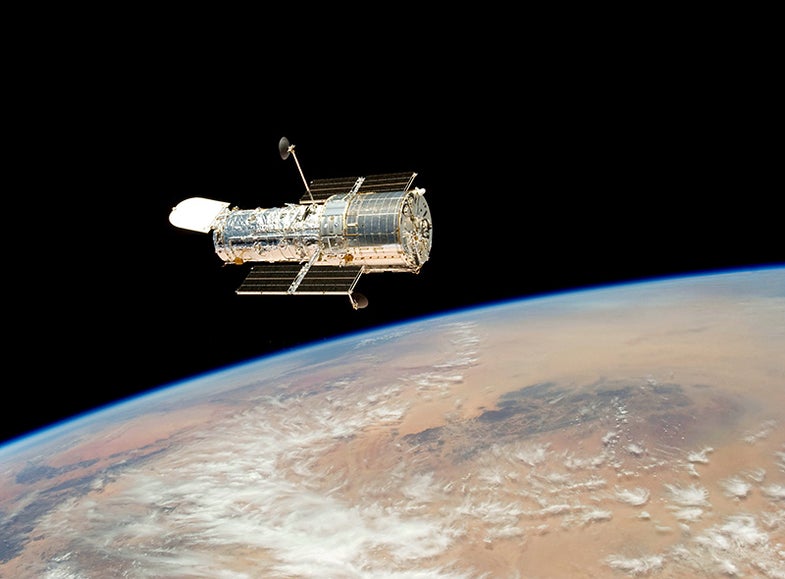
Final Release of Hubble, May 2009 Space Telescope Science Institute

The Hubble Space Telescope has sniffed out evidence of complex carbon molecules, the building blocks of life in this corner of the cosmos, lying on the frozen surface of Pluto. The distant dwarf world is known to harbor methane ice and other frigid compounds, but this is the first time scientists have suggested there could be other complex carbon chemicals, too.

Something is absorbing ultraviolet light on Pluto’s surface, and it may be organic compounds or some nitrogen-containing material, according to scientists at the Southwest Research Institute. That’s organic not as in life, but as in carbon-based compounds that make up the building blocks of life as we know it right now.

The chemicals could be produced as weak sunlight or cosmic rays bombard Pluto and break apart methane and carbon monoxide ice on the dwarf planet.

“This is an exciting finding because complex Plutonian hydrocarbons and other molecules that could be responsible for the ultraviolet spectral features we found with Hubble may, among other things, be responsible for giving Pluto its ruddy color,” said Alan Stern of SwRI in a statement.

The team found the high UV absorption using the Cosmic Origins Spectrograph, a new instrument installed during the final Hubble servicing mission in 2009. The new data marked the first time the COS was turned to Pluto and its largest companion, Charon. The COS is designed to split light apart and measure its components.

During measurements made in 2010, the team also discovered evidence of changes in Pluto's ultraviolet spectrum compared to earlier measurements from the 1990s. This indicates the dwarf planet’s surface might be changing, due to some unknown influence, or its atmosphere might have increased in pressure. The paper, published in the Astronomical Journal, shows there’s a lot left to be learned about Pluto, Stern said. NASA’s New Horizons spacecraft will be able to answer some questions when it arrives in 2015.

[SwRI]

12 Comments

pretty sure aliens tried to "seed" Pluto with all the other planets in their experiment with humans to see which one we could survive on....mars and earth were the only "inhabitable" ones.

"religion is like a prison for the seekers of wisdom"

-Killah Priest

Wouldn't it be ironic if the first finding of extraterrestrial life was to be on Pluto?

Its a Cosmic Alien evesdropping outpost! Well, we will only find out what's up when New Horizons probe gets there. :D

Perhaps a stupid question, but what would Hubble see if its pointed towards earth? Or are the optics just of no use to focus on something so nearby?

If we stick with the "life is seeded by asteroids/meteoroids/interstellar debris, than it would be completely illogical not to postulate that those same objects that seeded life on Earth also got peppered along every other orbiting body in our solar system.

Playing Devil's Advocate since 1978

"The only constant in the universe is change"
-Heraclitus of Ephesus 535 BC - 475 BC

Chelle12,
“What would Hubble see if it faces the earth ".
Hubble would see me, looking up with my telescope and waving of course. ;)

JediMindset,
All life from the cosmos is considered alien; no matter how small if it seeds and dots of life speckled Mars, Pluto, Earth and all the other planets, the cosmos, then yes we came from aliens originally.

If life is tiny life is abundant on Pluto and Pluto being so far from the sun, I believe this opens up more possibilities of life being abundant elsewhere in the cosmos. I am crossing my toes, eyes and fingers that there is life on Pluto!

Perhaps in some small corner of Pluto, if is existing, we then could put a space base there. Who knows, this corner of Pluto may just warm enough, with the right ingredients of life and us to exist, too. It could be our Earthly space base, outpost!!!

Hope they are right, who knows maybe Horizon will make first contact with intelligent life in our solar system when it gets there.

Remember intelligent life on another world may be aquatic marine life not surface dwellers like us. Life on earth started over 3.8 billion years ago in the sea, life on the surface that crawled out of the sea only started 700 million years ago, for 3.1 billion years on earth the surface atmosphere was too toxic too support life.

The obstacle to transition for aquatic life form to explore our universe would be much more difficult then surface dwelling creatures like humans, but if they have billions of years evolving then that bearer can be broken just like humans breaking the obstacle of space to explore the moon, from air to vacuum. We humans had it easy, Aquatic life forms in our outer solar system would have to go several steps further.

Most all the evidence for life bearing organic compounds are in our outer solar system. Except for earth, most all the water and water ice that exist is in our solar system. We have discovered several different ice covered water worlds in our outer solar system. We know that tidal forces can heat these worlds so oceans can lay beneath a sheet of surface ice such as Europa. We now know that you don't even need tidal forces to heat a world, internal nuclear furnaces have been found to heat small asteroids far away from large tidal effecting gravity wells and the sun causing volcanism on worlds so small that gravity can't hold the material on it once it erupts.

So to find intelligent life off this pebble we call earth look for all the markers of life as we know it, organic compounds and water. Where do you find that outside earth, in our outer solar system...

If we have New Horizons making contact with Intelligent Life on Pluto!? Then we are in deeeep shiiit!

Here’s a close-up!

I mean here: http://abcotv.typepad.com/photos/uncategorized/2008/12/12/santa_sleigh.jpg

Wouldn't that be a kick in the face for when they threw Pluto out of the brotherhood of planets. Pluto though just seems like it is the last place I would expect to find anything.

Science always asks "can we," but doesn't seem to ask "should we."

If asteroids, comets, meteoroids could act as seeds of life, then it wouldn't be surprising if life somehow developed on the surface of those space debris as well. Come to think of it, we're all just a pile of space debris hurtling through space.


June 2013: American Energy Independence

Five amazing, clean technologies that will set us free, in this month's energy-focused issue. Also: how to build a better bomb detector, the robotic toys that are raising your children, a human catapult, the world's smallest arcade, and much more.


Online Content Director: Suzanne LaBarre | Email
Senior Editor: Paul Adams | Email
Associate Editor: Dan Nosowitz | Email
Assistant Editor: Colin Lecher | Email
Assistant Editor: Rose Pastore | Email

Contributing Writers:
Rebecca Boyle | Email
Kelsey D. Atherton | Email
Francie Diep | Email
Shaunacy Ferro | Email

circ-top-header.gif
circ-cover.gif
bmxmag-ps