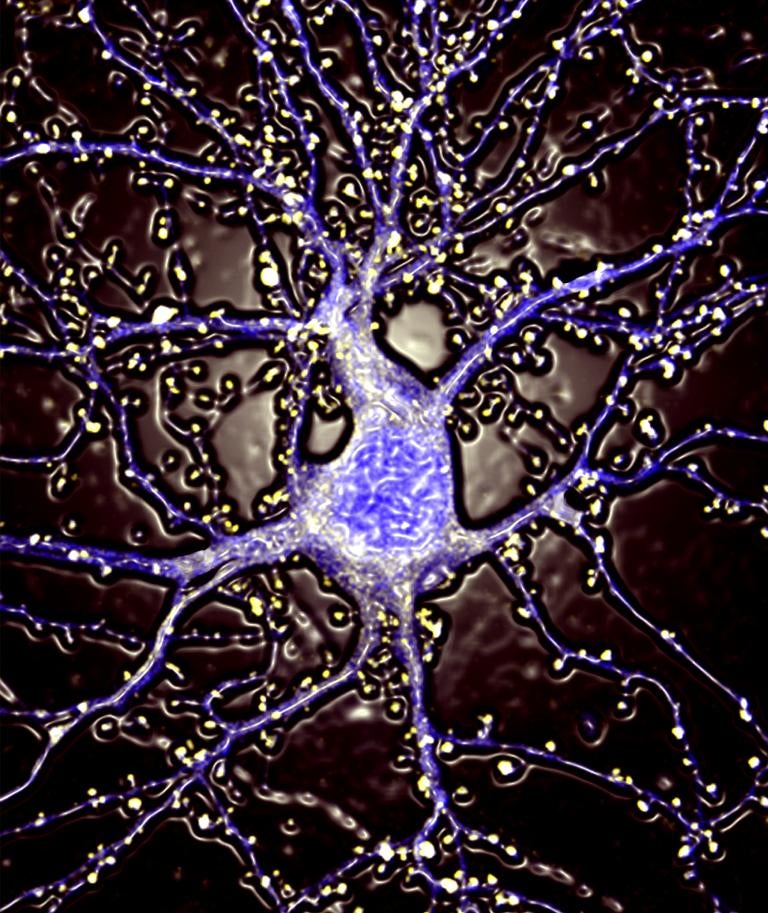
Hippocampal neuron (63X) Courtesy Nikon Small World Photo Micrography Competition: Photographed by Dr. Carlo Sala

A fluorescent protein derived from a Dead Sea microbe could be a novel way to track electrical signals in the brain, researchers say. It’s noninvasive and nontoxic, so it could enable neuron tracking without harming the neurons.

Neurons communicate via chemical and electrical signals, and monitoring these channels could help neuroscientists understand brain function and degenerative diseases. But tracking electrical impulses is tricky. Molecular tags can be slow and even toxic to cells, which must be exposed to light for the fluorescence to work. And piercing a neuron with an electrode will damage and kill them. But a new fluorescent protein appears to track these synaptic action potentials without toxic side effects. It is derived from the Dead Sea bacteria Halorubrum sodomense.

The protein was previously used to dampen overly active neurons, but in a new study, researchers at Harvard used it as a super-fast voltage sensor, reports Technology Review. A team led by biophysicist Adam Cohen used archaerhodopsin-3, or Arch, as an electrical sensor. They determined that an electrical potential could change the protein’s color, which could then be detected, serving as an electricity monitor.

The team used a virus to add the Arch protein into rat hippocampal neurons in a petri dish. Using laser light (and watching through a CCD), the researchers were able to map neuronal activities at sub-millisecond time scales, they write.

It worked faster and with a better resolution than sodium-ion monitoring, as well as other fluorescent compounds like jellyfish protein, they added. Next, they plan to use Arch to measure neuronal activity in live animals, starting with zebrafish and the worm C. elegans, Tech Review says.

“Microbial rhodopsin [protein]–based voltage indicators promise to enable optical interrogation of complex neural circuits and electrophysiology in systems for which electrode-based techniques are challenging,” the authors say. The paper is published in Nature Methods.

[Technology Review]

5 Comments

hell yeah ^^ i think that mapping the brain is as important as the "slow motion food play" ...

slow motion is the Justan Buber of science... (but i still like it ... (slow mo not J.Boober)) ^^

---
bored? lets go mine the stars... ^^

Can anyone say "zombie apocolypse"? I mean this is how it's supposed to start right? Scientists mess with a virus that messes with brain...

Famous last words from medical scientist, “We are going to make you better!”

Now go watch the movie “I am Legend ".

Enough said.

:

The Sixth Sense - New GROUNDBREAKING Book in 2012! The Sixth Sense leads to Enlightenment
DNA Healing Code - Hardwired in ALL Humans

As an example of what I mean by “Groundbreaking” info that can be found in the 2012 release of my new book on The Sixth Sense (not yet titled )…..
There is a sequence required to communicate with Infinite Intelligence – to gain insight and/or much more complicated yet achievable, HolisticDNA Energy Healing. The sequence required is on multiple simultaneous levels, not just “step by step” like an instruction manual for assembling a piece of furniture.
The “Key” sequence has to do with applying known facts, beliefs, emotions and faith (not religious) – if not applied exactly as detailed, the Sixth Sense will remain dormant, and not be “activated”. As an example:

fact --
fact --
fact --
belief --
fact --
in theory --
belief --
fact --
belief --
Faith --
fact --
fact --
fact --
Faith

you won’t find this in any existing text, which is why The Sixth Sense is so rarely utilized and hard to confirm. This will allow the Scientific Community to experiment and confirm my claims — remember, just a few decades ago, it was impossible to have a Man walk on the moon. Time for the next impossible to be challenged and confirmed — real

Steve Meyer HolisticDNA


June 2013: American Energy Independence

Five amazing, clean technologies that will set us free, in this month's energy-focused issue. Also: how to build a better bomb detector, the robotic toys that are raising your children, a human catapult, the world's smallest arcade, and much more.


Online Content Director: Suzanne LaBarre | Email
Senior Editor: Paul Adams | Email
Associate Editor: Dan Nosowitz | Email
Assistant Editor: Colin Lecher | Email
Assistant Editor: Rose Pastore | Email

Contributing Writers:
Rebecca Boyle | Email
Kelsey D. Atherton | Email
Francie Diep | Email
Shaunacy Ferro | Email

circ-top-header.gif
circ-cover.gif
bmxmag-ps