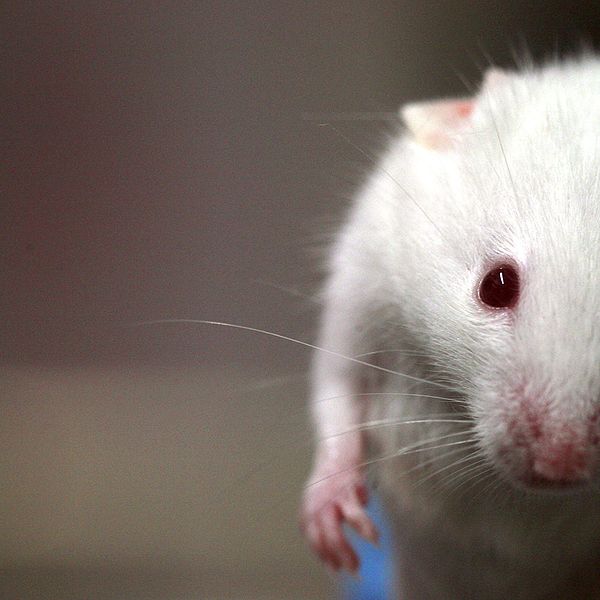
The thing about growing working organs in the lab is that the whole enterprise is completely mind-blowing. Yet we just keep doing it, and so we keep blowing minds. The latest: a team of researchers at Japan’s RIKEN Center--the same group who earlier this year engineered a mouse retina that is the most complex tissue ever engineered--have now derived a working pituitary gland from mouse stem cells.
That’s saying something. For one, the pituitary gland is an integral part of the body’s endocrine system. From it’s position at the base of the brain it doles out key developmental hormones that instruct the body on how to grow and develop over time. But perhaps more importantly, the pituitary gland cannot itself develop without special chemical instructions from the hypothalamus (the brain region just above it).
That’s a serious bioengineering problem, because in order to grow a working pituitary gland in the lab you need a hypothalamus--or at least a hypothalamus analog--to tell it how to develop. The researchers overcame this with a 3-D cell culture and some good old fashioned trial and error. They had a notion of what kind of signaling factors would be needed to make a proper pituitary gland grow and tried combinations until they found the right fit.The result is a working pituitary that expressed the right hormones and the right biomarkers. And to remove any doubt, the researchers implanted their lab-grown glands into mice with pituitary defects. The mice quickly showed restored levels of key pituitary hormones and behavioral symptoms of pituitary problems disappeared. These pituitary glands, by all appearances, seem to work like the original biological glands were meant to.
The next step is a human pituitary, though the researchers say that’s still years away. But progress is progress. If you can build a tracheaand a retina and a pillar of the endocrine system in a lab, the list of things you can’t build begins to narrow.
The incredible innovations, like drone swarms and perpetual flight, bringing aviation into the world of tomorrow. Plus: today's greatest sci-fi writers predict the future, the science behind the summer's biggest blockbusters, a Doctor Who-themed DIY 'bot, the organs you can do without, and much more.


Online Content Director: Suzanne LaBarre | Email
Senior Editor: Paul Adams | Email
Associate Editor: Dan Nosowitz | Email
Assistant Editor: Colin Lecher | Email
Assistant Editor: Rose Pastore | Email
Contributing Writers:
Kelsey D. Atherton | Email
Francie Diep | Email
Shaunacy Ferro | Email
So build a human, attaché electronic communications to the back of the brain and now we have our astronaut that can tolerate the long journey to Mars and maneuver like a human and act like a computer.
If it dies do some unfortunate problem, did science really risk a human life?
Science sees no further than what it can sense.
Religion sees beyond the senses.
One step closer to regenerative medicine maybe?
What if we grow a complete human and because we grew it and it has no history or emotional attachments to anyone and no person has emotional attachment to it.
If it dies, was it really a human death?
If we kill it, did we really kill a human?
If we order it to kill someone else, is it a murder or simply a tool doing its function?
Science sees no further than what it can sense.
Religion sees beyond the senses.
Combine two futuristic fantasies.
1. We are able to grow a complete healthy human clone of ourselves.
2. We can electronically interface with both the old original human and copy everything about what is stored in its brain and down load it in the new younger human.
What do to with the old human?
I suppose we can keep the younger human on hold and just wait a few years for the older one to die.
Imagine, this could be our way of living forever!
Science sees no further than what it can sense.
Religion sees beyond the senses.
Can be great for developing surrogates. No need to risk our selves when we have a surrogate to do cool stuff.
If science can grow replacement parts, can they also do some cosmetic tweaking before it's attached?
Grow you a new face, change it without the pain and reduce the down time, then attaché it.
Play with the X and Y genes; grow sexual body parts and then all the transsexuals can really convert to their desired sex.
Robot, sweetie, could you please stop mixing up religion and philosophy? What you're asking are philosophical questions, not theological questions.
@Robot, Hollywood already thought of that “The Island”. Where a colony of clones are kept until they are needed as organ donors. In the movie these clones were people with emotions and attachments, so not quite as amoral as using a robot. But growing a clone of yourself and then down loading your memories and getting to live your life all over again. Wonder how that will work out with the whole “over population” thing.
HMM pituitary gland eh? They say this is the gland responsible for telepathic phenomenon. (Every ancient culture thought this an important organ an even today it is represented in the Capital building in Washington D.C) This is going to be interesting.
Aldrons Last Hope,
No, you missed a point.
Say when you are a very old man, near death, you down all yourself into a younger self, knowledge, personality, experience, all of it. Then we put the younger self on hold.
We let the old self die naturally.
Then we boot up the young self, with all the life experience of the old self, but you do not repeat life, no. You go out into the world a young self, ready to start a new!
......................................
Here is a question for you. Suppose the oldself leaves his aparment and kills the oldself x wife and her youngself x wife too.
Then the oldself man dies naturally.
Who do you punish?
.............................
Science sees no further than what it can sense.
Religion sees beyond the senses.