Structural Self-Replication Based on DNA Could Create New Materials
One of the hallmarks of living things is self-replication, the ability to make new copies of biological structures. Scientists have...
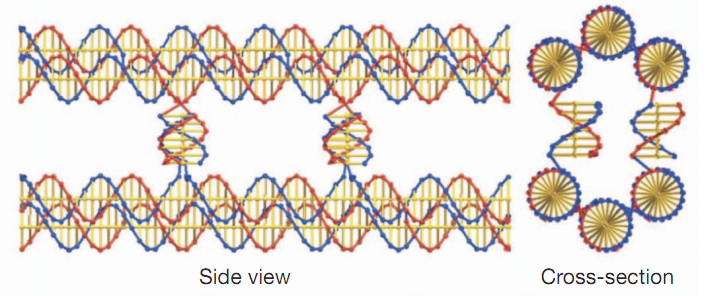
One of the hallmarks of living things is self-replication, the ability to make new copies of biological structures. Scientists have harnessed this ability in several ways, using DNA and viruses to organize materials for things like solar panels. But inducing artificial self-replication, which would enable new types of self-fabricating materials, has proven more difficult. Now researchers at New York University say they’ve taken a step in that direction, building a complex artificial system that can self-replicate.
The researchers started with artificial DNA tile motifs, which are tiny arrangements of DNA. Just like the base pairs of DNA, the tiles each serve as a letter, each of which pairs with another specific letter. DNA’s A-T and G-C pairs form the molecule’s double helix. In this case, the tiles were made of artificial bent triple-helix molecules, each containing three DNA double helices. The researchers wanted to use this motif to seed the creation of a new structure, which would be based on the rules established by the seed.
To do this, they created a sequence of seven tiles, or seven “words,” to serve as the seed, and placed the molecules in a solution. There it matched up with complementary tiles, and assembled into a daughter array. Then the molecules were heated up, separating the daughter tiles from the seed. The process started again, with the daughter array matching with new complementary tiles and assembling a granddaughter array — and so on.
The second-generation tiles reproduced the same sequence as the seed word, without any enzymes or other biological triggers, according to the NYU team.
It’s worth noting that the seed word was pretty much arbitrary — so the work shows that self-replicating materials can be created from any seed composition, said Paul Chaikin, an NYU physics professor and one of the study’s co-authors, said in a university news release.
This is a long way from being used in materials fabrication, of course, but the work shows it is possible.
“Our findings raise the tantalizing prospect that we may one day be able to realize self-replicating materials with various patterns or useful functions,” the researchers write.
The paper is published in the journal Nature.
[via Science Daily]