Data Age
The director of the Center for Extreme Quantum Information Theory at MIT answers our biggest questions
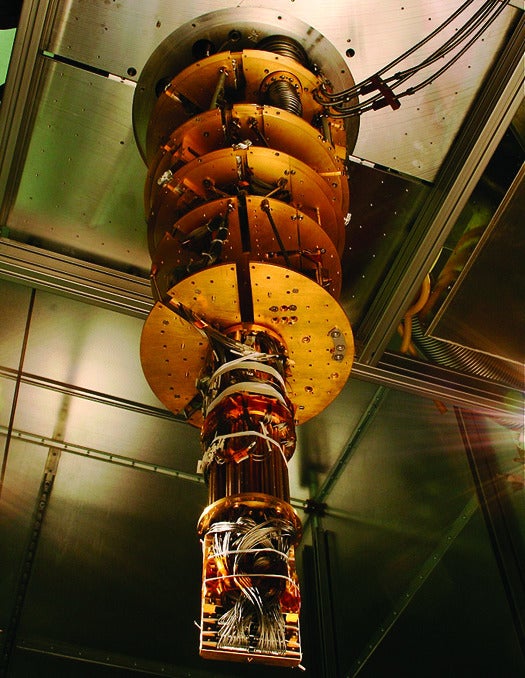
Qubits in Liquid Helium D-Wave Systems Inc.

Seth Lloyd, director of the Center for Extreme Quantum Information Theory at MIT, answers some (very) big questions, about his beer keg superconductors and our quantum universe.

Seth Lloyd on Quantum Computers

Popular Science: How are quantum computers different from ordinary ones?
Seth Lloyd: Quantum computers operate at the smallest, most fundamental levels allowed by physics. On a regular computer, a single bit of information is represented by a whole bunch of electrons. In a quantum computer, you store bits of information on the most elementary particles. So a "qubit" might be represented by a single electron.

Why is a smaller bit better?
At the quantum-mechanical level, an electron can be here and there at the same time. And if you're here and there, you can do this and that simultaneously.

PS:How is it different from regular computers with multiple processors?
On a regular computer, a bit can be 0 or 1. Electrons over there means 0; electrons over here means 1. On a quantum computer, a bit can be 0, 1 or both. So in your quantum computer, one qubit means two things at once, or with two qubits, four things at once, or three qubits, eight things at once.

How many qubits are there in today's quantum computers?
We're up to around a dozen -- so we can solve complicated equations really fast. And if you have 300 qubits, you can do 2300 things at once, which happens to be the number of elementary particles in the universe. So you can do a lot.

How does the machine actually work?
If you control an electron, you can control the qubit. You flip the qubits by zapping them with microwaves or lasers. Those are things that we know how to do pretty well. That's all that an ordinary computer does -- move bits from place to place.

Do quantum computers look like regular computers?
No. Your typical quantum computer is more like a digital computer of the 1950s. The qubits can be stored in molecules, which sit inside a tiny test tube. But to zap the qubits, you need to pop the test tube between superconducting magnets. That's inside a cryostat of liquid helium. It looks like a beer keg with a bunch of cables snaking out.

How do you do the zapping?
You give instructions on your ordinary computer. These get translated into a series of zaps by the microwave generator. Then you look at the weak microwaves given off by the molecules. Those are the results of your computation.

What if you don't use your computer for solving linear equations? How about quantum Googling?
You mean Quoogle? We've played with this idea. You could search databases faster with complete security and anonymity. After Quoogle gives you the answer, you're absolutely guaranteed that Quoogle cannot copy what the question is, because when you make a measurement on an unknown quantum state, you inevitably mess it up. The no-cloning theorem says that if you try to copy an unknown quantum state, (a) you can't, and (b) you inevitably mess up the quantum state by trying. So you can't copy the question.

This is private browsing on a new level.
Yeah, and actually I took the idea to Sergey Brin and Larry Page [of Google], and I said, "Hey dudes, we came up with this awesome idea for quantum Internet. How would you like to fund this or buy the company?" And they came back and said, "We're really sorry, but our whole business plan is based on knowing everything about everybody. So this goes against our business plan."

What are the biggest questions quantum computers could tackle?
Where the universe came from and where it's going in the far distant future. We can try to answer these questions because the universe is a quantum computer. Think about it in terms of information instead of energy. It's made of bits -- elementary particles -- and how they interact are operations. You can calculate how many bits are in the universe, how much energy it takes to flip them, how much energy exists, and use that to rule out lots of things about the universe's history. Anything that takes more bit flips couldn't have happened. That also means with enough bits you could make a quantum computer that would effectively be indistinguishable from the universe.

What would you ask a quantum computer universe-replica?
I'd ask it normal things I ask the universe -- like, Why? But I still wouldn't expect much of an answer.

19 Comments

so its kinda like little atoms/electrons flying around with digital code on them(atleast thats how the computer interprets it). pretty cool

-Knock knock
-Who's there?
-The Doctor.
-Doctor Who?
-Yes

of course it's cool, normal computers following moor's law states that the number of transistors on a chip doubles every 1 and a half years. this means that the power and speed of the computer increases with a steady curve. the new moor's law to this is saying that every new qubit added increases the number of calculations exponentially. basically you can have a top of the line computer and by adding a single new qubit you can significantly increase the speed and power of the computer.

in one year we can go from quantum computers keeping up with silicon chip based computers to personal quantum computers that are keeping pace with silicon based super computers. and here's a crazy thought, think about the next step! this is where the singularity will happen. if it is possible for life to spontaneously exist in systems with powerful computational processes then this is where it will happen.

to mars or bust!

I've always been intrigued about the superposition of quantum material, and the fact that there is (as yet) no rule which says that macro-events can't behave as quantum events (in other words, no reason why my car CANT "quantum tunnel" itself through a mountain :D ).

But what if we really could find the 'key' that unlocks the quantum world to macro events and get things to behave the way we need them to. A transporter could work like this:

User enters Pad A, a quantum field is induced meaning that the User is both on Pad A and Pad B at the same time. Then, the computer performs a measurement on Pad A, forcing the resolution of the User onto Pad B. And voila! Instantaneous transportation anywhere in the universe that can be WAY faster than the speed of light. Of course, this would require two linked pads in desirable locations. So if we want to transport ourselves or a ship to the Gliese system, somebody (or a robotic ship) has to make the long voyage out there.

But that's only until we figure out how to do this without pads, of course, after we figure out how to do this to begin with ;)

Q

That porch bug zapper if awefully big! I wonder what kind of bugs they are worried about? ;)

Q

D13,
Before I step into you bug zapper teleportation device, you go first. Oh, and may I recommend, make sure there are no flies or bugs with you. I seen the movie, it does not end well. ;)

Typo (or superscript font problem): "if you have 300 qubits, you can do 2300 things at once" should be "2^300 things at once" or "2E300 things at once" meaning 2 raised to the 300 power, which is an awful lot of elementary particles.

For Q# 4: How many qubits are there in today's quantum computers?
We're up to around a dozen -- so we can solve complicated equations really fast. And if you have 300 qubits, you can do 2300 things at once, which happens to be the number of elementary particles in the universe. So you can do a lot.

It should be 2^300 (Two raised to the power of 300) not 2,300, which is obviously much less than the number of particles in the universe.

(Cause for each new qubit you double the number of workable bits the computer has, so 300 qubits would be 2^300)

Q

Interview from POPSCI with Seth Lloyd:
Mr. Seth Lloyd, why made you do all this computation?

His reply:

I have to do it! I just can’t gubit!

So does this mean there will never be Quantum Computers available to the public like Regular Computers.

@Eric18, no... I'd say between 2050-2060 is the date. Look how long we had computers before mainstream public adapted them. Now look at how big of a national security threat a quantum computer has become simply because if one had it, they could crack any password in microseconds, not to say that it can. But it will eventually.
" Science without religion is lame, religion without science is blind." Albert Einstein

Dear Starchild_1,
Little facts you may not know. With due process, a legal warrant from a Judge, the CIA, FBI and other organizations can turn on your cell phone on after you power it off, make it appear off and listen to all the conversations in your room. With triangulation, even if you cell has no GPS, they know where you are.

With electronic listening devices, and excellent computer software, they can listen to you type and know what you type as you type it, words, sentences, logins and yes passwords.

If our government declares something for the benefit of national security, at many times they do not even need a warrant. And in the reality of life, you only considered wrong, when you get caught.

Just because you look in your windows folder and see the several folders you created, does not mean more isn't there. It could be there and simply hidden from your view. As an observer, you do not worry about, what you are not aware of.

I have said enough...... shoosh, the eyes are among us! ;)

Daniel A. Mercer

This paragraph was transcribed incorrectly from the print version:

How many qubits are there in today's quantum computers?
We're up to around a dozen -- so we can solve complicated equations really fast. And if you have 300 qubits, you can do 2300 things at once, which happens to be the number of elementary particles in the universe. So you can do a lot.

Instead of 2300 (a very tiny universe indeed) it should have read 2 to the 300. Obviously, superscript was not available in their font.

If I had the computing power of a quantum computer, I think I would attempt to make the holodeck off star trek. Using an omnidirectional treadmill (Or something similar), using an array of microsoft kinnects (positioned to captured the user from every angle), an array of pico projectors (surrounding the user, so no matter which way they look, there is a pcio projector in that general direction, to project just the right light for where the user is looking).
The omni directional treadmills will have pressure sensors in them, so that along with the microsoft kinnect, the system can really determine the users gait, to ensure that the treadmill moves in exactly the right direction at the right speed, so the user can not notice they are actually walking on a treadmill. The kinnects also pick up the users movements (Hands, face, eyes), so that the system can advise the picoprojectors what to project and where, and to tell the tradmill what to do.

Using a quantum computer with enough qubits, will mean that such a 3D interactive system, will be computationally effortless, meaning the images that are displayed can be near perfect, the decisions made around the treadmill and projectors can be made, so fast that a user wont even notice they are not in reality.

The only thing that stops this being a complete holodeck (Albeit for a single user at a time in one device), is the extra sensory experience (touch, taste, smell), as sight and sound are already covered, how would you provide that extrasensory experience, to make a use think they really are holding a baseball bat, or that they have just walked into a cake shop... If you can get those sensory devices established, I can not see why we using quantum computers and regular consumer products (kinnect, pico projector), we can't make an awesome gaming experience.

Remember that if we want the funding to really take this technology to the next level, gaming is often a good way of getting the investment to do more research and development... Just look at all the stuff that has come from wi-controller hacks, kinnect hacks, iphone hacks etc etc... Do away with movies, and get people actually indulging in those fantasies they immerse themnsevles in when they go to the movies... Play as Frodo in LOTR, play as Luke Sky Walker, play as the Little Mermaid (If you are a child of course)..

That is what I would do, if I had a quantum computer that had enough qubits to make this happen... Because with the money from the device, I would look at reinvesting in more R&D around quantum computers, quantum encryption, quantum anything you like....

Does god exist? I say - not yet.

@D13, well handled, well handled indeed.

What I would do with a quantum computer is rather easy to be honest, I'm simply let it scoure the interwebs and create a better quantum computer design, which would then be build to do the same til the point where either the process becomes self-sustaining, or we get bored and have a computer that can beat Minesweeper on Expert

@ NoConsequenc3 Nice like the Minesweeper idea...

since there can be two simultaneous states of one object, we can have tele-copies of ourselves and make our presence simultaneously at many locations .Like you have in Hindu mythology Krishna made himself available to all his 16,000 wives simultaneously in their different homes , playing with their children or bedding them all to the satisfaction of all concerned . Quantum tele-portation was in action in epic times . However due to some unknown reasons we lost the technology which is being revived now. Perhaps this might be easier than photocopying although we happened to stumble upon the cumbersome photocopying technology even before retrieving the easier technology of quantum computers, it appears !


June 2013: American Energy Independence

Five amazing, clean technologies that will set us free, in this month's energy-focused issue. Also: how to build a better bomb detector, the robotic toys that are raising your children, a human catapult, the world's smallest arcade, and much more.


Online Content Director: Suzanne LaBarre | Email
Senior Editor: Paul Adams | Email
Associate Editor: Dan Nosowitz | Email
Assistant Editor: Colin Lecher | Email
Assistant Editor: Rose Pastore | Email

Contributing Writers:
Rebecca Boyle | Email
Kelsey D. Atherton | Email
Francie Diep | Email
Shaunacy Ferro | Email

circ-top-header.gif
circ-cover.gif