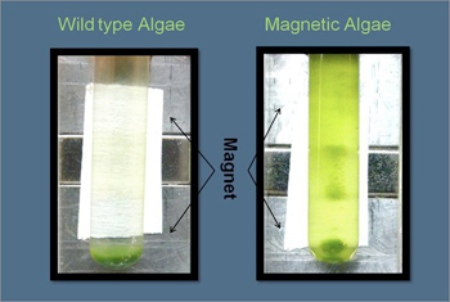
Magnetic Algae The wild algae on the left settles to the bottom of the test tube. The magnetic algae on the right sticks to the wall thanks to the magnet. Los Alamos National Laboratory via PhysOrg

Proving that there’s always a different way to approach a problem, researchers at Los Alamos National Lab have devised a pretty clever method of algae harvesting that could take a major chunk out of the cost of algae-based biofuel production. And all they had to do was create a magnetic organism.

Scientists at LANL have genetically engineered a new kind of algae that is magnetic, which could lead to new and simple ways of both extracting genetically engineered biofuel-producing algae from water and extracting the lipids that contain the hydrocarbons from the algae. This part of the process generally accounts for roughly a third of the total cost of algae-based biofuel production, but now could conceivably be performed with a simple permanent magnet. That’s a lot simpler and cheaper than complex separating machines and other mechanical means of dividing algae from solutions.

The team created their GM magnetic algae by lifting a gene from magnetotactic bacteria--those are bacteria that use the Earth’s magnetic field to get around--and dropping it into the algae. When expressed, the gene causes the production of magnetic nanoparticles in the algae just as it does in the bacteria. Those in turn can be used to manipulate the algae.

The result: an algae that can be separated from a solution with a magnet. Why didn’t we think of this sooner?

9 Comments

Lol! Cute experiment.
First of all, current continuous filtration system is so optimized that separating algae from water is almost child play... trust me, as a proud biological systems engineer, I've done the math.
Second, my guess is that they wish to do this in a batch process. Even with a very powerful electromagnet, it is likely the the algae in the bulk will not contact the surface once the surface accumulate to a specific maximum thickness (regardless if you crank up the EM power). I support this logic with the settled algae at the very bottom of the tube on the right. I see it as algae that failed to hold on to the surface.
Third, and my biggest curiosity with this, the bacteria gene that yield the iron component must be overexpressed for this to work. Now, current research is trying to increase the carbohydrate content and lipid content so more materials can be used (not to mention that was THE reason why we use algae: easy to grow and less other unless crap). If the magnetic components are introduced and amplified, that would theoretically decrease the concentration of our major products. So wouldn't that be counter effective? I look forward to their future research.

Q

@qksilver,
Are you suggesting that science and engineering can make something simple more complicated?

GASP! I can't breathe! Say it isn't so! lol

This has to be useful for something... how about this you coat this stuff make sure it does,nt corrode metal on ship hulls make it so that it attacks or is repellent to barnacles and other crustaceans the algae cant spread cause its stuck to the ship!

If they can do something like this they could probably create a seaweed that traps rare metals in its self.Theres alot of dissolved gold in the sea supposedly.

^ now that is an incredibly intelligent idea for the ships. Though I don't know if it would be feasible to collect gold because I would assume it is spread very thinly through out the ocean.

-The only way to discover the limits of the impossible is to go beyond them into the impossible.

How about using this invention to solve the problems with the Great Pacific Garbage Patch, the debris field made up large to micro fine polyurethane particles. Spread a little magnetized algae around in the debris field and use magnets like a sponge to pull up the algae and the fine particles.

@quseio2:

Uhhhh - just one minor problem. Gold and most rare metals are not magnetic.

@pedrox Hahaha excellent point. Thought the use for ships and the Pacific garbage patch and other gyres alike, still have perfectly legit applications.

Excellent comments thus far. I also have a comment regarding the feasibility for harvesting the magnetic algae on a hectare scale. I would imagine you need a magnet the size of an aircraft hanger in order to collect all the algae. The previous post by qksilver was right on target.

In addition, since this is a protein that comes from an anaerobe, does oxygen sensitivity become an issue over time (not sure of the growth rate time scale). This could be an explanation of why the test tube on the right does not have 100% of the algae concentrated to the magnet (even though qksilver has a pretty solid rationale as well). Basically, the protein is deactivated over time as a function of O2 production. I think the whole point of this exercise was to show the authors could express a foreign gene in an algal strain. The bigger picture is just a hand waving exercise.

I did some research on a company called solix biofuels that used long poly tubes to create an enclosed ecosystem with a tiered overflow and recirculation pumps at one end. It would be a simple modification to a a magnetized traveling screen at that end to continuously harvest the algae instead of using a batch method.


June 2013: American Energy Independence

Five amazing, clean technologies that will set us free, in this month's energy-focused issue. Also: how to build a better bomb detector, the robotic toys that are raising your children, a human catapult, the world's smallest arcade, and much more.


Online Content Director: Suzanne LaBarre | Email
Senior Editor: Paul Adams | Email
Associate Editor: Dan Nosowitz | Email
Assistant Editor: Colin Lecher | Email
Assistant Editor: Rose Pastore | Email

Contributing Writers:
Rebecca Boyle | Email
Kelsey D. Atherton | Email
Francie Diep | Email
Shaunacy Ferro | Email

circ-top-header.gif
circ-cover.gif