Another day, another wrinkle in the year's biggest physics story
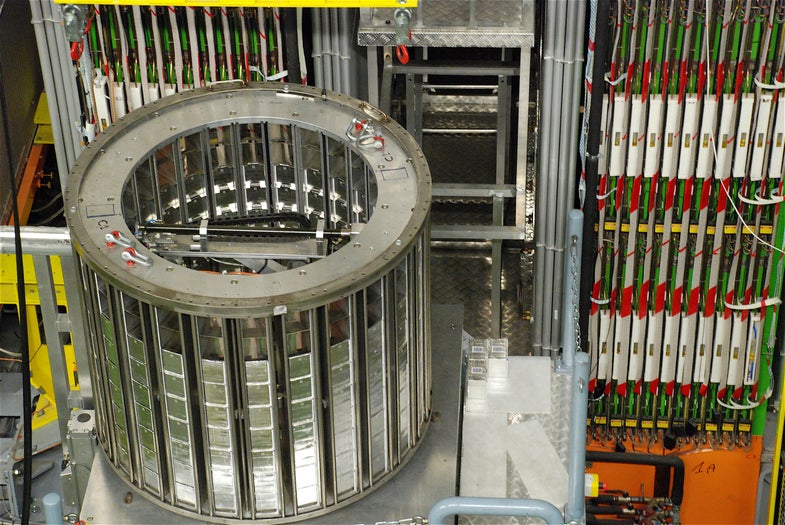
The Loading Station at OPERA CERN

Last week’s bombshell physics news--those superluminal neutrinos that CERN’s OPERA experiment clocked moving faster than the speed of light--are already getting the rigorous vetting that OPERA’s researchers were hoping for. And some physicists are already rejecting the notion that CERN’s neutrinos broke the cosmic speed limit outright. A paper posted late last week, titled “New Constraints on Neutrino Velocities,” argues that any particle traveling faster than light would shed a great deal of their energy along the way.

And since that didn’t happen, those neutrinos couldn’t have traveled faster than light. Case closed.

So let’s go a little deeper here. The physicists behind this assessment, Andrew Cohen and Sheldon Glashow of Boston University (Glashow has a Nobel under his belt, so these are no middling minds), ignore the debate over whether or not it’s possible for a fundamental particle to outpace the speed of light, and instead look directly at the OPERA neutrinos themselves.

In looking at the neutrino beams that landed at Italy’s Gran Sasso laboratory, Cohen and Glashow found that it was about the same as the beam emitted from CERN in Switzerland. That is, the neutrinos were of roughly the same high-energy flavor at their origin and at their destination.

But that’s not possible if these neutrinos surpassed the speed of light, they say. A neutrino achieving superluminal speeds would emit other lower energy particles--most likely an electron-positron pair-- along the way, and in doing so lose a good deal of its own energy. So the neutrino beam arriving at Gran Sasso should have been “significantly depleted” of high-energy neutrinos.

But this was not the case. Which means, they say, that in all likelihood these neutrinos never achieved superluminal speeds. The anomaly is an error in the data or measurement of the speed, or some other brand of misunderstanding or miscalculation.

Which makes a certain amount of sense, writes Steve Nerlich over at Universe Today over the weekend. Neutrinos do move very fast, straight through the Earth (neutrinos don’t interact much with normal matter), relying on GPS time-stamping and other methods of man-made measurement that are very precise but certainly not infallible to determine time and distance traveled.

And it’s not like these neutrinos were clocked doubling the speed of light or something like that--the difference is 60 nanoseconds. That’s another way of saying that the neutrinos in question are thought to have traveled at 1.0025 times the speed of light. That’s certainly a small enough margin to be explained away by some kind of measurement error.

Still, the jury remains out on this one, and we certainly don’t want to dismiss a perfectly good game-changing science story just because it seems hard to reconcile with the status quo. After all, if OPERA’s result turns out to be confirmed it is going to completely reorient physics as we know them. More on this as it develops.

[SciAm]

60 Comments

What we need is a more distant experiment of neutrino speed timing. We need to put neutrino beam on the moon and blast neutrinos’ back to earth and time this. It does give us another reason to go back to the moon, eh.

While it is far more likely that the experiment was flawed, this just makes the result all the more interesting if it isn't

When I saw the article about the faster than light neutrinos I was like "Man.. I knew light was slow!". But when I showed it to a friend of mine he was like "Yeah well you know that when you travel with speeds close to the speed of light time almost stops for you. So basicly these neutrinos just travelled a few nanoseconds in the future.. they didn't really travel faster than light."

So my question is basicly.. didn't anyone in the physics world think of that? And if they did why didn't we hear that as a possible theory for those unlikely results?

Well, this is intriguing. However, the result contradicts the observation of supernova 1978A by the laboratory of Masatoshi Koshiba at the University of Tokyo where neutrinos were detected a few hours before visible light were detected. Distance of SN 1987A from earth is about 168,000 light years. Then neutrinos should have arrived years before lights arrive. Note that the neutrino speed 1.0025 speed of light in the above article is incorrect. A careful caculation reveals that thr different from CERN result is much smaller.

@staticbg

I'd have to say that's a very excellent observation. Even a fraction over the speed limit smaller than 1.0025 would denote a temporal distortion that would allow the neutrinos' presence to register before they actually arrived at their destination.

Of course I knew that someone would eventually come up and throw up the "Impossible!" statement. While our technology is fallible it is not unreliable. So barring the explainations surrounding measurement errors, one of two things happened: the superluminal traversal of elementary particles, or the multi-dimensional traversal of elementary particles between realspace and subspace/hyperspace. The latter gives ground to the string theories such as M-Theory. The former breaks down a fundamental constant in the Grand Unified Theory of particle physics.

"The person is smart. People are dumb, panicky, dangerous animals and you know it. Fifteen hundred years ago everybody knew, the Earth was the center of the universe. Five hundred years ago everybody knew, the Earth was flat, and fifteen minutes ago you knew we were alone in this universe. Imagine what you know, tomorrow."
-- Tommy Lee Jones as Agent K, Men In Black, 1997

@gng

They are talking about the detection of particles as opposed to observing light. However, if they were observing light, I'm sure their implication is that they were observing the presence of the particles before light reached the other end.

Then again you have to consider the light from a supernova 168,000 lightyears away to two laboartories separated by over 500 miles. The shorter the distance, the observation will still appear to be simultaneous. Of course with instruments measuring the readouts, this is how they came to this conclusion.

"The person is smart. People are dumb, panicky, dangerous animals and you know it. Fifteen hundred years ago everybody knew, the Earth was the center of the universe. Five hundred years ago everybody knew, the Earth was flat, and fifteen minutes ago you knew we were alone in this universe. Imagine what you know tomorrow."
-- Tommy Lee Jones as Agent K, Men In Black, 1997

Listening to you people talk about this is painful.

Its like dragging a nail across a chalk board.

Lets put it this way. If you don't understand the math, you don't understand jack.

STOP ALREADY.

(and stop asking stupid questions like "did the scientists take this into account)

What you say:

"So my question is basicly.. didn't anyone in the physics world think of that? And if they did why didn't we hear that as a possible theory for those unlikely results?"

What I hear:

"I have such a juvenile understanding of physics that I think my coffee talk is a substitute for math"

CERN’s OPERA experiment clocked moving faster than the speed of light, neutrinos.

After this gets debated thoroughly and if later it’s found out that the manner of how Cerns times\clocks things are off.

Were other experiments and conclusions dependent upon knowing the true nature of the speed of light and having the ability to clock objects accurately relative to other conclusions Cern has made? Would this put other doubts on other conclusions Cern's has made in the past?

"A paper posted late last week, titled “New Constraints on Neutrino Velocities,” argues that any particle traveling faster than light would shed a great deal of their energy along the way.

And since that didn’t happen, those neutrinos couldn’t have traveled faster than light. Case closed."

Um, if your model tells you that nothing CAN travel faster than the speed of light, how can you conclusively tell what would happen if something DID?

Maybe this is a good opportunity to rethink some of the flawed assumptions instead of immediately dismissing the results as an error.

@Matt2210

Those are my thoughts exactly. In my mind, this argument is equivalent to saying "nothing can travel faster than the speed of light, so there's no way neutrinos could have."

If the potential implications of the measurements are that our current model is wrong, how can we apply the theory in this way? Surely we need to think a little more outside the box than this.

@judderwocky
My understanding of maths and physics is a bit more than you seem to think and because of that I want to know why is the most obvious and logical answer not given by "the big brains".
And please don't reply my comment and keep your opinion for yourself. I don't want to spam popsci..

@staticbg No. Your comment proved my point exactly.
To put it bluntly... YEAH DUH.

First of all, you have butchered the scientific principle.
Secondly, the machinery and detectors take into account things like relativistic mass at a very fundamental level. They are designed around the concepts you managed to butcher. Invariant mass, relativistic mass, lorentz factor...

How do you think they are detecting these particles? You think somebody has a flare gun and a stop watch?

They aren't stated like this though: ""Yeah well you know that when you travel with speeds close to the speed of light time almost stops for you. So basicly these neutrinos just travelled a few nanoseconds in the future.. they didn't really travel faster than light." "

They put it in mathematical terms and it gets incorporated into the detectors and formulas they use for analysis.

Again. What you are working with is not even "basic" information.

For starters.... go to wikipedia and look up the term "relativistic mass"

http://en.wikipedia.org/wiki/Relativistic_mass

again. nails, chalkboard.

why is it so irritating?

an uninformed population tends to oppose scientific progress.

for years scientists working at RHIC had to fend off the media and celebrities 'worried' and 'concerned' that their experiments would somehow generate a black hole to envelop the earth.

a little knowledge is a dangerous thing (to scientific research).

Some black holes in the real world are also called money pits, hmm! Working people have real working everyday problems and they want their taxes spent wisely.

Although this is an interesting report on this topic, I do feel that any such claims cannot possibly have come so quick. Understandbly these claims are based upon the known world of physics, however what it doesn't take into effect is the unknown such as this topic. There are certain ways to prove or disprove something that could in fact alter everyones knowledge of a subject. The more tedious and time consuming but most likely the more accurate way is repitition. This is something that is just plainly going to have to be repeated over and over and over again average the outcomes and then determine the solution. Sure there are mistakes in calculations thats why repitition is sometimes needed especially in a case where you can't always try to fit it into the known model and expect it to be solved.
Unfortunately what I am seeing of these 2 physiscts who have claimed that this isn't possible is they took their own known knowledge and applied it and determined that because it cannot fit into their teachings that it cannot happen. Have to be open to the possibily of change or the greater understanding of our Laws of Physics. Just because the laws have been set almost a century ago doesn't mean they are infalliable. In the events of human history Discovery, Breakthrough, or Greater Understandings of our world and that of everything consisting of and existing outside this world there has always been a constant, change is inevitable and it happens more frequently on the timeline than many seem to think. Human civilization is in fact overdue for the next scientific breakthrough. Many times through history has this same thing happened, a Discovery, those that say well it doesn't fit into our Modern Science and cannot be proven on our instruments thus it cannot be possible. But time and time again those that said nay without putting forth the hardship of experimentation and openness to change have eaten their own words.

Understandably the measurements could have been off or interpreted wrong, however that would be determined with the further study into this topic. But overall this is far too early to determine any such outcome. Sometimes solving the most complicated issues and puzzles comes from the most simplest of methods.

@judderwood
Not everyone has the time or wants to figure out all the mathematical jargon necessary to understand the "scientific language." Please stay on topic.

Anyway

I, "a juvenile in science," *think* that perhaps the planet moving; earth quakes and tectonic displacement; numerous undiscovered physics principles; and any number of mathematical errors accounted for the displacement. I still think it would be interesting for the theory of relativity to be the speed of neutrinos and not the speed of light.

I believe there are gonna be a lot of number crunchers tallying up the data on this for a long time to come and I also believe this is a prime example to start thinking outside of the box, due to the thought of relativity and the speed limit of light.

Science Is A Continual Lesson of The Challenge To Studying The Entire Known Existence of Everything.

-Truth-

laws were meant to be broken

Follow my previous post, I did some calculation with the following parameters:

l=732km, c=299792.458km/s, neutrinos are faster by 60 nanoseconds= 0.00000006s. I've calculated that neurinos speed is 299799.825km/s. Speed difference is 7.367km/s or about 1.0000246% faster. So for a supernova 168,000 light years away, neurinos should arrive about 4 years earlier than light.

GnG Editor
Gadgets-N-Gizmos

Lets say "A paper posted late last week, titled “New Constraints on Neutrino Velocities,” argues that any particle traveling faster than light would shed a great deal of their energy along the way.
And since that didn’t happen, those neutrinos couldn’t have traveled faster than light. Case closed." wouldnt there be some sort of distance the neutrino has to go before it would lose that much energy, say once the collision occurs the neutrinos speed out at double the speed of light but then almost immediately lose 99.9% of that energy, leaving .01% giving the extra boost.

I guess you could also say too that the neutrinos got a gravity boost from the core of the planet.

judderwocky I agree I hate listening to nerds discuss things. They always sound like robots who cant think for themselves. Instead they constantly parrot facts theyve read about in the past. "Oh there is probably a mistake in the experiment because nothing can go faster than light, I KNOW, Ive read a few pages on einsteins relativity theories(but didnt read the mathematics or studied quantum mathematics)"

and just to save themselves they add the safe comment "...oh yeah but if it is correct then this is a great story!...or it would change physics as we know it!"

Face it. A lot of you are nerds and parrots and always follow the crowd and think that just because a new idea dosnt fit into your shallow robotic minds that it isnt right.

I myself trust scientists who actually do the math. Even if their theories are wrong at least theyve spent years doing it and not making some self indulgent non mathematical remark like Ive seen most parrots do.

@judderwocky...i too have commented negatively towards the ideas some commenters put forth on here, the most common response is "anything is possible" which is blatantly false...what is true is this: it is 100% probable that these researchers have thought of all our concerns regarding "did they think of everything", it's guaranteed they thought of all and much more than we can come up with...i believe it will be shown that the "speed of light" speed limit will remain and our understanding of neutrinoes will become much better as a result of this, yes, i know the earth was once flat but that doesn't mean everything is wrong and will be corrected one day, and again, and again...cheers

To raise new questions, new possibilities, to regard old problems from a new angle requires a creative imagination and marks the real advances in science.
........................................
Reality is an illusion, albeit a very persistent one.
........................................
If at first the idea is not absurd, then there is no hope for it.
.......................................
Imagination is more important than knowledge. For while knowledge defines all we currently know and understand, imagination points to all we might yet discover and create.
.......................................

— Albert Einstein

@judderwocky - I cant help but agree in some respect that it can be frustrating to read folks with little knowledge (or a vast self-percieved knowledge) go on about a subject, especially one in which you are personally knowledgable (making an assumption there...)...

Having said that, being unapproachably abrasive to folks who may not have a classicaly taught or mathematical understanding of a topic is no way to promote understanding in science. Its hard enough to get kids to put down the playstation or turn off american idol and even give a passing glance to the sciences, let alone forcing them to deal with the self-important learned scientist rubbing in thier face how much they dont know.

I participate in STEM outreach, and to be perfectly frank, the scientific product out of most of the kids I see is laughable at best. It's an honest attempt, though, and in a broader context it is a huge leap in the right direction. You start ridiculing these kids for not adhering to your own professional standards for science, then they will stop making steps toward that level of understanding. That is, among a few others, the fastest road to killing the sciences.

If they dont understand, help them to understand. Do not berate them. If they dont want to understand, then move on to the next person.

And if you cant look at it from a more ideological perspective and require some math for legitimacy...

the sciences operate on money just like any other profession, and in most of our cases, it comes in large part from the people. I defy you to convince the layman of the worth of billions of dollars worth of equipment to build what amounts to them (nevermind what it means to you) a hypothetical physics experiment that wont provide any tangible benefit to them (again, thier POV).

If the minimum requirement to be interested and speak about a scientific topic on the individual level is a complete mathematical understanding of the sciences, then we will see a more and more isolated scientific community, and less and less money.

Why not a good old fashion drag race?

Put light on the line and Neutrinos or whatever on the line turn the light green and GO whoever gets there first is clearly the winner!! Put em pinks!! can't deny those findings!

I believe that since at least one postulate used to create Einsteins Theory of Special Relativity is not true there is some room for debate here. The Lorentz Transformation was used to postulate nothing can travel faster than the speed of light. It is nothing more than math to describe an optical illusion. No frame in spacetime can be fixed. And if this is all based off of that and relativistic mass then I think everyone should have an open mind and not just beat their chests over how smart they are. Relativistic Velocity should be considered as an alternative.

http://jetsrock.wordpress.com

Thank you iambronco, very well stated. It's the enthusiasm of the responses that makes the difference as to whether the scientific exploits of people continue in positive directions.

As for the article, I am going to disagree with the two scientists only because they are only using one model to disprove and not hard scientific evidence of the speed itself. This is not the only time that nutrinos have been clocked above the speed of light (although the first statistically significant one). This is something we will have to re-test elsewhere and look at data as it comes in.

Neutrinos are the slippery fast race horse and poor protons are the persistent slow mule, eh. I remember the good old days when it was great to be as fast as lightning. How times have changed, how times have changed. ;)

I agree with the whole "measure over a longer distance so the difference is larger than the margin of error" bit. Seems like the most straight forward path to take. Reams of data from 1 setup is a good jumping point. I'll get excited when they recreate it elsewhere.

and lol@ stopwatch and flare gun

@iambronco

THANK YOU!!

@judderwocky, reedeckmeckhecl, and any other pompous, socially unpopular, sociopath

Although you have yet to prove it with a statement that backs up your understanding of the physics on a quantitative level (that's mathematical if you didn't get that), you may have a better understanding than most, but there are still people dumber than you are and they take part in running this world. Go figure.

How is it a mathematician makes $54,000 to $86,000 annually, and an actor or actress can make $20 million dollars for every film they do?

Your Rodney McKayesque manner of being condescending towards those who don't appear to be as smart as you does not solidify any imaginative fairytale concept of the pedestal you stand on (don't know who Rodney McKay is, look it up on Wikipedia: SERIOUSLY, What truly educated person would offer Wikipedia as the first source option for educational facts?!!). By behaving as you do you only serve to point out the fact that you have used your intelligence in a fashion that has socially driven people away from you and placed you in a stagnant area of society causing you to be bitter about everything that doesn't seem to make any logical sense. This backed by your increased frustration with people you deem less intelligent that do not know how to stay in their lane and off your pedestal.

People like you steer people away from science because these types of scientists do not know how to work with anyone. You forget the fact that you need others to work with you in order to be able to use whatever knowledge you think you have. Try doing anything on your own and you'll find all the knowledge in the world won't be s###.

If you can't get over yourself and the fact that some people just won't like you for who you are, do the rest of society a favor and just shut the #### up, crawl in a hole and fade from existence so that we can remove yet another factor of society that stagnates scientific enthusiasm and thus progress.

@Rick Gillespie

I think relativistic velocity is the result of the phenomenon. Meaning we could be wrong about the universal speed limit based on one spacetime observation relative to the Earth and it's observable gravitational effects on the uniform flow of time across the fabric of space. Of course that's just me speculating. I'm human and I could be wrong, so you don't have to worry about me beating my chest.

@mp

The biggest reason that man was a great mind was not namely because of how smart he was, but because of how open minded he was. Most modern scientific egos seem to contradict his personality.

@beefymclovin

You're right about that. Also, consider this; if the majority of modern principles in physics is based on theory (one step up from hypothesis, one step down from fact/law, and always a split second away from being an elementary misconception), how well do you think that will hold up?

"The person is smart. People are dumb, panicky, dangerous animals and you know it. Fifteen hundred years ago everybody knew, the Earth was the center of the universe. Five hundred years ago everybody knew, the Earth was flat, and fifteen minutes ago you knew we were alone in this universe. Imagine what you know, tomorrow."
-- Tommy Lee Jones as Agent K, Men In Black, 1997

iambronco nobody gave me money to study mathematics. So I had to quit school and go to work. I got into IT and saved some money and quit to do what I had to do. A lot of scientists and mathematicians over the centuries were ridiculed and even prosecuted because of the amaizing things they discovered which gave use the rich lives we have today.

The public gives mathematicians and scientists SQUAT. It is government and economies of scale that funds these large projects, but the countless multitude of advances are done by scientists with little or no funding. Einstein funded himself when he worked on relativity by working in a patent office as a clerk! And you can thank him for your precious GPS.

We get NOTHING from the public except comments like "that research is a waste of money"...or "what practical use is researching that?".

One good example is how the RIAA prosecutes and blames people for using technology like P2P to share files. They werent there when the engineeres designed the network message protocols in the 60s, they werent there when the mathematical equations for electicity, current and electronic circuits were discovered centuries earlier. They werent even there when the programing languages were researched in the 60s and 70s. And now they say that SUDDENLY their fat wallets are being reduced by this terrible information sharing technology on the internet.

Advances are done by many many many people with many many ideas.The public funds SQUAT. The public has funded NOTHING. Go ask those italian scientists who are being charged of manslaughter. The public should be split into 2 camps: the smart people who use math and science to better the world and the ignorant people who dont(these people should return their computers, tvs, toasters because they didnt come up with the mathematics that allows them to be privy to these comforts of life and the mathematics that was developed several hundred years ago was "didnt seem practical to them back then")

Again, the public has given us SQUAT. Theyre just mafia who want to use what scientists develop for their own advantage. The main problem is that most scientists and programmes are robots who always just give it away for free in the open......and then are prosecuted by the public anyways. hehehhehehheee dumb scientists, mathematicians and programmers ;PP

In times like these there is only one thing to do, make it go 61nanoseconds faster or more :) If you can only go a extra 60nanoseconds faster then it hardly seems worth it, except for taking a punch at Einstein's glorified status.

Hopefully in the future people set up even more elaborate tests and can get a little bit more then 60ns, that would then be a little bit more interesting because as it is now and like many say (I'm no expert) the 60ns could easily be a error due to many factors, and why always 60ns, if this is possible surely there is a way to increase this somehow (what would I know? zip, but surely there is).

actually what I said above about the public being like mafia was kind of harsh. It is not right to vilify generaly like that. sorry about that. But still if you say "But that research is not practical!" How the hell would you know? How the HELL would you know. You must know the winning lotto numbers too or you must be talking to God or something. leave me alone

@reedeckmeckheck

When you say the money comes from the government.... who do you think gives the government money? Much of the research undertaken (especially that done in the theoretical realm where little immidiately profitable outcome exists) is funded by government grants and subsidies, all of which is either funded directly through taxation or borrowing (which is then paid back through taxation).

Any positive future for the endeavor of science MUST be conducted in the public eye. If you think the public is not an important stakeholder in the advance of science then you need to take a step back away from the microscope (a figure of speech, please dont whine about stereotyping).

@reedeckmeckheck...it is irritating to hear people wining about how most science is a waste while typing from their computer on the internet-@iambronco...you are correct, science lives with the good and bad of publicity, cheers

@iambronco

Once again you have proven the depths of your insight.

@reedeckmeckheck

OOOO! SOMEBODY MUST HAVE STRUCK A NERVE (This guy here)!

Seriously get off your high horse. You made a choice to contribute to society through science and engineering based on your educational choices (that's about all a mathematician is good for besides crunching numbers for economists, and business execs). If you wanted to make money you would have chose otherwise and done anything else, legal or illegal.

The scientific community could try to start a movement to revolutionize their place in society but the problem is our general nature has established a general human society where money, power, and intelligence are separate pillars. Scientists are intelligent, but being small in numbers and influence, they don't possess enough real power to make drastic strides in short periods of time. That coupled with the fact that the majority of scientists are as egotistical as you, making it very hard for any group of brilliant minds to work with each other.

If scientists want advocates to place them in better economic position amongst societies worldwide, they have to appeal to the people in a positive way. This means taking their language into layman speak, putting up a presentation that will inspire and excite the masses, and being charismatic enough to be supported by the public.

BTW, you don't disserve to even think you stand above anyone if you think that people who don't have the intimate understanding of the creator of a device should not use said device. For that reason you shouldn't drive a car because you didn't conceive of or fully understand the engineering behind the four stroke cycle reciprocating engine, or you should never set foot on a plane because you failed to develop the concept of fluid dynamics as it pertains to the generation of lift. Maybe you should give back your smart phone because you didn't create the revolutionary circuit boards & battery, or derived the computational formulas capable of bringing computer style system operation to a cellular device, or you should get off the internet because you were not one of the engineers responsible for the creation of the ARPANET that brought rise to what the internet is today.

Sounds like you're a hypocrite to me. Just because you understand differentiation, limits & continuity, the numerical value of e for a natural log and other logarithmic functions, and every single digit of pi does not make you intelligent (just educated there's a difference) let alone as intelligent as the great minds that established modern physical theories.

"The person is smart. People are dumb, panicky, dangerous animals and you know it. Fifteen hundred years ago everybody knew, the Earth was the center of the universe. Five hundred years ago everybody knew, the Earth was flat, and fifteen minutes ago you knew we were alone in this universe. Imagine what you know, tomorrow."
--Tommy Lee Jones as Agent K, Men In Black, 1997

@pheonix1012

You seem inspired today, it's nice to see someone standing to hypocrisy once in a while. judderwocky and reedeckmeckheckuubungaheitweck were really asking for it, I doubt people can tolerate having a conversation with them. They probably have lots of monologues though.

@drchuck1
"... the most common response is "anything is possible" which is blatantly false...what is true is this..."

Every single concept will always have a correction or an adjustment to be made, intelligence thrives on that basic principle. What is "true" will only be as such until proven otherwise, there is no place for utopianism in science.

@Matt2210
"Um, if your model tells you that nothing CAN travel faster than the speed of light, how can you conclusively tell what would happen if something DID?"

That's actually a very good point, I wonder if physicists take that into account often. Um...

I think everyone should step back from the harsh comments and silly name calling. If someone posts something that seems completely wrong, let them know in a respectful way. The people who read PopSci and leave comment are the people that keep the sciences funded.

@judderwocky
This site is not for expert opinion. There are other sites for that, so all of us must be prepared to read many creative comments based on little knowledge. Even those with a reasonable amount of knowledge can still only speculate. I have some knowledge of quantum mechanics and special relativity but any comments I make are almost purely guess work. You are right that anyone that doesn't understand the math is only being creative ... but that is everyone here, probably including you!

@gng
A measurement like the supernova you describe is not very helpful. The source is not well understood with many possible explanations as to why the neutrinos arrive first. For example, the light could be blocked until shrouding dust and gas are blown clear by the explosion ... or the neutrinos may be released before the visible portion of the explosion. Perhaps the paths were not the same for a number of reasons. Yes, I know you were arguing against the faster neutrino data but the same reasons would apply. The "race" may be unfair.

Maybe the simplest explanation is they simple quantum tunneled while in transit to arrive at their destination just a bit sooner than they were excepted. Being quantum objects, especially nearly massless objects, this wouldn't be such a far reach.

honestly i dont see why everyone is getting bitchy. im sitting here reading the comments laughing my ass off. and its a large ass so its a lot of laughing. people seem to forget that "laws" change as we learn more. "its not possible" is complete bull. by our understanding it may not be possible but we do not know everything. if this actually happened then its repeatable by others. if the same results are repeated over and over again then yes this would change things. if not then its business as usual.

smoke a bowl n chill out.

back to the current article, would the neutrino hit the speed of light and shed the particle before it could reach superluminal speeds. or would it lose it afterwards or before? if it lost it a few nanoseconds afterwards it could explain this.

I think the bottom line is: IF these high energy neutrinos apparently ignored one facet of physical limitations we understand, who's to say they can't do the same for others, such as what is discussed in this article? Perhaps they are an "exception" in the same sense that subatomic particles seem to not abide by some laws of classical physics.

lol @ the arguing. i guess its back to square one.

_________________
The people of the world only divide into two kinds, One sort with brains who hold no religion, The other with religion and no brain.

- Abu-al-Ala al-Marri

I'm down with Delkomatic now. Let's do a good old fashion drag race. We can make it a pay-per-view event. The particle physics event of the century. The lead ins can be dark matter, supernova explosions, cosmic acceleration and premature neutrino detection.

Sitting on the bench at the collider, one Proton says to the Neutrinos, " Are we there yet?", " The Neutrinos reply, Oh yes, been there, done that!"

Scientists can rerun the experiment and the results may go one way or the other. However, there is a way to see if the speed of light is constant or not; whether e=mc2 is right or not, and that is to go back to the original equations of special relativity and see what they teach from the basic lorentz equations and the derived e=mc2....
www.relativitycollapse.com/speedoflight.html
www.relativitycollapse.com/e=mc2.html

I agree with JediMindset. I find it funny that people actually try to argue on the Internet of all places.

IF the speed of light is indeed a limiting factor and IF the particles arrived sooner than expected a simple explanation is that the space contracted. IF the neutrino has mass and is subject to gravity then space should contract around the particle. It does have a lot of momentum and is traveling very fast so the construction of space should tend to be along the vector of its travel

^^^yes, much like in the videogame "MassEffect".This claim is creadible enough though. If we look at space time as a fabric what's stopping it from contracting to fit within the parameters of physics. Likewise if we incorparate string theory into this, the one dimensional string of space could be vibrating at an higher frequency. Then if we assume this is true then that would lead to the assumption that perhaps transdimentional factors are in play. Physicist Brian Cox mentioned on his radio show that pergaps Einsteins theory of relativity should be revised so that "nothing travels faster than light In The Third Dimensional Plane"

--stay open-minded when it comes to physics

The neutrino's mass should produce a gravity well surrounding it and in rapid motion should produce an accumulation of spacial constriction along its axis of motion. The amount of spatial constriction could be a function of the time-distance traveled, the momentum or velocty of the particle, with some kind of gravity constant worked in.
In such a model the neutrino does not actually have to be traveling at light speed; it is possible that the overall constriction of space might compensate and the neutrino might appear to be traveling faster, at, or slower than light speed depending upon various factors.
Scientists acknowledge that neutrinos from supernova arrive hours before visible light and have theories to explain this the delay. One factor could be that each neutrino is constricting the space along its axis of travel and doesn't have so far to travel.

Were Einstein’s conclusions of the behavior of light based on an incorrect assumption?
Einstein concluded that the speed of light (from a 3rd and relatively stationary perspective) never changes and is constant regardless if the source of the light is also traveling forward.
This supposes that light actually moves. Physicists for years have been trying to model the behavior of light; proposing that it is either a wave or particles or both. But what if there is a 3rd option? What if light does not actually move? What if light sources like the sun or a flashlight are not actually light originators but light activators? I propose that light does not actually have velocity and does not travel through space. Imagine instead there is something already all around us that becomes activated by a light source (light activator) in a cascading action. To illustrate what I mean: If you have ever played with domino's, then you are already familiar with something that does not actually move through space, though the effects do travel. It is actually one domino acting on another domino, acting on another, acting on another, and so on. What if light acted the same way? What if there is an activator that sets the cascade in action? Wouldn’t this explain why light “travels” at a constant speed regardless of the speed of the activator? If I were to run past and quickly tip (activate) the first domino, yes the first few would tip quicker because of the initial force, but quickly the constant action of each domino (influenced by the mass of the domino and the constant of gravity) return to a constant speed of action and reaction transferring the initial effect of the first domino to the final effect of the last, un-relative to the initial speed of the activator. Isn’t this what Einstein observed: that light had a constant “speed” un-relative to the velocity of the originator? But, what if his conclusions are based on incorrect assumptions? What if light does not have velocity? Would this open up the possibility of travel exceeding the speed of light?
Food for thought
:)

Now I'm not in any way a certified physicist, but in the article it says the neutrino would have lost energy in the expulsion of an electron positron pair. Now I'm under the assumption that the pair wouldn't need energy to be created because as a pair they equal zero (not sure the scientific words for that)

Why (if that is in fact what happened) would the expulsion of the pair have drained the neutrino of energy? Furthermore, why would this have happened and when? Would it have been spontaneous, continuous or would it have happened in a pattern or when the neutrino came into close contact with the nuclei of another atom?

If any of this sounds uneducated I apologize, I won't pretend my cursory knowledge of the sciences is good enough to make accurate statements :P

@wkroeplin I've thought about that same thing, the only problem would that if that was true than the photons could be found anywhere only in a inactive state, and I don't recall ever reading/hearing about anything like that. I don't think we know much about light to be honest, it's not like you can look at it under a microscope and see what makes it what it is. Most of what we have no far is theory and observed phenomena that points more towards a particle wave structure rather than a flow of energy activation.

Also if it was simply a flow of energy activation then light in a vacuum wouldn't work because nothing could be used to house the inactive photons. Nice to think about though.

NoConsequenc3
Would we only need to look for photons? Perhaps there is something else. As you mentioned, we don't really know what to look for. I am optimistic that there is a 3rd option...we just need to keep looking

Thanks for the good cerebral volley
:)

Alon Ashkenazi,
Well the answer for this measurement anomaly is simple,
the sentience forgot to add the Earth Speed to their calculation - this is a wild guess:

From (Wikipedia), Average Numbers
Earth Orbital Speed around the sun is 29780 m/s
Earth rotational speed around it access is 465.10 m/s
As so the fastest point of earth (on average) runs at 30245.10
m/s

Speed of light : 299,792,458 m/s
Speed of Measured Neutrinos: 299,798,454 m/s
Maximum Relative Speed (C + Max Earth Speed) : 299,822,703

So numbers fits, I don't have the inputs to do a more accurate calculations , but i believe in this direction>
Alon Ashkenazi, IDMull118144,IDSUM025

Pls View my last comment, it might have a clue for the Anomaly measured.
Where can I find a good model that provide the Earth orbit and velocities , at a certain time ?

For you "educated" types that want to disparage open creativity, check out how this doc may have managed to find a cure for AIDs by using a bit of interdisciplinary knowledge and applied creativity:

nymag.com/health/features/aids-cure-2011-6/

@NoConsequenc3
I'm no expert either but I think that when there is particle decay there must be a force helper and this is where the energy is lost. Perhaps somewhat similar to radioactive decay where a gamma ray is emitted immediately after the alpha or beta particles are released. Yes, you end up with balancing particles but work was done to separate this pair from the neutrino.

@wkroeplin
I have indigestion! Just kidding. You have an interesting creative idea and I have thought of similar ideas in the past. You need to take into consideration (and accept) the peculiarity of light. Unlike the dominoes, light appears to be moving a speed c to any observer regardless of their reference frame. When you tip over the first domino and watch the process, it appears to have a given speed to you, however that speed would look different to someone running past or racing by in in vehicle. Light does not behave that way. Think about how you could make a domino set fall with a speed that looks the same to anyone no matter what their speed is!

I think that this might be a kind of error even in the experiment itself, or in the equipments that were used. Also we should notice that neutrinoes travel the distant directly through the ground and not on the surface of the ground; we know that the distance between 2 points are closer if we connect them through a direct line; and so this could be the prigin of the error.

@Matt2210
"Um, if your model tells you that nothing CAN travel faster than the speed of light, how can you conclusively tell what would happen if something DID?"

Actually, I believe the theory postulates that MASS cannot be ACCELERATED past the speed of light. Big difference, particularly in the mathematical world of elementary particle, some of which have no mass.

@judson_rosebust

The arrival times of neutrinos from supernovas is easily explained - with no need for super-luminary travel. Neutrinos do not readily interact with other particles - when the stars core collapses, and the burst of neutrinos (and light) occurs, they burst out of the star with no appreciable delay. Photons, OTOH, readily interact with the stars surrounding layers, being absorbed and re-emitted countless times as they make their way to the outer layers of the star.


July 2013: The Future Of Flight

The incredible innovations, like drone swarms and perpetual flight, bringing aviation into the world of tomorrow. Plus: today's greatest sci-fi writers predict the future, the science behind the summer's biggest blockbusters, a Doctor Who-themed DIY 'bot, the organs you can do without, and much more.


Online Content Director: Suzanne LaBarre | Email
Senior Editor: Paul Adams | Email
Associate Editor: Dan Nosowitz | Email
Assistant Editor: Colin Lecher | Email
Assistant Editor: Rose Pastore | Email

Contributing Writers:

Kelsey D. Atherton | Email
Francie Diep | Email
Shaunacy Ferro | Email

circ-top-header.gif
circ-cover.gif
bmxmag-ps