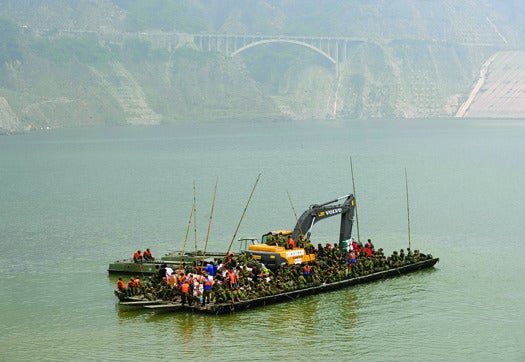
Yes. We drill into the earth to mine for gas, oil and minerals and construct massive dams and, as a result, have caused at least 200 quakes of more than 4.5 magnitude in the past 160 years, says Christian Klose, a researcher at Columbia University who studies man-made quakes.
The best-known case is the earthquake caused by the Zipingpu Dam, in China’s Sichuan province, in 2008. Zipingpu held 42.3 billion cubic feet of water, the weight of which precipitated what Klose says is the largest human-triggered earthquake to date: a 7.9-magnitude quake that killed nearly 80,000 people. Klose estimates that Zipingpu, with nearly 320 million tons of water pressing down on a fault line, contributed enough stress to trigger the quake through a process called impoundment. “If you push your finger on top of a paper plate, the plate will bend,” he says. “That same effect works on all the tectonic plates on the Earth’s crust.” The quake occurred two years after the dam’s completion, and its epicenter was a mere three miles from the structure.
Authorities in Basel, Switzerland, shut down the city’s geothermal plant after a 3.4 quake in 2006. Tapping geothermal energy involves boring into rock miles beneath the Earth’s crust in search of steam as a source of energy. Engineers in areas without much water, such as Basel, sometimes create boreholes by way of hydraulic fracturing, or “fracking,” which involves forcefully injecting water to create fissures. Fracking can generate small tremors, but the real damage may happen as excess liquid pools in the cracks between rocks, making them less stable. Although dams have caused some 76 earthquakes, mining is responsible for at least 137 earthquakes, over half the number of man-made quakes to date.
In 1989 a 5.6-magnitude earthquake hit Newcastle, Australia, the direct result of coal mining. Extracting millions of tons of coal added stress to the fault lines, but the real danger resulted from the water that was extracted during mining. For each ton of coal produced, Klose estimates, 4.3 times as much water was pumped out of the ground, a necessary step to prevent flooding inside the mine. But removing so much water dramatically altered the stability of the earth surrounding the mine. Klose says the earthquake caused $3.5 billion in damage—an amount that nearly equaled the profit of all the coal produced by the mine over its 200-year history.
Have a science question you've always wondered about? Send an email to fyi@popsci.com
Five amazing, clean technologies that will set us free, in this month's energy-focused issue. Also: how to build a better bomb detector, the robotic toys that are raising your children, a human catapult, the world's smallest arcade, and much more.


Online Content Director: Suzanne LaBarre | Email
Senior Editor: Paul Adams | Email
Associate Editor: Dan Nosowitz | Email
Assistant Editor: Colin Lecher | Email
Assistant Editor: Rose Pastore | Email
Contributing Writers:
Kelsey D. Atherton | Email
Francie Diep | Email
Shaunacy Ferro | Email
geothermal energy productions has been known to cause earthquakes as well.
--------------------------------------------------------------------------
why learn from your own mistakes, when you could learn from the mistakes of others?
“The most incomprehensible thing about the universe is that it is comprehensible” -Albert Ein
@-my name here- "geothermal energy productions has been known to cause earthquakes as well."
"shut down the city’s geothermal plant after a 3.4 quake"
yeah that's kind of what the article implied........
I'm waiting for China to blame theirs on HAARP again.
@nighthawkich: I missed that.
@everyone: PAY NO ATTENTION TO MY PREVIOUS COMMENT.
--------------------------------------------------------------------------
why learn from your own mistakes, when you could learn from the mistakes of others?
“The most incomprehensible thing about the universe is that it is comprehensible” -Albert Ein
Well, to be specific, they were not caused by humans, or even triggered by. Influenced, yes. Perhaps made worse than they would have been naturally, and certainly occurring sooner than they would have.
A human-triggered earthquake would likely require something like a nuclear detonation inside a fault line...which we are indeed capable of as well, though I'm not aware of any such occurrences.
Well nuclear tests above ground allready managed to create earthquakes. They just weren't called "earthquakes" but "nuclear shockwaves" ;)
Kinda doubtfull, fracking usually isn't at the deep levels that earthquakes occur, and fracking would be like a pin prick in a piece of styrofoam. Fracking only disturbs rock in a very small area next to the scale of the earth, it would be almost negligable, like walking up to a mountain and picking off a little peeble, than saying you caused an earthquake. Not very realistic.
Sounds like a left wing environmental article, not neccessary based on actual facts, but more like global warming!
Curious how the earthquakes described were "caused" by humans pursuing increased energy production; an activity essential to supporting the growing human population and its prosperity and also vilified by progressives. Coincidence? I think not.
For imagining a connection between earthquakes and relatively benign human activity I give Klose 3 Pinocchios. Not yet in the lifetime achievement rank of James Hansen and Al Gore(4.5 Pinocchios each) for dreaming up the fantasy that human-generated CO2 is the primary cause of so-called global warming, but good effort anyway.
C'mon Popsci, don't you do independent research before publishing the claims of enviro-wackos? "...dams have caused some 76 earthquakes, mining is responsible for at least 137 earthquakes..." Really? You can say that with a straight face?
When did conspiracy theories and pseudo-science get elevated to the realm of accepted scientific fact? Zechio, rg-5, baddogbob52 are closer to the truth than Klose and they probably have never been published in a journal of any kind. Try being skeptical occasionally when someone makes outrageous statements.
I have no doubt that humans can and do cause earthquakes. However, I'm not convinced this is necessarily a bad thing. Obviously a 7.9 that kills 80,000 is a tragedy, but smaller more frequent earthquakes caused by humans may prevent the massive naturally occurring ones by releasing tension over time instead of all at once.
A dam the size of Zipingpu can probably increase the 'carrying capacity' of the area by 10 or 15 million people - water for irrigation and clean pollution free power. It probably will spare millions from cancer and other diseases caused by fossil fuel power over it's lifetime.
It seems reasonable that the quake was at least associated in some way with the dam.
On the other hand, if it was built on a fault, obviously there were quakes there before - otherwise it wouldn't be a fault. The question is, what size earthquake is typical for the region, how frequently they occur, and was the place overdue for 'the big one'?
There are peaks nearby over 20,000 feet tall. These were probably pushed up by plate tectonics, with associated earthquakes.
sure they can.. just watch dr doolittle.. when they have that familly dinner and everyone starts farting pfhahha...eartquaaaakllee
the answer is obviously yes. and we have and will continue using them as weapons. the Japan Tsunami was no act of nature. someone deliberately detonated some sort of "sound weapon" with high frequencies that caused the death of thousands of people.
_________________
The people of the world only divide into two kinds, One sort with brains who hold no religion, The other with religion and no brain.
- Abu-al-Ala al-Marri
Frack me! We really fracked that one up, eh? Frackin' crazy.
This would make a great premise for one of those cautionary science fiction movies; in the distant future, when the surface of the earth is riddled with seismic and volcanic activity, due to extensive sub-surface mining.