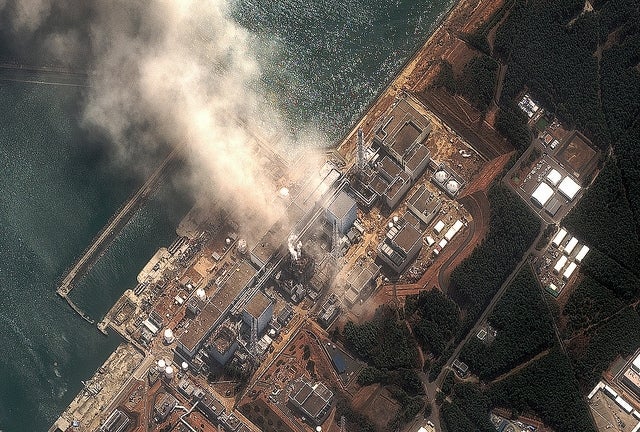
Fukushima Dai-ichi Nuclear Plant, March 14, 2011 DigitalGlobe via Getty Images

This spring’s nuclear disaster at the Fukushima Daiichi power plant released almost double the amount of radiation the Japanese government has claimed, according to a new analysis. The authors say the boiling pools holding spent fuel rods played a role in the release of some of the contaminants, primarily cesium-137 — and that this could have been mitigated by an earlier response.

Researchers at the Norwegian Institute of Air Research examined radiation monitoring stations throughout Japan and the rest of the globe, extrapolating their findings from initial radiation-release estimates. They say the amount of cesium-137, a long-lived isotope that persists in the atmosphere, was about twice as high as the Japanese government’s official estimate. That number (3.5 × 1016  bequerel, for those of you keeping track) is about half the emission from Chernobyl.

The researchers also say about 20 percent of the total fallout landed over Japan, but the vast majority fell over the Pacific Ocean. (The effects of this fallout on fisheries and aquatic wildlife are still being determined.)

The Fukushima Daiichi power plant, you’ll recall, shut down after the devastating earthquake and tsunami that wracked Japan March 11. The tsunami knocked out backup power needed to keep the plant’s six reactors cool, and the active reactors overheated, venting hydrogen gas in a series of explosions. These explosions started fires and also exposed a pool containing spent fuel rods from reactor No. 4. The rods started heating up, releasing a radioactive isotope called cesium-137, among other radionuclides.

Cesium-137 emissions peaked three or four days after the quake and tsunami, remaining high until March 19, according to this new study. That’s the day authorities started spraying water on the spent-fuel pool at reactor unit 4, the researchers note. “This indicates that emissions were not only coming from the damaged reactor cores, but also from the spent-fuel pool of unit 4 and confirms that the spraying was an effective countermeasure,” they say. This contradicts Japanese government reports claiming the pools released no radiation, as Nature News points out.

Nature News says the disparity between the Japanese government’s totals and this new study, led by atmospheric scientist Andreas Stohl, can be explained at least in part by the data set. Japanese researchers used monitoring stations in their country, whereas Stohl used monitoring stations throughout the world, which captured much of the radiation that blew over the Pacific and toward North America.

The paper was just posted online for peer review in the open-source journal Atmospheric Chemistry and Physics.

[Nature News]

11 Comments

Wait...what are you doing here reading this comment if you are from enenews?

disobeying ! lol

as someone who lives in Japan, it was quite obvious to those of us living here that the government was either keeping the truth from us on purpose or becuase they are so inept. The government in Japan is run by greasy alcoholic old men who have never lived in reality a day in their life. They probably thought if they told people the truth their would be mass panic, which they did a fine job of causing anyway.

Hey OD! Just trying to figure out why so many are still unaware Fukushima Daiichi's nuclear reactors are STILL in meltdown

Nuclear News Now http://realitycheck.no-ip.info/nnn.html

half the release of Chernobyl? I find that very hard to believe. Chernobyl went super prompt critical, vaporized its core, and spewed it over the countryside. Fukushima is nowhere close to what Chernobyl was. We need to have better perspective statements in commercial nuclear power...

I agree Brainwood. And if anyone actually compares the numbers, the long term effects of cesium contamination will be minimal. You have a higher risk of exposure due to shoddy Chinese steel than to harmful exposure from Fukushima. The entire output might kill a small dog in three weeks, but that diffuse, maybe minutely higher risks of cancer over the next 100 years. Negligible impact outside of Japan, physically at least. More howling greenies and impedance to effective zero carbon energy projects, but we can't do much about that, can we.

I have noticed in the past... what many of the nuclear related article fail to do is put the information they cite about radioactivity into full context (I guess that's news in general today...).

For instance, they are accurate in stating that the cesium-137 release was half that of Chernobyl (and the reader fears pangs of fear). Chernobyl released about 9x10^16 becquerels of Cs-127. What they fail to include, is that Chernobyl also released an additional 3.6e+18 becquerels of radioactive material. Notice the power of 18, not 16. That's about 100 times greater.

Before I get scolded for hypocrisy, yes, Fukashima also released other isotopes other than Cesium-137. Yes, Cesium-137 is generally regarded as the most considerable long-term exposure hazard released in a nuclear accident. This is exactly the reason we need completion when dealing with nuclear accidents in the news. You very quickly realize you don't have enough information to take anything meaningful (unless all you wanted was to be alarmed) away from the article.

@Falconer13 - As much as I hate to take a stance on what would be perceived as the anti-nuclear side of the line... You aren't entirely correct in your statement. The entire Cs-137 release, if you were to hypothetically concentrate it and place it(hoping you're American for the purpose of this example)at the 1 yard line on a football field, and went and stood at the 25, you would accumulate LD50/30 (50% of those exposed would die in 30 days) in one hour.

You are correct in your statement about dilution. Considering the article notes that cause of the increase in release numbers was looking at global measurements of release, the release has been considerably diluted, and will have little measurable affect (not NO affect, but likely below the uncertainty of any medical studies) outside Japan.

Bioaccumulation locally may cause some issues. I would see that as the most likely source of harm to human populations.

The disaster is a result of a number of mistakes. At one time I wondered why Japan didn't request US help. Surely in some place in Japan there were 50 or 400 hz generators that could be used to have prevented the disaster.

I understand that the culture if Japan is quite different than most western countries. No on in Japans seems to be in charge. It is lead by committee.

By the way I am still mad at Japan for not informing the US service members who were subject to anthrax attack in Yokosuka. While the terrorists failed to create anthrax they did spread TB to many who were in front of the USN EM club that night.

"The Fukushima Daiichi power plant, you’ll recall, shut down after the devastating earthquake and tsunami that wracked Japan March 11. The tsunami knocked out backup power needed to keep the plant’s six reactors cool, and the active reactors overheated, venting hydrogen gas in a series of explosions. "
Apparently the big lie - that the problems at Fukushima started with the tsunami and not the earthquake - has won out. I recently read a 'New Yorker' article that had the same misinformation. Congratulations to the nuclear industry for making it look like unsafe inland plants with the same design will withstand earthquakes, so no expensive corrective action is needed.

"Fukushima in meltdown before tsunami hit"

rt.com/news/fukushima-doomed-reactor-plant/

"Mitsuhiko Tanaka, a former nuclear plant designer, describes what occurred on 11 March as a loss-of-coolant accident. "The data that Tepco has made public shows a huge loss of coolant within the first few hours of the earthquake. It can't be accounted for by the loss of electrical power. There was already so much damage to the cooling system that a meltdown was inevitable long before the tsunami came.""

www.independent.co.uk/news/world/asia/the-explosive-truth-behind-fukushimas-meltdown-2338819.html

"A radiation alarm went off at Tokyo Electric Power Co.’s Fukushima nuclear power plant before the tsunami hit on March 11, suggesting that contrary to earlier assumptions the reactors were damaged by the earthquake that spawned the wall of water"

www.bloomberg.com/news/2011-05-19/fukushima-may-have-leaked-radiation-before-quake.html

this is so scary. i don't know how people can possibly eat anymore seafood after hearing about all the radiation landing in the pacific ocean.

@ ctrl-z

You may be right, but at least the pumps were still working. The meltdown *may* not have been as severe if the tsunami hadn't knocked them out too.


June 2013: American Energy Independence

Five amazing, clean technologies that will set us free, in this month's energy-focused issue. Also: how to build a better bomb detector, the robotic toys that are raising your children, a human catapult, the world's smallest arcade, and much more.


Online Content Director: Suzanne LaBarre | Email
Senior Editor: Paul Adams | Email
Associate Editor: Dan Nosowitz | Email
Assistant Editor: Colin Lecher | Email
Assistant Editor: Rose Pastore | Email

Contributing Writers:
Rebecca Boyle | Email
Kelsey D. Atherton | Email
Francie Diep | Email
Shaunacy Ferro | Email

circ-top-header.gif
circ-cover.gif
bmxmag-ps