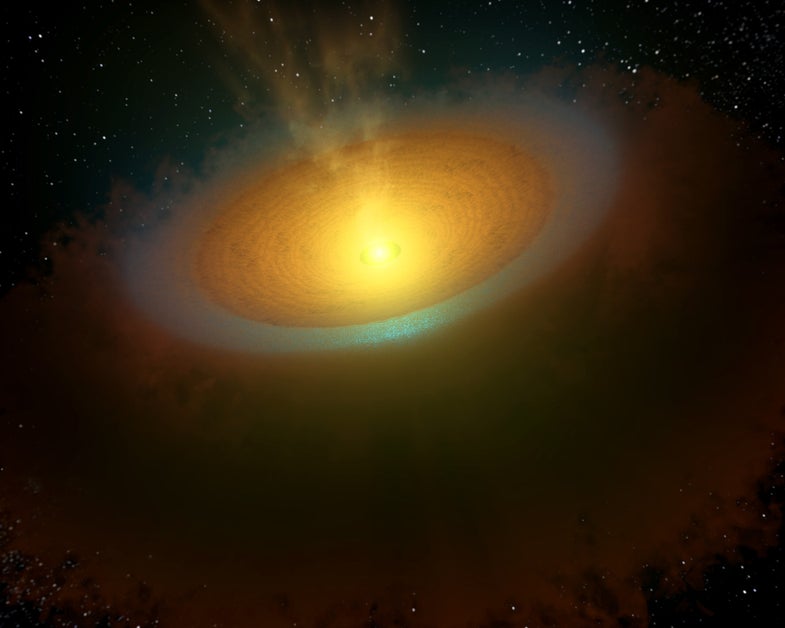
A pair of new comet studies from two space telescopes show how other planets might grow oceans. For the first time, astronomers have detected a ring of cold water vapor encircling a young star’s dusty planetary disk. And a separate study in a different star system shows a hailstorm of icy bodies could be bombarding a young planet. Together, the studies bolster a theory about how comets may have delivered Earth’s oceans — and they show this is not a unique occurrence in the universe.
Today's issue of the journal Science contains a paper describing cold water surrounding a young star called TW Hydrae, located in the Hydra constellation. Astronomers have previously found warm water around planet-forming regions, but not huge amounts of cold water. This cold reservoir demonstrates how comets form in a solar system’s outer reaches."Our observations of this cold vapor indicate enough water exists in the disk to fill thousands of Earth oceans," said astronomer and lead author Michiel Hogerheijde of Leiden Observatory in The Netherlands. TW Hydrae is just 10 million years old, and astronomers believe the dusty disk surrounding it will eventually coalesce to form planets. The frosty water vapor will probably coalesce to form comets, some of which might rain down on those new planets.
This does indeed happen in other solar systems, as a separate study shows. On Wednesday, astronomers using the cold-observing Spitzer space telescope described finding a dusty band around a star called Eta Corvi, a billion-year-old star system in the constellation Corvus, the crow. The band’s contents strongly match that of an obliterated comet, suggesting a massive collision, perhaps with a planet. This sounded like what happened during Earth’s own Late Heavy Bombardment. The system has a second, bigger ring much farther out, just like our own Kuiper Belt. And the bombardment is even happening around the same time that ours did, about a billion years after the Earth formed.
During the Late Heavy Bombardment here, a cascade of frosty space rocks rained down on the planet, delivering water and other things. (Earth was too hot after its formation to hold on to any native H2O.) Earlier this month, researchers using the European Space Agency’s Herschel Space Observatory said they found the chemical isotope signature of Earth water out in the distant reaches of our solar system, suggesting that Oort Cloud comets may have been one source of this bombardment, not necessarily just asteroids. This new Spitzer study suggests the same type of bombardment is happening at Eta Corvi.
So it sounds like comet clouds and water reservoirs are not uncommon at all. Perhaps around each star’s a pool of water — which could mean very interesting things for the search for extraterrestrial life.
The incredible innovations, like drone swarms and perpetual flight, bringing aviation into the world of tomorrow. Plus: today's greatest sci-fi writers predict the future, the science behind the summer's biggest blockbusters, a Doctor Who-themed DIY 'bot, the organs you can do without, and much more.


Online Content Director: Suzanne LaBarre | Email
Senior Editor: Paul Adams | Email
Associate Editor: Dan Nosowitz | Email
Assistant Editor: Colin Lecher | Email
Assistant Editor: Rose Pastore | Email
Contributing Writers:
Kelsey D. Atherton | Email
Francie Diep | Email
Shaunacy Ferro | Email
This article speaks of a balance in space that allows thousands of oceans water vapor balancing together orbiting a sun. How spectacular that water could exist at all together in space! What caused this water? What influences it so it just does not disappear in the vacuum of space?
Can microscopic life of any dimension exist among the water vapor and time?
The article also suggests planets could create and filled with comets from this water vapor and dust. Were millions of comets striking earth the source of our oceans and the precursors of our basic life?
This is exciting astronomy!
I think you misunderstand a little bit on this subject.
WATER VAPOR
is the gaseous state of water, and when it condenses (due to cooling), it forms liquid water. If it condenses (cools) too quickly it form ice (dry ice to be exact). One key way comets differ from asteroids is that comets are composed mostly of ice, whereas asteroids are usually rocky and may have some ice on/around it.
What is orbiting around those stars is water vapor which has condensed forming a bunch of tiny ice crystals, as opposed to big globs of ice that have compacted upon each other to form comets.
There is not literally any "water vapor" in space because of the rules that govern that molecule... if it exists in a gaseous state (which it did when it was created from the explosion of an earlier star), and that gas is cooled (as space is constantly cold) then it either forms a liquid (water) or a solid (dry ice) depending on how fast it was cooled.
The sun does play a role though, it may be heating those ice particles, converting them back into gas. If so, the ring would grow outward from the star until it reaches an equillibrium where it is close enough to not be diffuse yet far enough away to be in a stable physical state (read: ice). If the ring is still growing, it may appear as a "cloud" on our sensors... but what are terrestrial clouds other than a collection of very small, light ice particles mixed with dust?! Same thing in space.
lawsonrw,
The writers of this article and maybe those who provided the facts to them called it water vapor and so maybe led me down a bunny trail of confusion. I hope you comment further.
My own imagination was trying to fit in the missing pieces of how one then can go to another as in our own planet earth being formed, acquire its oceans and yes life. When it comes to the chemistry and mechanics of this far way cosmic water vapor, I have not a clue.
All and all, I still consider this exciting astronomy!
this is true. comets have different "ingredients" in them. maybe we should crash one into mars seeing how it has the outlines of an ocean. we all know that oceans once dominated the landscape of mars. maybe we should strengthen its magnetosphere in the process by heating up its core to be similar to Earths.
_________________
The people of the world only divide into two kinds, One sort with brains who hold no religion, The other with religion and no brain.
- Abu-al-Ala al-Marri
Splish splash I was taking a bath along about 9 o’clock, on long come a comet and interrupt my bath and now life has gone amuck! I have squiggle things here and there and some in my tub with my duck! I say, HEY YOU, Mr. Squiggle, get out of my bath and find your own your own yuck! Hops out this thing with a big EYES and a mouth so WIDE and says back to me, YO, buddy can you spare a Squiggle a buck? I say no you mister space alien, go back and find a job. We have enough of illegal aliens and you are enough!
@cosmic, click on the links in the article for more info,--@lawsonrw, water vapor can exist in space, according to the article, cheers
Water in Interstellar Space
by Nancy Atkinson on May 6, 2008
http://www.universetoday.com/14075/water-in-interstellar-space/
Wow, this is one for the astronomy journal. Note to self, just saw what appears to be a massive cosmic poached egg!
@lawsonrw
Just thought I'd clarify. "Dry ice" is the solid form of carbon dioxide and has absolutely no H2O.
I always believed that there is other life form living other than earth so this idea from this post is very much close to possibility.
Dreamweaver CS4 tutorials