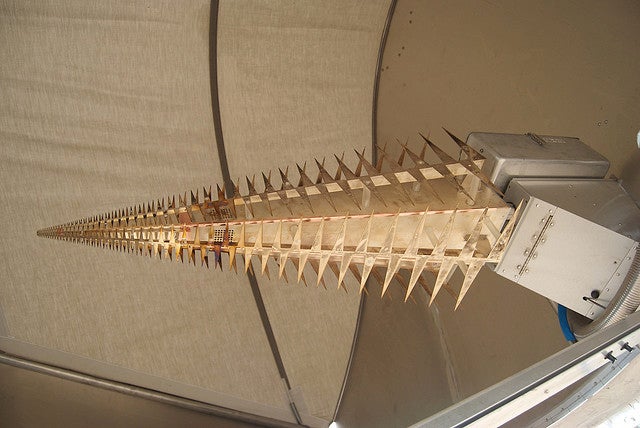
As part of my article about the search for extraterrestrial life, I interviewed Seth Shostak, a senior astronomer at the SETI Institute in Mountain View, California, about when we'll find ET, why intelligent beings will be artificial, not biological, and why arms and legs make more sense than wheels. Here's the fascinating transcript of what he had to say.
Jennifer Abbasi: How soon do you think we'll find extraterrestrial life?
Seth Shostak: I've said that we'll do it within 20 years, because it's a three-way horserace. Each of these horses has about an equal chance of crossing the finish line first and doing so within two decades.
First, we might just find it within the solar system. There are claims that there are plumes of methane gas leaching out of the rocks on Mars. And that's very strange, because if you release methane on Mars, within 300 or 400 years the sunlight will destroy the methane. So if you're finding methane today, that means something is making it, at least within the past couple hundred years. Some people dispute those measurements, and other people say it can be explained by geology and has nothing to do with life. But there are lots of reasons to think that if you could send a robot to Mars and drill down a couple hundred feet that you might hit a liquid aquifer. You might also find life. When are we going to do that experiment? In the course of the next 20 years, it just might happen. There are other places in the solar system that might have liquid water. To find it requires mounting a big mission with rockets and robots and going to look. The timescale for that is 10, 20, 30 years, depending on the funding.
The second possibility is the Terrestrial Planet Finder (TPF) telescope, which will look for and analyze extrasolar planets. It ran out of funding, which is why it's not being built now, but in the next 20 years, presumably, it will be.
The third way is SETI, looking for intelligent life. The technology would allow you in the next 20 years to examine a million star systems, which is a big number-and I think the right number to have some chance of success.
With these three different approaches, it seems to me likely we'll know within 20 years if there's life beyond Earth. If not, either we didn't spend the money or we're lonelier than we thought we were.
JA: If we ever find extraterrestrial animals, what do you think they could look like?
SS: Nobody really knows, but the facts are that if you just go to your local zoo, you'll find that there are lots of different shapes and designs that work even here on Earth. Most of the things at the zoo don't look like us. We're one design that works. Our chimp pals sort of look like us, so that's a different take on the same basic design. But fish don't look like us, and giraffes don't. They look a little like us, but not too much. And insects certainly don't look like us, and they work just fine.
Life adapts to its environment. This is a planet where the average temperatures are usually above freezing and below boiling. And you've got a thick atmosphere and you've got gravity, and all life here is adapted to that. If you have another planet that's sort of like Earth, a cousin of the Earth, where these sorts of things also exist, then I imagine that a lot of the designs would be familiar to you. Fish look fairly streamlined, particularly fish that have to hunt other fish, like barracudas, or even mammals that live in the ocean, like dolphins. They have to hunt, so they all look like torpedoes. It's because eventually evolution figures out that you can make animals speedier in water if you shape them like a torpedo than if you shape them like, say, a bicycle.
JA: How big could they get?
SS: Animals have been bigger than today in the past, but not much bigger. The whale is probably as big as anything ever got. There's a limit to how big you can make an animal, because their strength goes up as the square of their size but their weight goes up as the cube. So that means if you make things too big, they become kind of incapable of being very nimble; they can't move around. If you were to make something the size of 10 elephants, it wouldn't work anymore because its bones just couldn't be strong enough to support it. It couldn't move around, it would just collapse. So the fact that animals have never been a whole lot bigger than they are today just reflects a basic engineering problem that will be the case on any planet.
JA: And is the same true if you go in the other direction? Could extraterrestrial bacteria be a million times as small as ours?
SS: Well, the answer to that is probably no, because if you make it a whole lot smaller, then there isn't enough volume inside microbes to do the chemistry that is life. You just don't have enough molecules in there. So there are limits anywhere, I would think.
JA: In terms of land animals, what are the characteristics that we tend to have in common that could show up on another planet? Appendages or heads, for example?
SS: Heads are a good deal, and I think they would be a common feature. It's hard to think of species that don't have heads, although there are some. It's good to have a head because it puts some of the sensory organs-eyes, ears, whiskers or whatever-next to the CPU, the brain. And that's a good deal because to get the information from your eyes to your brain, for example, you don't want that to take a whole lot of time, because then you can't react quickly enough, and you get wiped out. So you want your brain to be close to your eyes. Having them up high is usually an advantage because you get a better view and you can see predators or prey, depending on what your interest is. So all of those things point to animals having a head where the sensory organs are.
Having appendages is the result of the fact that we live on a planet that didn't come prepaved. The Earth wasn't born with railroads or roads everywhere; it just had this rough topography. And so if you had animals with wheels, for example, they'd have a hard time getting around. Appendages are much better for that. You can scamper around the ground, climb into the vegetation. And then it turns out that they're also good for wielding screwdrivers and soldering irons. So eventually appendages are useful for technology, too.
We have two arms and two legs, and that's because we came from some four-lobed fish way back. But what if we'd been a six-lobed fish? Then you could play piano duets because you'd have four arms instead of just two. Most of the animals on Earth have six legs, not four. They're called insects. Six works. Probably if you had 106, that wouldn't work so well because it takes too much brain to coordinate it all. So a lot of it just depends on the happenstance of evolution.
JA: What about plants? Are they likely to exist elsewhere?
SS: Plants on Earth managed to pull off a really nifty trick, and that was how to turn nothing more than gases they could find in the atmosphere, a little bit of water that falls on them occasionally on the ground, and sunlight into food. That was a great trick, and of course we call it photosynthesis. Photosynthesis is a great way to convert the environment into food. You would think that that would eventually appear on any planet because it's just an opportunity that's so advantageous-if you could do it, eventually it would happen.
JA: So what will intelligent life look like?
SS: Does it matter how we picture what ET looks like, as long as they can build a radio transmitter that we can pick up?
The problem is that we tend to picture ET as looking something like us. And I think a lot of that has to do with movies that always portray the aliens as looking very much like us, variations on us that are very anthropomorphic. Hollywood does that not just because they're naive about this, but I think because they know that the audience needs to be able to read the intentions of the aliens. "Wow, he looks hungry." Or, "Oh, he looks friendly." You know how to read the faces of humanlike creatures. You can read the intentions of chimps at the zoo but not insects when you look at them up close, because they're so different-looking.
There actually is at least one scientist, Simon Conway Morris, who thinks that we're a good design for an intelligent creature and, consequently, if there are intelligent beings out there they will look something like us. I don't buy that. I don't know why we are the best design. That sounds so self-congratulatory.
From the standpoint of SETI, the important argument is that we invented radio around 100 years ago. In less than a century after the invention of radio, we invented computers, and today computers are very commonplace and they're getting faster. Following Moore's Law, they're doubling in speed every 18 months. By 2020, most home computers will have the computing power of a human brain. That doesn't mean that they are brains, but it means that in terms of raw processing, they can process bits as fast as a brain can. So the question is, how far behind that is the development of a machine that's as smart as we are? A machine that can take over your job and write articles for Popular Science. We're talking about artificial intelligence. Maybe that will take 10 years, maybe 50, 100 or 200 years. There are some people who say we'll never be able to do it. I don't believe those people. Whether it takes 20 years or 200 years, the point is that you invent radio and then, within a few centuries, you've invented machine intelligence.
Most of the intelligence out there must be artificial intelligence. We keep looking for critters like us living on a planet like ours, where in fact the majority of the intelligence out there is not biological. That would be my argument. The timescale to go from being technological so we have some hope of finding you, to going to an artificial-based intelligence is very short.
JA: So what is the definition of the type of artificial intelligence that you're talking about?
SS: From the standpoint of SETI, we consider something intelligent if it can make a signal we can pick up. Can it build a radio transmitter? Can it build a big laser? If it can, we might be able to find it. Of course, that doesn't say anything about whether they have art or music, if they're peaceable or non-peaceable, or whether they're little, soft, squishy gray guys-billions of them on a planet running around doing their thing-or whether they're thinking machines hanging in space or special places in the galaxy.
JA: When do you think we'll find intelligent life, or it will find us?
SS: Finding us is actually harder, because how could they find us? You could conceivably pick up our television, our radar, our FM radio, but you have to be close enough for the signals to have gotten to you within, say, 70 light-years. The number of stars within 70 light-years is maybe a few tens of thousands, but it's not a very big number. I don't know that they're going to find us until we've been on the air for a lot longer. But for us to find them is maybe not such a problem because, after all, the universe has been around three times as long as the Earth has. There has been plenty of time for other intelligence to get way beyond us, so they might have been sending signals for a long, long time, literally millions or even billions of years. There could be signals washing across our planet all the time that we just haven't found because we haven't done the right experiment.
JA: Is there any way to estimate how long it will be before we come across something?
SS: In a paper I wrote a couple years ago, I looked at the increase in speed of our SETI experiment, and I took some reasonable, or what I thought were reasonable, estimates of how many societies are out there broadcasting. I took the range of estimates from 10,000 to a million. Ten thousand is what Frank Drake, the founder of SETI, usually says, and a million is what Carl Sagan said, and those are both guesses. But if those guesses encompass the right number, then you can combine that with the speed of SETI searches as they will increase in the future. I estimated that it was two dozen years until we detected a signal. Within two dozen years we'll be able to look at a million star systems. As of today, we've looked at maybe 1,000 carefully in the radio [wavelength]. That was the basis of the argument. But the point of the number was not two dozen years, so much as it was to say that this is an experiment that, if SETI has any merit, will work relatively soon, within a generation, rather than something that might take 1,000 years.
There have been 10,000 generations of humans before us, 10,000 generations of Homo sapiens before you were born. I think that you're the first generation that will learn whether what's happened on Earth is a miracle or something that's happened many, many times.
Five amazing, clean technologies that will set us free, in this month's energy-focused issue. Also: how to build a better bomb detector, the robotic toys that are raising your children, a human catapult, the world's smallest arcade, and much more.


Online Content Director: Suzanne LaBarre | Email
Senior Editor: Paul Adams | Email
Associate Editor: Dan Nosowitz | Email
Assistant Editor: Colin Lecher | Email
Assistant Editor: Rose Pastore | Email
Contributing Writers:
Rebecca Boyle | Email
Kelsey D. Atherton | Email
Francie Diep | Email
Shaunacy Ferro | Email
The interview makes a good point. Since the universe is constantly expanding there will be parts of the universe that we will never be able to travel too. Even if we travel at the speed of light.
I call BS on not being able to explore places in the universe
yes in a sense we will be able to "travel" to any point in the so called "universe". the word "travel" is only used be objects of mass. i say turn to spirituality to expand our consciousness and travel with our minds. when i say spirituality im not talking about religion. they are not the same thing.
_________________
The people of the world only divide into two kinds, One sort with brains who hold no religion, The other with religion and no brain.
- Abu-al-Ala al-Marri
@D13
Sounds like a bit of SG influence to me. But that does make logical sense. Energy is the most efficient form. Not created or destroyed but merely transformed. Whatever path of biological evolution lies in between for humans, it seems like existing on the energy level would be the final evolutionary transformation of all sentient beings. As energy their is a partial assurance of eternal endurance.
No matter how advanced we make our machines, they are still fallible, pliable and unable to endure the weathering of thousands to billions of years of cosmic exposure and/or terrestrial exposure. Finding a way to download a human consciousness into a computer, or robotic drone would only assure an ultimately cosmically insignificant measure of greater existence beyond the normal human mortality range, as such devices are subject to the same wear-down and destruction that our physical bodies are subject to.
Energy doesn't have that problem. For all we know the answer could be in the stars. Think about it.
@boka
Never say never.
@D13 I had the same thought about the Dinosaurs. The weight to mass ratio is only for vertebrates so don’t think it would affect insects. But Dinosaurs were huge and theoretically they shouldn’t have been able to operate outside of water. This is a mystery and unanswered / ignored by modern science (like all the tough questions). Luckily fringe science has already answered this question.
@JediMindset if you are talking about Astral projection, I believe that is real. However it takes so much discipline that not many people in the world can do these things anymore.
Let me tell you why Seti will NEVER find intelligent life. Because if there is intelligent life out there and they survived from a type 0 to a type 2-3 civilization, they are more than likely operating on frequencies higher than radio, gamma or x-ray. So you can search for all the radio waves you want, but the Aliens are operating at much higher frequencies. Stupid humans.
@Aldrons Last Hope
exactly what im talking about. im sure that with the proper tools all humans have the ability to do such things. you are right it requires a lot of discipline and belief and "faith".
i think david wilcock and dr steven greer can do it.
_________________
The people of the world only divide into two kinds, One sort with brains who hold no religion, The other with religion and no brain.
- Abu-al-Ala al-Marri
I agree that life is most likely to be artificial. Over the next 100 plus years, man's thirst for immortality will probably result in our transferring our consciousness into robotic bodies. This would probably be done when our bodies have been damaged by aging and disease, and after we have already enjoyed living in the flesh, so to speak. Those who could afford this procedure could be our first cosmic explorers, with no time limits hampering their desire to see the universe. Their spaceships may be stocked with embryos, to seed uninhabited planets. Sounds like a great sci fi novel :-)
Finding something not hidden is one thing. But what if you’re searching for something that is powerful enough and more advance enough it simply hides itself in view.
Suppose there are many aliens’ races and one attacks the other and visa versa. They being hidden would be typical response for offense and defense purposes.
Suppose aliens do not want to interfere with our natural growth and wish to stay out of view.
We may never find the advance alien race, until they decide to reveal themselves to us.
Then this would be our FIRST CONTACT.
JediMindset,
How does one use the word spiritually and have no religion. I could except you do not accept the religions on earth, but do acknowledge a higher self spirit. But to say there is not religion and then say be spiritual is confusing.
By the way, Flash Gordon would want this device in the picture back! ;)
@Grunt
Don't bother trying to understand Jedi Mind Set or ALH. They're products of religious propaganda and new-age spiritual philosophies.
--
We don't have to worry about traveling at any speed if we can manipulate the ol' fabric. Worm holes and whatcha-ma-call-itz. Why not teleportation?
The only thing wrong with any of that is getting to the location you desire.
On a odd side note, if you look really close at the picture. One third of the way down from the point, the little golden points look heat fried; like the device burned out for some reason.
@SETI
I have been running your software on my computers since 1998
@Grunt,
religion is a prison for the seekers of wisdom. spirituality is the understanding of the reality of our sanity. didnt mean for it to rhyme lol
read the following article for more insight.
http://www.melanietoniaevans.com/articles/religion-spirituality.htm
_________________
The people of the world only divide into two kinds, One sort with brains who hold no religion, The other with religion and no brain.
- Abu-al-Ala al-Marri
insects do have a maximum size. and it is much smaller than vertibrets. Their size is very limited by the structure and composition of their caprices. (I took a class or two of entomology in school)
If there is a God, we must be like their Reality TV programming ... Yes, Unscripted but predictable!..
@Aldrons Last Hope
It is nonsense to say that we will never find intelligent life because they are transmitting at frequencies we cannot sample. If there exists type 2 or 3 civilizations today, then those lifeforms had to have evolved from a type 1 civilization first. Which means the first broadcasted radio signals they transmitted will be within SETI's estimate range. Or do you want to assume that a type 3 civilization is going from system to system sharing their advanced communications technologies with primitive lifeforms?
i've read some articles that we already encounter alien from venus and his name is "Valiant Thor" >>http://www.theallseeingeye.us/Valiant_Thor.html
picaboo,
Any relation to picachu?
For one thing, dinosaurs were gigantic. There was way more oxygen in the atmosphere at the time, and thus they were able to survive. O2 levels dropped, and so did they (and I suppose a meteor or two may have also dropped... from the sky).
-------------------------------------------------
But in regards to an intelligent race having six appendages, I doubt that. Brains suck up way more energy than any other organ. IIRC, brains use somewhere between 20 and 40 percent of all caloric intake. And they weigh 3 pounds. 1/60 of your weight is sucking up between 1/5 and 2/5 of your energy input. Oh, and the sodium-potassium pump is also hyper efficient, hence why we don't need energy inputs in the form of uranium to keep ourselves conscious.
Brain size is also almost exclusively defined by the size of the organism. Bigger muscles require bigger brains to run them. This is a primary reason why men have bigger brains than women. It's not intelligence, but rather the fact that guys simply are larger.
The heaviest taxes on the human mind are vision and fine motor skills. Human eyes aren't the most adept at vision, there is a slug that actually beats us as it has acuity nearing birds of prey, sees in infrared as well as color, has eyestalks so it has 360 degree vision, and because of the eyestalks, can switch from monodirectional binocular vision to entirely different directions. We do however have the most advanced brain on the planet. And when you combine one of the best cameras on the planet with the best computer on the planet, you still end up with something very very good. The brain does so much post-processing, it's astounding. You have to actively trick your brain to get it to not understand something. Likewise, image recognition is probably the best of any species.
That was a bit of a digression, so I'll get back to my point: The other highly taxing thing is fine motor control. I believe around half of motor control in the brain is dedicated to control of the hands/fingers. It's a huge number for such small parts of the body. If you try multiplying that number by two, your result is a larger tax on the brain, and thus, brains will be larger to compensate.
That's not to say that they couldn't have little T-Rex style secondary arms that hold stuff, but have no true fine motor control. Alternatively, I suppose you might have something that could potentially have both wings and arms, but because of weight growth versus strength growth, the size of the animal (and thus the brain) would be limited, so it probably wouldn't even have the capability to perform fine motor functions.
In the book Revelation Space, for instance, there is an alien race called the Amerantin (I think I've got the spelling right there...) that evolved from avians similar to terrestrial birds. They only achieved higher level intelligence though once they became bipedal organisms that no longer could fly (due to simply being too large).
Basically, four dextrous hands is not going to happen any time soon. To further comment on this, a group of scientists once got together to attempt to design the most efficient being possible.
The result was a bipedal organism with a head, two arms, and two legs. Each hand had six fingers, the mouth was different from the air opening and both had their entrances to the body not in the head. The fact of the matter is, vertical organisms are going to be the most advanced. We can see farther without having to be extra large because we are vertically, rather than horizontally, based. Two arms are such because of the immense brain power required for fine motor control. Hands have six fingers instead of ten for the same reason. Fine motor control takes processing, which means a bigger brain, and brains are energy hogs.
So, if you ask me, if we find other intelligent life, it will be like us if organic. If it's cybernetic, all bets are off. It's not self obsession. It's logic.
if aliens are smart they will avoid us like the plague
@Volt,
thanks, thats a lot of great info.
_________________
The people of the world only divide into two kinds, One sort with brains who hold no religion, The other with religion and no brain.
- Abu-al-Ala al-Marri
Volt,
I suppose some people may count the thumb as being a finger, so fine. But I have a total of 5 on each hand. Do you have 6? Maybe you do have 6 fingers on your hands and so explain that the rest of us humans must be odd in only having 5. Well, I am ok with you having some pride. Stick to that story, by golly!
No wait, I read you comments again and you say hands have 6 fingers instead of 10. So does that mean you only have 3 fingers on each of your hands. Now I am beginning to think you are a muppet. Volt, are you a muppet, sir?
@Infinion Your comment is based on the assumption that an Alien race will go through similar development stages as us. That they will transmit using Radio waves before switching to a higher frequency. But what if this species is completely different than us, and don’t have to crawl before they walk? I think it’s safer to assume an intelligent species operating a Type 2-3 Civilization are communicating at higher frequencies. So let’s scan the X-Ray, Gamma Ray spectrums and see what we find. No I don’t think it would be responsible for aliens to give us technology we aren’t ready for. At the same time that’s not stopping us from looking.
@JediMindset It’s definitely a lost art. I’m sure only a select few can still do these things. But one thing we can all try out is lucid dreaming. Trying to take control of your dreams while in R.E.M sleep. To take control and have amazing vivid dreams you have to face your fear. Usually in a dream you will come up to an obstacle that is terrifying. For instance, if you are afraid of heights, in your dream you will be in a situation where you have to face that fear. Most people can’t do it, they just wake up, or start dreaming another dream. But if you realize you are dreaming and face your fears it will open up a whole new dream world. I’ve experienced this, but only a few times, it’s hard to know you are in a dream when it’s happening.
@Aldrons Last Hope,
ive also have tried it. i got it to work a couple times than i wake up. sometimes i wake up but manage to go back to the same dream. i heard that writing a number on your hand with a marker and remembering to look at your hand in the dream helps. when you look at your hand the number will be different or distorted. that way you can tell if its a dream. and also remember not to panic. i remember having one dream where i was being chased by a group of people and being cornered in an ally and wanting to fly. but decided to blow a hole in a concrete wall with my fist. very vivid dream. you are right sometimes its hard to tell the difference between whats real and whats not. sometimes my dreams are more exciting than my "real" life. maybe its because i have a vivid imagination. check out this link its about the power of the pineal gland.
http://www.youtube.com/watch?v=nR-klTa1y54
_________________
The people of the world only divide into two kinds, One sort with brains who hold no religion, The other with religion and no brain.
- Abu-al-Ala al-Marri
@JediMindset Awesome! I like that trick with the numbe too. Trying to read anything in a dream is very difficult, most people can't do it. But that's a giveaway you are dreaming. Sometimes your dreams can tell you or warn you about something. Like one time when my brother went to Florida for an extended period of time. I had no idea when he was coming back. Then one afternoon I had a dream he came home and I answered the door and he was in all white. The next day I heard a knock at the door, when I answered it was him, except he was in all black and he told me he touched the previous afternoon. Coincidence? Maybe. But I try to pay attention to my dreams. Sometimes I think the dream world is like annimatrix zero on Voyager. The Borg lived whole lives while they were regenerating (sleeping) and were not aware of it in their conscious state.
Thanks for the link I'll check it out. Wilcox has some great info, I don't agree with everything, but I agree with some of his points.
The pineal gland or the "acorn" has been honored by all ruling classes. From ancient Egyptians, Hindu's, Sumerians. To the modern day Vatican (largest sculpture in Vatican city is that of an Acorn..lol pretty bizarre for the uninitiated), to the founding fathers, there is the zodiac and pineal gland represented in the capitol building. That is because it is key to astral projection and other forms of telepathy.
Check this out
http://www.youtube.com/watch?v=9CAWwk9nN1k&feature=channel_video_title
Seth is a great guy, but he needs a paradigm shift. SETI needs to look for life as we understand it by using the harmonic of 0.273:
www.magic-point.org/Html/1.html
THAT would narrow down their search considerably.
Either that or use the most powerful eye on Earth: it's just sitting there waiting.
We got there first, but we can't tell you how to do it!
Rex: Your site has actually touched on something that I have been working on for the past ten years. The concept of the fractal-based universe. Everything on the aforementioned page actually meshes with the statistical models and "imagination experiments" that I have been conducting for some time. Indeed to fly forwards and become large, you must first fly inwards and become small.