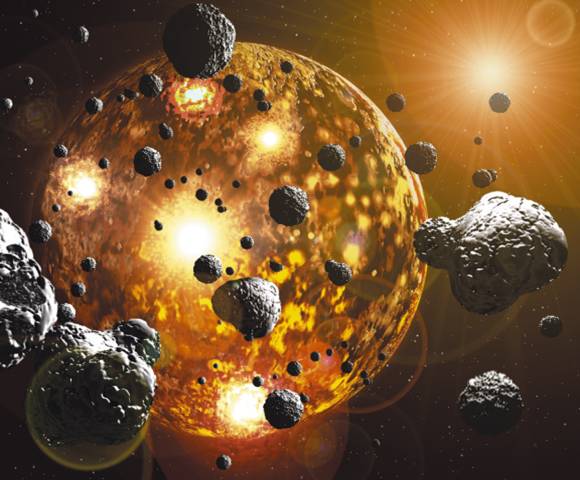
When our planet was still forming, collisions with other planetesimals — and a Mars-sized object that sheared away the moon — turned the embryonic Earth into a roiling ball of molten rock. Iron and other heavy elements sank toward the core, and other iron-loving elements did, too. As a result, there’s plenty of gold at our planet’s center. So why, then, is there also gold in the hills? A new study supports the theory that it was all a gift from above.
Meteorites seeded the Earth with a fresh, crust-level supply of noble metals half a billion years after the planet coalesced, British scientists say. And given how the Earth’s crust has been mixed since then, the researchers speculate that meteorites may have even given us plate tectonics.
The Late Heavy Bombardment was a cataclysmic era between 3.8 and 4.1 billion years ago in which waves of meteorites rained billions of tons of material onto the Earth, moon and the other terrestrial planets. These meteorites brought gold, tungsten and other precious elements, explain Matthias Willbold and Tim Elliott of the University of Bristol.
To test this theory, the team studied 3.8 billion-year-old rocks from Isua, Greenland, some of the oldest rocks on the planet. The rocks formed after the bombardment era, but they contain isotopic information that can tell scientists about earlier Earth conditions. Willbold and Elliott zeroed in on an isotope of tungsten, 182W, of which there’s an elevated ratio in the Earth’s mantle. This is because the tungsten isotope is a daughter product of another radioactive element present amid crustal silicates. Which is to say, an added veneer of metals from meteorites would have a relatively lower ratio.Using incredibly precise analysis — this tungsten ratio is measured in units of parts-per-10,000 — the researchers were able to tell that Greenland rocks do have a higher tungsten-182 ratio than modern-day rocks. The small difference is in agreement with how a bombardment would have added material to the Earth’s crust. This bombardment explains the otherwise surprisingly high abundance of precious metals in the crust, the researchers say.
“Our work shows that most of the precious metals on which our economies and many key industrial processes are based have been added to our planet by lucky coincidence,” Willbold said in a statement.
There’s one other cool aspect of this study. Willbold and Elliott discussed that the ratio in modern rocks means plate tectonics must have stirred in the new, meteorite-delivered rocks relatively quickly. Thus the Late Heavy Bombardment, in addition to giving us precious metals, may have initiated mantle dynamics that still exist, they write.
The paper appears in this week’s issue of Nature.
[via Science Daily]
Five amazing, clean technologies that will set us free, in this month's energy-focused issue. Also: how to build a better bomb detector, the robotic toys that are raising your children, a human catapult, the world's smallest arcade, and much more.


Online Content Director: Suzanne LaBarre | Email
Senior Editor: Paul Adams | Email
Associate Editor: Dan Nosowitz | Email
Assistant Editor: Colin Lecher | Email
Assistant Editor: Rose Pastore | Email
Contributing Writers:
Kelsey D. Atherton | Email
Francie Diep | Email
Shaunacy Ferro | Email
Now there's a reason to put a little more importance on space travel (but I knew this already). Everything about Earth comes from space. The fact that the precious metals and other material that we hold dear to our modern societies comes from space is logical, not ground breaking. It's just that the majority of people thought that this stuff just appeared outta thin air.
All of these materials are floating free through our solar neighborhood. Mining these resources could not only help to establish a firm infrastructure on other worlds, but it could improve and maintain a high quality of living hear. One way to deter the damaging effects of industrial processes is by transferring these processes to the space environment. Combining this with environmentally friendly methods of industrial processing, we could move forward without worrying about having to revert back to caveman status for fear that we'll destroy our planet's ecosystem.
Or we could just go back to the 'life on Mars building WMD with connections to Al-Qaeda,' sentiment for motivation.
evrything came from space ^^...
bored? lets go mine the stars... ^^
.if you continue with the studies logic, everything came from space. It's just as likely anything that we think formed on earth could have formed elsewhere.
Also, we aren't lucky that we have those metals. If we didn't have them we would have just placed value on something else.
pheonix1012 is right !
no space... no future... ^^
bored? lets go mine the stars... ^^
@jmadrigal12
True, but without these material we wouldn't have been able to advance as far as we have. There's only so much you can do with mud, rocks, and trees. Especially if all of the materials for industrialism is trapped deep in the earth's mantle near the core.
Also, you only put value on things that are not abundant. You can increase your earning power through supply and demand. Demand is hard to create with something that is abundant. Of course, that's the place we're trying to reach.
If we have abundance in resources, production will become much more inexpensive. Energy doesn't have to be cost anything to generate (or more realistically doesn't have to cost as much as it does). The price of building and selling facilities, automobiles, boats, airplanes would be cheaper per company. Spacecraft production would be just as clockwork as aircraft or automobile production. More resources means more availability to the 'have nots.' No reason to wage wars over limited resources (except for greed and corruption, maybe).
Let's face it we need this.
all the heavy elements were created by supernovas and humanity (all life on earth) is in constant jeapardy from any number of cataclysms, we must move out into the stars for humanity to persist as long as the universe, cheers
Humans will not be able to withstand the rigors of space travel. People watch too many movies. Humans will have to have advanced modifications. So much so there won't be much left of us to be considered human.
Maybe human destiny is to be some kind of collective entity. Not bound to anything physically. And then beamed through space.
we are in space..not on earth..
we just need better technology to protect us, like artificial gravity, better shielding and wormholes to take shortcuts across space
@boka
Not to antagonize, but is not that concept born of science fiction as well?
Star Trek? Stargate? Anyone?
My point is, it doesn't take much for us to survive outside of our means. If that weren't true we'd all still be huddled in Mesopotamia, down in the Middle East (yes, Earth's climate varies that much).
Also, we do not need a lot to journey through the short distances of space to get to the moon or even Mars. However, once we master space travel on those levels, when we expand further, we will have developed far more sophisticated devices capable of preserving our physiology across the greater voids of space.
You just gotta have faith and a strong will in the human capacity to make progress. The moment you put limits on yourself as a person is the moment you choose to settle for less.
Actually most of it came for those little Leprechauns whose names have been lost to antiquity......occasionally we find their 'pot o golds'.
you are all wrong earth is the central of the universe
I think people under estimate the psychological damage that happens from being off the home planet. The destructive nature of radiation and weightlessness.
I believe humans can overcome those obstacles - by advanced modifications.
@boka
That can be loosely translated to mean anything, to include technological development.
@Delkomatic
What is this Earth you speak of?
@Delkomatic
The central of my universe is Florida. Vast peninsula of the Southern gulf of the west. Land of blue skies, blue waters, and cinnamon tans. Crown jewel of all of Midgar.
How dare you speak of such fallacy as this "Earth."
@ boka
There is an old military phrase
Improvise, adapt and overcome.
There are a number of real world nonfiction solutions being tested for all the problems you mentioned.
Weightlessness is being addressed with torsion suits that help to exercise muscles.
The effects of resveratrol found in red wine are also being looked at to reduce the effects of weightlessness.
There have been a number of advancements radiation protection.
Even recent stories that show a study on how some Radiologist show are showing an adaptation to the increased radiation exposure.
Concerning psychological effect. The mind is a very adaptive and rigorous tool. It’s a lot more resilient than your giving it credit for.
Being off planet won’t matter when you have been in space for a while because then space becomes your home.
drchuck1 stated all heavy metals came from supernovas.
This is correct. All elements heavier than Iron came from supernovas.
This is because Iron is the last element on the chain of normal elemental fusion.
Ignoring isotopes
Hydrogen fuses into Helium and so on till you get Iron.
In a supernova those fusion processes are amplified by the explosion of the star.
Thus heavier elements are born.
@pheonix1012,
The contrary argument would be that now there is even more of a reason to stifle space exploration by those who hold vast amounts of scarce resources here on earth.
If I have hoarded enough gold to inflate market value and stay filthy rich, why would I want anyone to undermine that by hauling in a giant meteor made of gold?
;)
---
"Do not offer sympathy to the mentally ill.
Tell them firmly:
I am not paid to listen to this drivel.
You are a terminal boob." - William S. Burroughs
People are already becoming cyborgs-- the iphone has become like another limb for some people
I agree with boka in the sense that we cannot travel in space as we are WITH THE MEANS WE CAN CURRENTLY CONCEIVE OF
whether or not well be mechanically or biologically improved or be able to travel as we are cannot yet be determined, who knows what the effects of traveling on a ripple in space faster than light would be!
@ Boka, it;s good to see your still here, anyways, while the rigors of space are extreme and the psychological effects vast, i agree with manannann, adapt, survive, conquer. while there will be problems i think that if we can get the right people together we can colonize mars in a heartbeat. i would give all my money to be one of them simply because when I'm on mars money is going to be useless until i a so rich that i can buy my way back to earth!
and now i leave you with my footnote that, as always, stands at the last part of my every post!
to mars or bust!
"Other terrestrial planets"? There's only one terrestrial planet: Earth. "Terrestrial" means "related to Earth".
Humanity will most likely have "force field" capability within the next 100 years, so that will pretty much solve the radiation problem. In fact we already have a limited force field technology using magnetism/magnetic fields. Artificial gravity is probably going to become a reality within the next 100 years too. That new Vasmir Ion Engine is only the beginning; getting to Mars in 39 days is a great start. Its important to remember that man once believed it impossible to fly in the sky, but look at us today. There are some old science fiction movies from the 20s, 30s, and 40s that showed humans going into space and landing on the moon. Decades later, we actually did it. The cell phone was invented from a Tricorder in Star Trek. Things that were once deemed fiction are becoming fact. I'm not sure about the rest of you, but I plan to live forever, and my spaceship will be bigger on the inside.
Also, I'm very happy to see that the World is participating in the exploration and colonization of space. Just having the U.S. do it, was stupid. Now that we have tons of other countries and companies participating, hopefully things will pick up much faster, and we won't be wasting another 40 years. If turning space into Disney World gets the ball moving, then so be it.
IceMetalPunk,
From merriam-webster website
Definition of TERRESTRIAL
1
a : of or relating to the earth or its inhabitants b : mundane in scope or character : prosaic
2
a : of or relating to land as distinct from air or water b (1) : living on or in or growing from land (2) : of or relating to terrestrial organisms
3
: belonging to the class of planets that are like the earth (as in density and silicate composition)
artificial gravity could be utilized now if a spaceship would be designed to spin, centrifugal force...@Cookiees453,"How long has Scotland Yard had this?" lol
@cholin3947...he did say related to earth, contradicted himself, same as like earth, cheers
this is the BIGGEST "no sh*t sherlock" thing on the internet since "1+1=2" ... EVERYTHING beyond hydrogen came from stars, even you and me.
logically the smaller less massive objects to crash into earth would deposit their material within the outer crust. since 1. they're too small and not massive enough to penetrate the crust and 2. the later stuff is always on top.. hence layers in rocks.. the blue sand that was put in last that's on top of the green, that's on top of the red in my 4yr olds ant farm. who when making it said he wanted blue on top, then he made it that way.. first try!
congrats! "gold in crust came from small space rocks that hit later in earths history" = toddler science .
you can file this crap-tastic piece of writing with all the apple computers commercials that belong in the trash can.
cheers, eh
ptv83, you are correct. It seems like somebody did a scientific study of the obvious. I guess it kept them paid for a while, eh. I like the graphic in this article.
On earth we have the weather, erosion, mountains rising, continents moving. All those extra things that change the land. In a way the earth should look the same as the moon, but it does not do to all the earth changes.
Soooooooo, I was thinking. We do not have all that stuff on the moon and I imagine the moon was hit with as many meteriotes as the earth. Seems like there be lot of precious metals would be on the moon too.
I guess the problem then is how to mine for them and would it be worth it?
With current launch/recovery costs exceeding the price/lb for gold, it would make no economic sense to mine gold from extraterrestrial sources even if the moon were made of solid gold. The immutable economic laws of supply and demand would quickly make space mining of gold uneconomical.
riff_raff, ok, thank you.
Gee...another half baked theory spin'ed at us as fact....how i'm impressed with this overpriced study!
this is old news. everyone knows we came from space. we are mad from the stuff of stars. we are all connected.
_________________
The people of the world only divide into two kinds, One sort with brains who hold no religion, The other with religion and no brain.
- Abu-al-Ala al-Marri
tamiko- What you need is called Impulse Launch. There are Ram jets, Scram jets, Electric guns, Magnetic guns.... and the winner... Light Gas Guns. A hydrogen gas gun, based on the SHARP system developed at Lawrence Livermore National Labs, can launch projectiles at 6 km/sec with out damaging the barrel. A small single stage rocket motor helps the projectile to reach 7.4 km/sec, orbital velocity, to put it into low earth orbit, then circularize the orbit. Not only is this do-able but it is much more efficient for the access to Low Earth Orbit at 1/10 the cost of rocket launch, check... www.facebook.com/pages/Quicklaunch/170146893049825?sk=wall This sonic boom, impressive flash and meteoric egress creates a adrenaline elevation effect that resonates with most space enthusiasts….
Check the news entry on this site, its a story (1:43 minute length) this shows the gas launcher shooting scram jets at Mach 9. The nanosecond camera footage gives you a glimpse of the projectile before it hits the sand pit and evaporates. For launch to LEO, the sabot and aeroshell protect the payload from damage. This technology is scalable and makes space exploration possible within existing NASA budgets by reducing the cost to LEO from $5000/lb to $500/lb. Gold at $1800/oz is $28,800/lb so it is a good deal either way.
Even when we reduce the cost to LEO to something more reasonable (via Light Gas Gun, Space Elevator, flubber, or whatever) for asto mining to be worth while you have to find something worth mining in quantities worth mining. Stuff that is rare on earth are going to be rare on space too.
On Earth certain geological processes like volcanic eruptions and erosion help concentrate rare minerals. These processes [mostly] do not exist on the moon so rare minerals will likely be less concentrated thus harder to mine in quantity.
I hope one day someone comes up with a technology to identify minerals from a satillete and make mining of minerals easy on the moon. Any way it goes, I am for the human race to establish itself in space, moon and the planets. I am a dreamer for the stars!
We need manned exploration of the asteroid belt. In the long run it may be cheaper to mine asteroids than it does to mine here on earth. On earth, most iron is found in an oxidized form, but not so for the iron in meteorites. Maybe we will get lucky and find a large asteroid made almost entirely of some other useful metal other than iron or nickel. But we will not know until we look.
It just doesn't rain like it used to; the manna from heaven, I mean. We could blow up Mars and everyone can get rich. Of course by then, the new rich would still be poor. So we could blow up Venus. Yeah, that's the ticket. So, a few planets along with blowing the crap out of a few thousand planetesimals, and we should be about ready to artificially create a supernova in Sol so that we can ALL be instantly rich-in such staggering volume as to make someone else's 2000 year head start absolutely meaningless. Let's get started!
Supernovae Inducers. For a stable, secure financial foundation. The Department of Commerce and The Fed should not only give research and development cash; we should all be able to buy penny stocks in the group effort. Now that China owns the New York Stock Exchange that should be possible large scale. It's a good time to be alive.