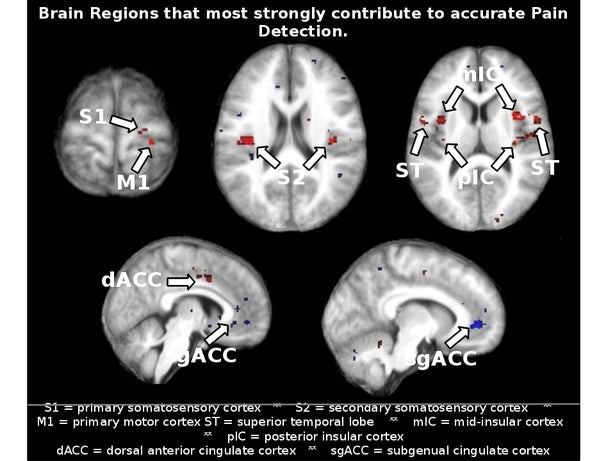
Pain must be the bane of many a doctor's existence. It's a major symptom and indicator of many illnesses, but doctors have to rely on humans to describe and rate it, and humans are a distinctly unreliable source of information. What's a "7" on the pain scale for someone might be a "4" for another. What's a "pulsing" pain for someone might be a "pounding" for someone else. At Stanford, some doctors are figuring out the first steps to objectively measure pain, finally putting that all to rest.
A new, very early version of a "painometer" is being tested at Stanford. The tests are actually sort of medieval-sounding, but to test pain, you've got to inflict pain. Subjects were touched with a heat probe (on the arm, people) and the ensuing brain signals were measured. Those measurements were used to create an algorithm that, the researchers hoped, would be able to indicate pain.
The algorithm does work, though not perfectly; the current accuracy rating is around 81%, which is plenty to show that it works but also not nearly high enough to actually rely on. The other major problem is the relative lack of understanding we have about the nature of pain: this test, says Sean Mackey, an associate professor and member of this project's team, only measures "thermal pain" in a lab setting, and "We should take care not to extrapolate these findings to say we can measure and detect pain in all circumstances."
Still, it's a major step forward to creating a real, objective pain sensor, which could have some pretty major effects on diagnostic medicine, as well as helping those who are too young, too old, or otherwise unable to properly communicate their degree of pain. Then we can get back to making pain medicine out of sea-snail spit and marijuana.
Five amazing, clean technologies that will set us free, in this month's energy-focused issue. Also: how to build a better bomb detector, the robotic toys that are raising your children, a human catapult, the world's smallest arcade, and much more.


Online Content Director: Suzanne LaBarre | Email
Senior Editor: Paul Adams | Email
Associate Editor: Dan Nosowitz | Email
Assistant Editor: Colin Lecher | Email
Assistant Editor: Rose Pastore | Email
Contributing Writers:
Kelsey D. Atherton | Email
Francie Diep | Email
Shaunacy Ferro | Email
"Painometer"? Just to stop it from sounding so childlike, why not go Greek and call it an "algometer"?
This is a wonderful idea, another thing I would look forward to seeing a way to measure someones eyesight other than based on their description. To be honest, half the time when my optometrist says 1 or 2, sometimes I pick the wrong one and then either I feel to stupid to say anything or I will have to make him go back really far to figure it out.
While I realize this is a stupid problem, for someone who has -13.75 -14 eyes, this is a big deal
With this breakthrough they can finally tell people that their pain is not adiquit to have medical marajuina. A great day for science indeed.
@Ignorantiam...
Maybe this will also debunk the nut jobs that think that cell phones and iPads are causing them pain too.
@Shakouhousha
Pain is subjective because it's based on hearsay. On the extremes people in excruciating pain with high tolerance can claim to be in no pain, and people looking for attention can claim to be in excruciating pain and have none.
The only way to measure pain is through brain signals that are universally translateable for anyone to properly gauge how much pain someone is in, regardless of their reaction.
As for things like eyesight and hearing, they are already objective as the quantitative measures for them are sufficient for accurately determining your sonic sensitivity and visual acuity.
In other words, your eyes aren't that bad because someone else says so. They just are.
What you wish for is better sight.
As a physical therapist, I would gladly welcome an accurate, unbiased pain rating. Pain is entirely subjective and a patient can easily give an inaccurate score either through a simple misunderstanding of the scale or even an ulterior motive. If you've got better things to do than go to PT, tell your therapist that your pain is a 1/10 and you're ready to be discharged; not ready to go back to work or want sympathy from your family and friends, say your pain is 8/10 and its just not getting any better.
Now don't misunderstand me, both of these circumstances are more rare than one would think. An objective measurement of pain could be a crucial tool in providing the proper type and amount of care to our patients. 'A few weeks ago your pain was a 5.75/10 and today it is a 4.92/10. It appears the new treatment techniques are working.'
On the other hand, it would give Medicare, Medicaid and insurance companies another reason to deny treatment without actually knowing anything about the patient.
How about a verbal abuse-o-meter?
@Ignorantiam and phoenix
no matter what the machine says these people will insist it is wrong.
This is interesting. However, it worries me that an objective measure of pain will minimize the importance of patient report. I would suggest that fMRI is measuring nociception but not "pain". Pain is the interpretation of the signal and it is colored by the meaning that sensation has for the patient (eg. will it go away and life will return to normal, does it mean the loss of income or a loved hobby, does it indicate disease progression?)
There are examples in studies of sleep disturbance where the subjective measurement and the objective measurement do not fully agree. Which is right? I say the patient report is the gold standard - it's their personal experience. If the objective measure doesn't match the subjective report then it's not measuring the right thing. It may be measuring something closely related which can be helpful in understanding the biological mechanism but ultimately pain is what the patient says it is.
Having both severe Fibromyalgia and Widespread Myofascial Pain Syndrome trigger points I really hope this tech advances quickly. Just finding out what was wrong was a very long process, with my initial doctor not believing anything was wrong with me as Most pain related health issues are very poorly understood within the non-specialist field world wide.
I have actually dealt with a family doctor that honestly believes and preached that fibromyalgia doesn't exist and is an entirely made up disease.
As with many other patients i was first given antidepressants to "treat" my fibromyalgia, and was told to "stick with it another week" over and over, doctors will put you through torture with drug trials in order to avoid the use of narcotics. If this tech could identify how the pain is being felt, perhaps it could direct the doctor to properly chose the correct prescription in the first place... especially when a lot of those drugs are NOT covered by many drug plans... muscle relaxers for instance are not covered by many private and government provided plans as "they aren't proven to do anything".
if this was a viable diagnosis tool when my pain was becoming too great and forcing me to go to my doctor it would have saved my a ton of cash and 2years of my life.
cheers, eh
@pallitive nurse
well recent medical reform requires a good deal of patient report as well as a rateing of pain under a consistant basis so i dont see that going away any time soon. but this might discourage pain medication addicts from clogging up the emergancy rooms so people that are actually sick or in pain can be seen in a reasonable time