Quantum Dot Thermometers Take the Temperature of Individual Living Cells
Next time you take your temperature, maybe think twice about its accuracy. Despite what the mercury says, not all of...
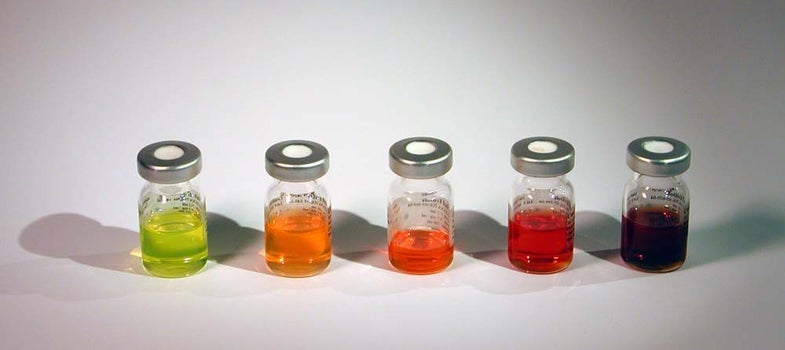
Next time you take your temperature, maybe think twice about its accuracy. Despite what the mercury says, not all of your cells are really at 98.6 degrees, scientists reported in a new study. Using nanoscale thermometers, researchers have shown for the first time that living cells can exist at different temperatures. Busy sections are warmer, and less-active ones are cooler.
Scientists know plenty about what happens inside a living cell, from the chemical reactions to the physical changes that take place, but information about cell temperature has been sorely lacking. This is a curious problem, because temperature is one of the most important physical factors involved in a chemical reaction, explains Haw Yang, a researcher at Princeton University. Understanding temperature variations could go a long way toward illuminating cellular action, protein use, even diseases.
A myriad of chemical reactions take place inside every cell, and some of those transactions produce excess energy. Active cells may discharge some of this energy as heat, Yang and colleagues say. Other cells may have warmer regions, where mitochondria — cell power plants — are busy producing energy.
So it makes sense that cells would have variable temperatures, but researchers have not been able to measure this. To do it, Yang and Liwei Lin at the University of California-Berkeley used nanoscale thermometers, in the form of quantum dots. The dots are wee semiconductor crystals that change color as temperature changes, Yang explains in a news release from the American Chemical Society. The dots, in this case made of cadmium and selenium, emit different wavelengths of light depending on the temperature.
They inserted the dots into some mouse cells growing in lab dishes, and found the cells’ temperatures were different in some regions. Yang and colleagues stimulated cellular activity to watch the changes, and reported a difference of a few degrees Fahrenheit — a pretty big difference. They don’t have enough data to give an exact number, however.
The temperature changes could have major impacts on how cells work and survive, Yang says. Increases in temperature could affect how genes work, for instance, and how protein is manufactured and used. Beyond that, temperature differences could even serve as some form of intercellular communications system, Yang says. The team is now trying to figure out how cellular temperature is regulated.
The research was presented at the American Chemical Society’s annual meeting, in Denver this year.
[via PhysOrg]