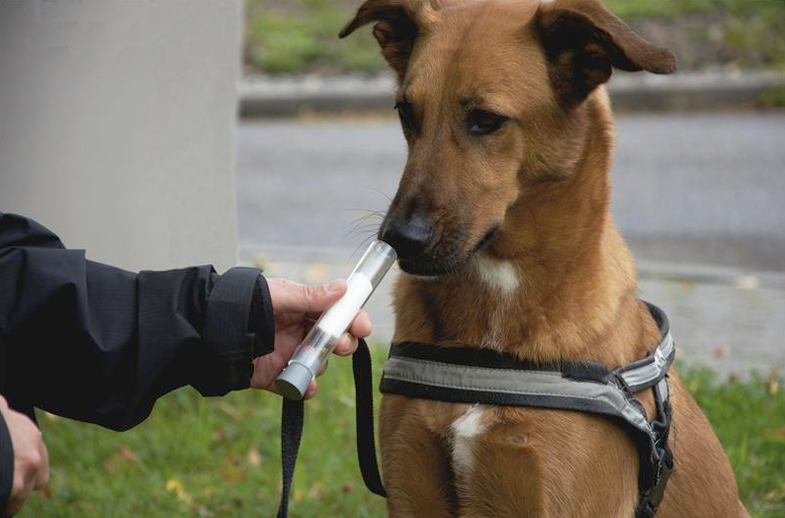
A dog can accurately detect the early presence of lung cancer by sniffing patients’ breath, doctors in Germany say. While researchers have known for some time that dogs can sniff out the telltale signs of other forms of cancer, this is the first study that proves dogs can reliably smell this particular kind.
This is a breakthrough for lung cancer researchers who have been trying to figure out if there are specific volatile organic compounds associated with the presence of the disease. The dog study suggests that there are.Researchers at Schillerhoehe Hospital in Germany worked with specially trained dogs who were asked to smell the breath of 220 volunteers. The group included healthy patients, as well as people with lung cancer and chronic obstructive pulmonary disease. The dogs correctly identified 71 positive lung cancer samples out of a possible 100, the researchers write in the European Respiratory Journal. They also correctly identified 372 non-cancerous samples out of a possible 400.
What’s interesting about this is that the dogs were able to detect cancer even in the presence of other factors, like tobacco smoke and COPD. Current lab tests for lung cancer can't do this. This suggests that there is indeed a VOC associated directly with lung cancer, which can be detected — at least by a dog — even in the presence of other compounds.
VOCs are emitted from the surface of cells as they undergo tumor-induced gene and protein changes. Identifying the VOCs that certain cells make can go a long way toward early diagnosis, when a scan might not be able to detect anything.
Other researchers have been working on lab chips that can make the same diagnosis, without using dogs. Israeli researchers reported last year that their gold nanoparticle e-nose could differentiate among lung, breast, prostate and colon cancer — by differentiating among the VOCs.
But as we’ve seen before, sometimes dogs are simply the best sniffing technology out there. The Defense Department figured this out after spending billions of dollars on research. This new study suggests that doctors may be learning the same thing.
Five amazing, clean technologies that will set us free, in this month's energy-focused issue. Also: how to build a better bomb detector, the robotic toys that are raising your children, a human catapult, the world's smallest arcade, and much more.


Online Content Director: Suzanne LaBarre | Email
Senior Editor: Paul Adams | Email
Associate Editor: Dan Nosowitz | Email
Assistant Editor: Colin Lecher | Email
Assistant Editor: Rose Pastore | Email
Contributing Writers:
Rebecca Boyle | Email
Kelsey D. Atherton | Email
Francie Diep | Email
Shaunacy Ferro | Email
This tells us two things.
1: Dog noses are incredible!
2: Cancer could be detected from simply analyzing a person's breath.
It shouldn't be that hard to corroborate breath scans with these dogs to isolate the chemicals. The article says this has happened already with a few cancers, let's hope work continues.
Now i wont just need a C(a)T scan i will need a Dog scan too i wonder how much that will cost!
Prior to the 20th century and the widespread availability of microscopy and fast testing, field medicine depended on diagnosing pathology on the basis of the odor. Medical students used to smell and distinguish between the various odors of bacteria as part of their clinical training. That's no longer true, of course. But the olfactory distinction of disease was well known, in the past. Another back to the future moment.
About the only vestige of that legacy you can readily see in old movies where doctors decide whether to amputate based on the smell of a wound. The science of smelling disease actually was much more advanced than that in the past. But it has since been forgotten. Until recently.
Yeah funny, I'm sure corporations are hard at work developing cancer sniffing machines to do the same thing dogs can do for practically nothing. It's just like the multi million dollar machines that are used to scan people by the TSA. Dogs could be employed to do that job too at a much lower cost. But heaven forbid corporations can't profit from sniffing for cancer or examining your body for weapons. A few people made a small fortune off that contract.
My wife owes her life to our Jack Russel Terrier. She received her annual mammogram, and ultrasound (3) weeks before, which the results had been negative. While she was lying on the couch reading, our Jack Russel was lying on the top of the back cushion above her. The dog jumped down on her chest, and started sniffing, then made pawing movements on her chest, causing her quite a bit of pain. The next day she scheduled an examination, believing she had received a bruise or hemotoma. As it worked out, it was a level 3 rapid growing, breast cancer tumor. My wife is a 12 year cancer survivor, and we are fortunate to still have our beautiful, loving, Jack Russel to whom we both are eternally great full!
Wow I am amazed at your story.
We should definitely push this into mainstream medicine