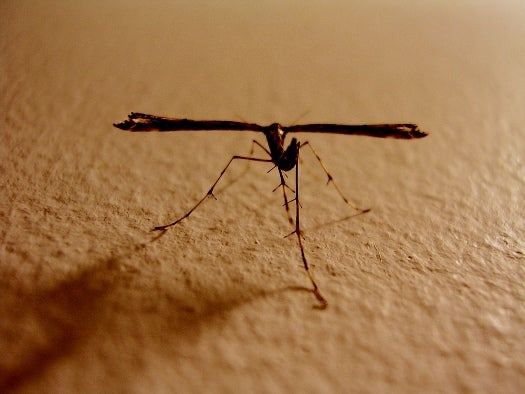
Researchers are testing a potent new tool in the fight against malaria: dirty socks. Experiments are underway in three villages to see if smelly socks can lure mosquitoes into poisoned traps as effectively as synthetic chemical baits that can be expensive and complicated to mix. If so, good old fashioned human stink could become a key tool for curbing malaria infections.
It turns out mosquitoes--the number one carrier of malaria, which kills something like 900,000 people per year--love smelly socks. Previous studies have shown that synthetic, chemically-derived bait is more attractive to mosquitoes than human bodies (up to the point the mosquitoes realize there’s not a meal in it for them), but smelly socks could be just as effective as the synthetic bait. This is the first time a study has pitted human odor and chemical bait against each other in the field, and the results could change the conventional ways authorities fight the infection in malaria-prone regions.
The experiment is pretty straightforward: Three different villages have deployed three different kinds of traps--one with synthetic bait, one containing dirty socks worn for a day by adults, and one containing cotton pads worn inside the socks of schoolchildren for a day. Researchers will simply compare the number of mosquitoes caught and killed by each method.That previous research showed that synthetic bait attracts four times as many mosquitoes as the human body does, and if the socks or sock pads work anywhere nearly as well they could significantly boost the number of traps a given village or community could deploy to defend residents from potential malaria threats (the sock pads are the preferred method, since people wouldn’t have to give up their socks to arm the traps). Modeling shows that the smelly sock traps--if they prove to be effective--could reduce malaria infections in a given region by 20 percent.
[WaPo]
The incredible innovations, like drone swarms and perpetual flight, bringing aviation into the world of tomorrow. Plus: today's greatest sci-fi writers predict the future, the science behind the summer's biggest blockbusters, a Doctor Who-themed DIY 'bot, the organs you can do without, and much more.


Online Content Director: Suzanne LaBarre | Email
Senior Editor: Paul Adams | Email
Associate Editor: Dan Nosowitz | Email
Assistant Editor: Colin Lecher | Email
Assistant Editor: Rose Pastore | Email
Contributing Writers:
Kelsey D. Atherton | Email
Francie Diep | Email
Shaunacy Ferro | Email
hmm... they may yet be on to something.
The picture is a moth and not a mosquito. Anopheles mosquitoes (the malaria carriers) rest with their wings over their abdomen like all mosquitoes. The other dead giveaway is the spines on the legs. It's probably some sort of pyralid moth. Mosquitoes don't hold their abdomen that way either, typically it is held straight and that one is clearly curved.
The most obvious evidence is the presence of two pairs of wings (you can make them out by following the edge). True flies (such as mosquitoes) only have one pair (the second pair evolved to halteres.
@tickparasite:
I only see one pair of wings, some types of mosquitos DO have spines on their legs, and not only is the body too thin, and the antennas the wrong shape to be a moth, but some mosquitos (I've seen the myself, I know this) have abdomens that curve up.
and if it JUST landed, then the wings would be still out.
not to mention that, while feeding, some mosquitos hold their wings away from their body.
the picture that goes with the article doesn't have to be a malaria carrying mosquito, it just has to be a mosquito.
This is definitely not a mosquito. I've worked with mosquitoes for over ten years, have a medical entomology degree and ran a mosquito control agency. I tell you it is some kind of moth.
The leg spines of mosquitoes are greatly reduced or absent. These are much much too long. Look at the trailing edge. It isn't a smooth curve. The edge of a mosquito wing is. That is a second wing close to the fore wing. Many insects link them closely together with a row of bristles (frenulum). I agree that it doesn't have to be an anopheles mosquito, but it shouldn't be a moth. Most other mosquitoes do not have patterned wings (Anopheles do).
Moths can have antennae like this and for the record I have a masters and Ph.D in medical entomology. I have also never seen a mosquito with an abdomen curved up like this even after emerging from the pupa. This behavior is very common in moths.
I was wrong about the family of moth. It isn't a pyralid it is a plume moth (Pterophoridae). Look it up and you will agree that the picture is of a moth.
Wasn't this an episode on married with children?
I see. but it would seem that the coloring is still wrong.
I have found that my motorcycle helmet was a great mosquito hangout, especially after riding on a hot day.