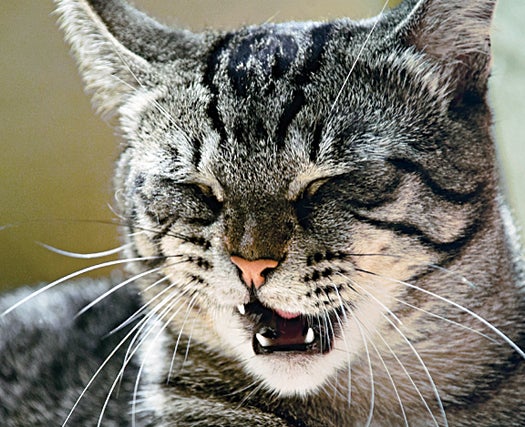
Cats get seasonal allergies to pollen and grass, and some have year-round allergies to fleas and dust mites. Sandy Willis, a veterinary internist who advises the American Veterinary Medical Association, says that when cats interact with an allergen, their body sends immunoglobulin E antibodies to link with it, triggering the release of histamine and other chemicals that cause itchy eyes, runny noses, sneezing, hives and rashes.
The same process happens in other pets (dogs, rats, hamsters) and humans. In rare cases, cats can even be allergic to people. People allergies are uncommon, since we bathe more often than most other species and don’t shed as much hair and dead skin—which trigger our own allergies to pets. When cats do have a bad reaction to us, it’s usually caused by residue from our perfume, soap or laundry detergent. Any water-based cleaning product usually contains some preservatives. Cats tend to be more sensitive to chemicals than dogs. Specific chemical allergies are difficult to isolate and diagnose, so pets can’t be vaccinated for them or build up their tolerance with exposure like they can for organic allergies.
Cats can even be allergic to other pets. Vets offer antihistamines for dogs to treat cat, horse and bird allergies. Cat antihistamines recently hit the market too.
The incredible innovations, like drone swarms and perpetual flight, bringing aviation into the world of tomorrow. Plus: today's greatest sci-fi writers predict the future, the science behind the summer's biggest blockbusters, a Doctor Who-themed DIY 'bot, the organs you can do without, and much more.


Online Content Director: Suzanne LaBarre | Email
Senior Editor: Paul Adams | Email
Associate Editor: Dan Nosowitz | Email
Assistant Editor: Colin Lecher | Email
Assistant Editor: Rose Pastore | Email
Contributing Writers:
Kelsey D. Atherton | Email
Francie Diep | Email
Shaunacy Ferro | Email
I guess the artical is public awareness of a new product for cats " Cat antihistamines ". Alrighty then.
This poorly writen "article" ( I wouldn't call it that) seems to suddenly end, fizzle away in a half assed one line (almost two in a half width format) paragraph that is unfinished in its own right.
Go ahead Popsci.. you can now fire Lazy Lizzie... who's officially an author imposter!
one case where you SHOULD quit your day job...
cheers, eh
@ptv83: I believe the point of this "article" is stated in the headline "FYI". So, I'm assuming the author has no need to go into depth as its simply a "mater-of-fact" topic. A "real" article could have cited case studies and elaborated on the preservative chemicals found in soaps, perfumes and laundry detergents and perhaps explained why the topic focused specifically on cats.
That's so sad. My cat died of allergies. I was on my way to the drug store to get some Benedril. I left the radio on while I went inside so that my pet dog would have something to listen to. Well, that ran the battery down, so I had to call roadside assistance. They showed up to give my car a jump, but in the process they let my dog out of the car. So then I had to chase the dog, but he was running too fast, so I stole a moped that was parked at the coffee shop. I was able to catch up and retrieve the dog, but the moped ran out of gas, so I called a taxi. Well, I didn't know that the taxi driver wasn't actually a taxi driver, but a car thief. He hit me over the head and robbed me. As a result, I ended up in the hospital for two weeks with amnesia. I got better, but no-one had bothered to feed the cat.
To rettaH_daM:
Just an FYI...your cat died from starvation NOT allergies