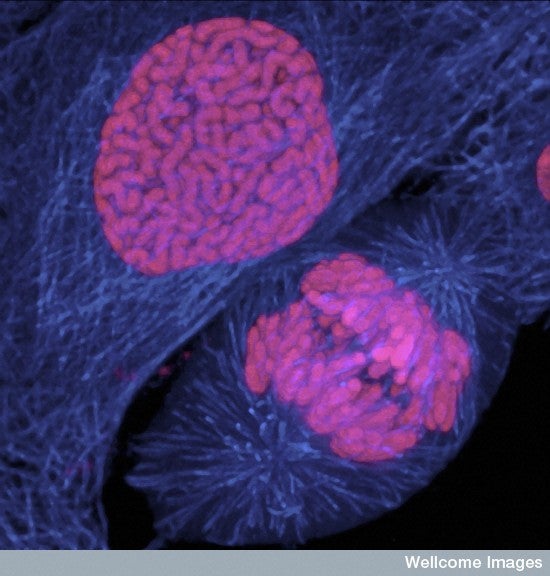
Breast Cancer Cells Dividing This confocal micrograph shows two human breast cancer cells dividing. The cell at the top is at prophase, showing the condensing chromosomes prior to their separation. The cell at the bottom is in anaphase, where the chromosomes are in the process of pulling apart. Wellcome Images

Cancer patients may feel like they have alien creatures or parasites growing inside their bodies, robbing them of health and vigor. According to one cell biologist, that’s exactly right. The formation of cancers is really the evolution of a new parasitic species.

Just as parasites do, cancer depends on its host for sustenance, which is why treatments that choke off tumors can be so effective. Thanks to this parasite-host relationship, cancer can grow however it wants, wherever it wants. Cancerous cells do not depend on other cells for survival, and they develop chromosome patterns that are distinct from their human hosts, according to Peter Duesberg, a molecular and cell biology professor at the University of California-Berkeley. As such, they’re novel species.

He argues that the prevailing theories of carcinogenesis, or cancer formation, are wrong. Rather than springing from a few genetic mutations that spur cells to grow at an uncontrolled pace, cancerous tumors grow from a disruption of entire chromosomes, he says. Chromosomes contain many genes, so mis-copies, breaks and omissions lead to tens of thousands of genetic changes. The result is a cell with completely new traits: A new phenotype.

Cancer as evolution in action, which represents a fundamental re-thinking of the disease, has been proposed before — evolutionary biologist Julian S. Huxley first described autonomously growing tumors as a new species back in 1956, according to a Cal news release. But the prevailing view has long been that cancer is the result of genetic mutations.

Oncologists and pharmaceutical researchers are studying ways to find and block those mutations, aiming to turn off the switch that sparks carcinogenesis. But gene therapy has largely failed to deliver many meaningful results.

Duesberg argues, controversially, that it's misguided. Chromosomal mutation, called aneuploidy, is the cause instead, and it destabilizes chromosomal patterns. Some of the disrupted chromosomes are able to divide, seeding cancer. The result is a new chromosomal pattern that is distinct from our own. The Cal news office explains this in much greater detail.

Duesberg said he hopes this theory will spark new types of cancer diagnosis and treatment. Chromosomal tests could potentially pick out aneuploidy very early, before the damaged chromosomes have had a chance to divide, for instance. And new treatments could target the chromosomal disruptions, rather than knocking out or switching off genes.

32 Comments

I'm surprised at the lack of comments here. If cancer does qualify as a new species, think about what that means:

It's the first time in the 200 years since the idea was offered that we have actually witnessed the emergence of a new species from mutation.

Even with their staggering numbers of generations, not even malaria and HIV have been able to give us a new species.

lulz.

CANCER.

What a pathetic offering.

to say that a parasitic species evolves from its host is an interesting concept to me. I think more people should look in this direction

Given the timeline you'd expect to see hosts evolve from parasites.

I would argue that all life on earth could be seen as species evolving from its host, which is the planet itself.

Great. The "Humanity is a cancer trope" -extended to every living thing on the planet.

Newly evolved species that evolve in almost every single species of mammals? HIGHLY improbable. Not impossible, of course, but extraordinarily unlikely. I'd say the complete opposite theory that I saw floating around several months ago is more viable, in that cancer is a throwback to proto-multi-cellular creatures, and that the mutations that cause it simply knock out the more advanced adaptations we have that make us more complex.

My point is that cancer-as-a-parasitic-new-species is much less complex than a human and it doesn't fit the complexity and beauty of "cutting-edge" nature. If anything, this would be a de-volution.

Reading from Science Digest: "....The number of bacteria living within the body of the average healthy adult human are estimated to outnumber human cells 10 to 1. Changes in these microbial communities may be responsible for digestive disorders, skin diseases, gum disease and even obesity. Despite their vital imporance in human health and disease, these communities residing within us remain largely unstudied and a concerted research effort needs to be made to better understand them, say researchers June 3 at the 108th General Meeting of the American Society for Microbiology in Boston....."

@anotherjarvi: "It's the first time in the 200 years since the idea was offered that we have actually witnessed the emergence of a new species from mutation."

That is so incorrect. We've witnessed flies trapped in newly-built subway tunnels evolve into new species. We've also witnessed (through experimentation) a population of bugs with access to apples and a population of bugs with no apple access evolve into different species as well.

"Species" itself is a very arbitrary term. It can mean many different things depending on your perspective and the organism at hand. In addition, every definition of "species" is a relative term: it depends on comparing two organisms to each other and saying "these are the same species" or "these are different species".

Nature sees no distinction between species. They're just a way for humans to organize the information about the biological world.

-IMP ;) :)

It's funny that for what I said to be wrong the word "species" has to be arbitrary. My point is that what's infecting millions of people around the world after relatively huge numbers of mutations and hundreds of millions of generations *per person* is still HIV and Malaria. These two should be evolution's superstars. By Science's reckoning there are far, far fewer generations and mutations between humans and anything else that you and I would both agree are a separate "species". What has emerged from these two is.....nothing that resembles anything other than the specific parasite and virus that they are.

Wife and I have been battling Stage 3 cancer for years...I hope they find do,something that can help.

I read that there was a guy in the early 1900 that said cancer is a nutritional deficiency. It seemed pretty credible. He said the body was lacking B-17. You can get it called laetrile, but strangely you can not buy it in the US. Conspiracy? maybe. Do a search on B17 or laetrile, interesting stuff.

IT is interesting that cancer can successfully become a parasite in certain species such as dogs and hamsters when transmitted across species. Rather a peculiar case of an infection. A hard case to argue if its the fault of the immune system of dog/hamster which could not defend the cancer cell, or the successful adaptation of the cancer cell to skip through the firewall - Probably both.

I wonder if there is already a karyotype different cell existing inside the host such as RBC or giant cells or any other sort of mature-differentiated cell type? I guess you would go ahead and say that its a parasite existing in harmony. I guess that definition works...

Interesting developments for drug targeting to prevent the roots of karyotype changes instead of mutation.

TJ
Keep Grinning

I heard it said that by all the over farming, the farm land is mineral and nutrient deficient and so goes our current food, which is the reason for the increase of all human health problems.

My hearts and prayers goes out to the people who have cancer or a family member. A few months ago, my mother left towards heaven do to lung cancer. May God Bless You, Protect You and Your Life Is Filled With Much Happiness!

I like how someone is thinking outside of the box on this. But I think cancer is a new species is B.S. Cancer is the result of our own DNA breaking down as we age.

@BubbaGump - Our vegetables and fruit are more nutritious now than in the past, so that theory does not hold any water.

If I had to guess why more people were getting cancer now is because people are living longer due to better medical care. You have to die from something, less people are dying from treatable diseases, so that means more people will die from difficult to treat diseases like cancer.

@hickey10. I see you point completely. Rather than someone falling over dead from a heart attack or quickly been over ridden by disease or cancer in the past, today's science can deal with these things as they develop. Your right, by the time you die of old age, you body will have many things wrong with it, just prior to you death.

Here is a interesting link, talking about the plus and minus of current nutrition in fruits in vegetables. The argument does go both ways...

http://nutritiondiva.quickanddirtytips.com/are-fruits-and-vegetables-getting-less-nutritious.aspx

anotherjarvi
07/27/11 at 6:11 pm
"Great. The "Humanity is a cancer trope" -extended to every living thing on the planet."

I didn't say humanity is a cancer. Just stating that as an external environment plays a role in an organisms evolution, the planet itself can be viewed as a host on which life evolved. Besides, unless you're photosynthesizing, your behavior as a human is that of a consumer of the planet's resources, which one could view as parasitic.

The current views of life have barely scratched the surface of what's waiting to be discovered. We've categorized the world around us to make it easier for members of humanity to begin exploration of the mysteries of reality... Don't confuse that with knowing what existence actually *is*.

Are you suggesting: ".....the Earth is GIA. A living life form of itself and we are all part of GIA...."

Anything is possible...

@rolloutthebarrel, saying '... Anything is possible...' well that is just a fun or funny thing to me. I wonder if you repeat that same quote to me in the future, should you ponder some of my comments on this site so far. But, anyways, I wish you a HAPPY GIA DAY! There must be at least one holiday for GIA, don't ya think!

re: rgetty

Please, before you kill some ignorant and trusting individual, do a modicum of due diligence before posting.

www.wikipedia.org/wiki/Amygdalin

Since the early 1950s, a modified form of amygdalin has been promoted under the names laetrile and "Vitamin B17" as a cancer cure, but it is not a vitamin,[3] and studies have found it to be ineffective and potentially toxic[4][5][6] as a possible cause of cyanide poisoning.[7] The promotion of laetrile to treat cancer has been described in the scientific literature as a canonical example of quackery,[8][9][10] with Irving Lerner of the University of Minnesota describing it as "the slickest, most sophisticated, and certainly the most remunerative cancer quack promotion in medical history."[3]

Really now.. Then, surely we can cure it using some kind of drug..
shawcapitalmanagement-news.com

@ rolloutthebarrel and anotgherjarvi, i agree with rolloutthebarrel in the fact that we are parasites.... call it whatever you want, i dont see primates going about and gouging huge holes in the surface or the planet, or putting dangerous chemicals into teh enviroment, yes we may be living and thriving, but thats what parasites do, untill they kill there host, then the parasite dies as well unless another host is found, colonised and exploited for its valuables. watching discovery channel one day, found out that by 2050 mankind will have wiped out 90% of all other species on that planet (im assuming that doesnt include bacteria, virus, etc) because of this like destroying habitats, pollution, and global warming (yes i realize global warming is a natural proccess).

so we may be classified by deginition as mammals, but by action we are parasties. and actions speak louder then words.

Duesberg is the same guy who vehemently argued that HIV does not cause AIDS. I am trying to help my beloved, scrappy dog fight cancer. Is my time being wasted right now with this article and this discussion? I went to U.C. Berkeley, and I know to question professors there. Duesberg exercised his right to publication without peer review and probably caused undue denialism of HIV as the cause of AIDS. How is it that there are only three known types of transmissible cancer if this theory is correct? Many of us have been around loved ones with cancer. Wouldn't we know by now if it was transmissible?

I'd like to add that the three known parasitic or transmissible cancers are relatively rare cancers found in Tasmanian devils, hamsters, and dogs. The parasitic cancer in dogs is called CTVT - Canine Transmissible Venereal Tumor. My dog has lymphoma, one of the most common cancers in dogs. As far as I understand it, Duesberg's research is only relevant to these rare forms of cancer. I could be wrong. And if the history of Duesberg's theories tell us anything, he could REALLY be wrong.

I'd say the complete opposite principle that I saw floating around several months ago is a lot more viable, because cancer is a throwback to proto-multi-cellular creatures, and that the actual mutations that create it simply bump out the heightened adaptations we now have that make us more complex.

To those battling cancers - please consider insulin potentiation therapy. Of all the quackeries and semi-poisonous remedies out there, this is the most solid.

There's a doctor in Mexico whose family invented it, but you don't need to go there. IPT should be doable with the help of suitable qualified medical personnel - existing or expired patents in the field do a good job of describing the administration protocols.

I've linked a document in an idea filed on this website:
http://www.halfbakery.com/idea/Cancer


June 2013: American Energy Independence

Five amazing, clean technologies that will set us free, in this month's energy-focused issue. Also: how to build a better bomb detector, the robotic toys that are raising your children, a human catapult, the world's smallest arcade, and much more.


Online Content Director: Suzanne LaBarre | Email
Senior Editor: Paul Adams | Email
Associate Editor: Dan Nosowitz | Email
Assistant Editor: Colin Lecher | Email
Assistant Editor: Rose Pastore | Email

Contributing Writers:
Rebecca Boyle | Email
Kelsey D. Atherton | Email
Francie Diep | Email
Shaunacy Ferro | Email

circ-top-header.gif
circ-cover.gif
bmxmag-ps