It's Getting Hot in Here Berkeley Lab via IOP

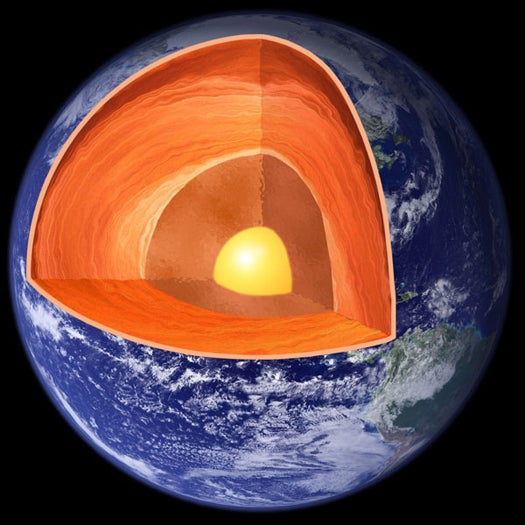
Scientists measuring the subatomic particles flowing from Earth’s interior have taken the most precise measurement ever gathered of the home planet’s radioactivity. It turns out nearly half of the Earth’s total heat output comes form decaying radioactive elements like thorium and uranium in the Earth’s crust. But that’s an answer that begets more questions.

Previously, there were varying theories on just how much of the Earth’s heat came from radioactive decay, with many--accurately, it would seem--placing that value at about half of the roughly 40 terawatts of heat produced by the Earth. That heat drives convection currents in the outer core and give us our magnetic field, among other natural processes (tectonics come to mind).

The measurement was taken at the KamLAND detector in Japan, which has been tallying up the flux of antineutrinos flowing outward from the inner Earth since 2005 (it takes a while to gather a meaningful quantity of antineutrinos). And, as usually happens, the answering of one question leads to many more.

For instance, we now know that radioactive decay accounts for half the Earth’s heat. But what of the other half? Some can surely be accounted for by what’s called primordial heat--heat leftover from the Earth’s violent formation. But whether or not that could account for all of that remaining 20 terawatts is unknown (and some think unlikely).

So even though we now have a pretty good handle on how much heat comes from radioactive decay, we still have plenty of questions about the Earth’s makeup that need answering. Feel free to theorize in the comments below.

[Physics World, New Scientist]

22 Comments

My question would be: How long before the Earth's nuclear fuel depletes to the point the dynamo driving the core shuts down? Will it be before our sun goes red giant?

Durge say it's stuff rubbin on other stuff.

Durge is probably right... I think its pretty obvious the solid core of the planet is layered. Iron probably only makes up the outer "crust" of the core, deeper inside is likely heavier elemnts producing the radioactivity. These layers might be moving over each other creating heat... The molten outer core is probably creating heat as it moves across the inner core... the crust is probably creating heat as it moves across the outer core...

But with a planet as old as this one I wonder what elements might be in the core still kicking off that much radioactivity. Nothing heavy enough to be that "deep" has a half life long enough to still be kicking (unless I'm wrong, please enlighten me). Which might suggest some form of fusion taking place, producing a constant, self replenishing supply of unstable (read: radioactive) isotopes. That ability to self-replenish might degrade over time, leading to the eventual "death" of a planet, but it just might be possible, and that very process of "fusion" (or even fission) might be creating all that extra heat.

Well whatever energy dissipates from the radioactive core over time I'm sure mankind can make up the difference with global warming!

@democedes - Thorium-232 has a half-life of about 14 billion years, so only a small fraction of the thorium present upon the formation of Earth has decayed. There will still be oodles of thorium present by the time the sun goes red giant on whoever or whatever is still occupying the plant at the time.

@ semaj001 and democedes:
That being said, all the Thorium-232 here on this planet would decay into nothing at roughly the same time, unless Thorium-232 is still being produced, or some was produced after the first batch was.

Note: I may be misunderstanding what a half-life is. As I understand it, it's the time measurement of how long it takes an element undergoing radioactive decay to reduce to half the original amount. If I'm right, then the element wouldn't be able to decay anymore. Example of my thinking:
64 atoms of Uranium 238: 64-32-16-8-4-2-1-.5 atoms. I don't think you can slit an atom in half. Please correct me if I'm wrong, as I probably am.

Hethos - I believe that the half-life of thorium-232 being 14 billion years would render 64 atoms to 32 atoms in that time. Then another 14 billion years to reduce to 16.

Hethos, you are right. You don't understand what a half-life is. It is how long it takes for half the isotope to decay. Then you have half left, so one more half-life later, you have 1/4 the original amount, one more half-life you have 1/8th the original.

Has anybody figured out how much heat is caused by the flexing of the earth caused by the moon's gravity?

So we have a lava lamp nuclear reactor where the hot stuff flows to the center (low gravity) of the earth and the cool stuff sinks to the crust (high gravity).

This means that there must be some stratification of metals in the lava soup like a planet size centrifuge. Some where there is a layer of thorium, iron, silver, gold, lead, uranium and plutonium.

We have known for years that the east cost of the United States has decay heat a few hundred feet down.

This would be a great new scare theme for a James Bond story, where Dr. Evil places a buried neutron bomb off which caused a nuclear volcano to form from the neutron power peaking of the naturally occurring plutonium layer.

I have a question.
Isn't it that the innermost core of planets and stars have no gravity?

How can sun produce fusion?

GO NUCLEAR! What's wrong with a little radio active material? The Earth is made of the stuff! :D

Trescend -
While it is true that the center of stars and planets lies at the bottom of the gravity well, that point is irrelevant to fusion.

What causes fusion is the intense heat and pressure caused by all of the matter that is NOT in the center trying to GET to the center (trying to fall). Basically, the center of the sun is experiencing the weight of 700,000 km of hydrogen. The resulting pressure and temperature is sufficient to cause fusion.

Has anybody ever thought that the earth could be an old star that condensed itself under particular circumstances ?

The equations of electrostatic force and gravitational force are similar. The equations have the same form, but each term has a different meaning.

Electrostatic force (Coulombs Law):
F = (C*q1*q2)/(r^2)

F = Force
C = Electrostatic Constant
Q1 = Charge 1
Q2 = Charge 2
R = Distance between each charge

Force of gravity (Newton’s Law of Gravitation):
F = (G*m1*m2)/(r^2)

F = Force
G = Gravitational Constant
M1 = mass 1
M2 = mass 2
R = distance between each mass

For multiple objects, the total force on one object is the sum of the forces from each other object.

Similar equations give the electric field and gravity field at a point in space:

Electric Field = The sum of: C*q/(r^2) for each charge and distance.

Gravity Field = The sum of: G*m/(r^2) for each mass and distance.

Gauss’s Law states that the flux of the electric field through a closed surface is equal to the net charge within the closed surface. By applying Gauss’s Law to symmetrical surfaces, some conclusions are made (Fundamentals of Physics, 3rd Edition, Page 581, Section 25-11):

“A uniform spherical shell of charge behaves, for external points, as if all its charge were concentrated at its center.”

And:

“A uniform spherical shell of charge exerts no electrical force on a charged particle placed inside the shell.”

This is related to how the electric field inside a conductor is zero (at equilibrium) and how a Faraday Cage protects its interior from electric fields.

Similar equations using the gravitational field will show that a massive spherical shell will not contribute to the gravitational field inside it.

These reasons show that the gravitational field of a solid decreases when going from the surface to the center. This means that the gravity at the center will be very low.

An integral equation of calculus should be able to show the gravitational field as a function of radial position for a solid sphere. The magnitude is expected to increase from zero at the center to a maximum value at the surface. Beyond the surface, the magnitude decays proportional to the inverse square of the distance from the center. I wonder about the equation of this curve from the center to the surface of a uniform solid sphere. It has been a while since calculus class! Also, I wonder about the shape of this curve for the Earth, either based on theory or measurements.

Thanks,
-Tony

Come on people, it's the moon. The gravitational pull of the moon influences the tides. That rise and fall is being exerted on the molten core, generating heat from the friction.

Whoever said frictional, rub your hands together until the partially melt. How long did that take?

Just a little note about half-life. An element that decays does not split in half, that describes fission. Decay is a process where it looses one proton or neutron. Half-life means half of the atoms in question have gone through a single decay. So if you start off with 100 atoms and a 1000 year decay then after 1000 years there would still be 50 original un-decayed atoms left. 1000 years later there would be 25 etc.

dannypilot,

That description is not too far off. Suns (stars) start off as huge balls of hydrogen and as they burn they create all the other elements. If the star is big enough at the end of its life it goes nova (explodes). The earth is made from the dust of the exploded star.


June 2013: American Energy Independence

Five amazing, clean technologies that will set us free, in this month's energy-focused issue. Also: how to build a better bomb detector, the robotic toys that are raising your children, a human catapult, the world's smallest arcade, and much more.


Online Content Director: Suzanne LaBarre | Email
Senior Editor: Paul Adams | Email
Associate Editor: Dan Nosowitz | Email
Assistant Editor: Colin Lecher | Email
Assistant Editor: Rose Pastore | Email

Contributing Writers:

Kelsey D. Atherton | Email
Francie Diep | Email
Shaunacy Ferro | Email

circ-top-header.gif
circ-cover.gif
bmxmag-ps