It was not projected to happen until 2014
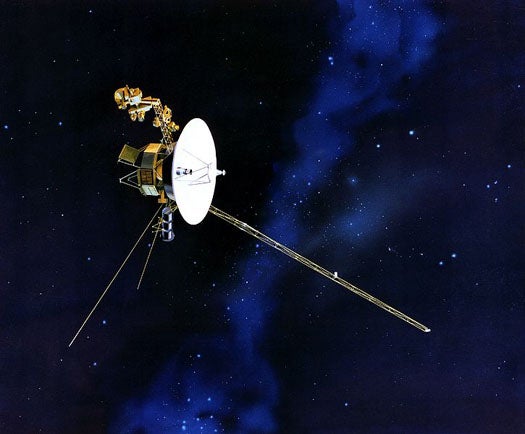
Voyager

The Voyager 1 spacecraft might be crossing the interstellar boundary at the edge of our solar system much sooner than scientists thought, according to new data from the probe itself and from the Cassini spacecraft. This milestone — marking the first Earth-born object ever to leave the sun’s field of influence — could actually happen any day now. According to scientists' best estimates, it will happen by the end of 2012.

Voyager 1 is careening away from the sun at 114,155 miles per hour, covering a mile in about 0.03 seconds, able to circumnavigate the globe in under 15 minutes. At that blinding speed, the spacecraft travels a billion miles every three years. Right now, it’s cruising through the heliosheath, a zone that marks the outward boundary of the huge bubble of charged particles blowing out of the sun.

Scientists are not sure exactly how thick the heliosheath is, so they can’t pinpoint exactly when the spacecraft will burst through the border, known as the heliopause. But new data shows that it’s likely between 10 and 14 billion miles from the sun, with a best estimate of approximately 11 billion miles. Voyager 1 is a little more than 10.8 billion miles away, so it could depart at any time, according to a new study published in the journal Nature.

“Voyager 1 speeds outward a billion miles every three years, so we may not have long to wait,” said Ed Stone, Voyager project scientist, based at the California Institute of Technology in Pasadena.

Last spring, instruments on Voyager 1 noticed the solar wind, already slowing down from speeds of 150,000 miles per hour, had stopped. Specifically, the data showed that the speed of the charged particles hitting Voyager 1's outward face matched the spacecraft's own speed. Scientists thought this could be an anomaly at first, but as of this February, the wind was still not blowing, suggesting it has bumped up against pressure from the interstellar magnetic field in the region between stars.

This indicates a thick outer solar system transition zone that had not been predicted before, and that Voyager may be very close to the heliopause, the border crossing between the sun's sphere of influence and that of interstellar space.

"The extended transition layer of near-zero outflow contradicts theories that predict a sharp transition to the interstellar flow at the heliopause — and means, once again, we will need to rework our models," said Stamatios Krimigis of the Johns Hopkins University Applied Physics Laboratory, principal investigator on the instrument that made this finding.

This is the second new breakthrough from the 34-year-old Voyager craft in as many weeks. Last week, we learned the spacecraft were flying through a foamy froth of magnetic bubbles, a bizarre phenomenon that results from the criss-crossing and rejoining of magnetic field lines at the edges of the solar system. The bubbles impact the rate at which cosmic rays can penetrate the sun’s protective sheath, but it’s not quite clear whether they’re helpful (trapping cosmic rays) or harmful (helping rays hitch a ride toward the sun, and us).

This latest data comes from Voyager's low-energy charged particle instrument (it's on the boom to the right in the diagram below) and Cassini’s magnetospheric imaging instrument. The Cassini instrument measures neutral atoms streaming into the solar system from the outside, a Jet Propulsion Laboratory news release explains. The new calculations led scientists to estimate the heliosheath’s size at roughly 11 billion miles.
Voyager Probe: On the boom to the right, the Cosmic Ray Science instrument, Low Energy Charged Particle detector, the Infrared Spectrometer and Radiometer, Ultraviolet Spectrometer, Photopolarimeter and Wide and Narrow Angle Cameras are visible. The bright gray square is an optical calibration plate for the instruments. The Golden Record, containing images and sounds from Earth, is the yellow circle on the main spacecraft body. The dish is the spacecraft's high-gain antenna for communications with Earth. The magnetometer boom stretches out to the upper left. The radio isotope thermoelectric generators, Voyager's power source, are visible to the lower left. The two long thin rods extending out to the left are antennas used by the Plasma Wave instrument. The Planetary Radio instrument also used these antennas when it was turned on.  NASA

Voyager 2 is about 9 billion miles away, so it will cross the boundary after its twin.

The Voyager probes launched in 1977 on a multi-decade journey through the solar system, taking photos and measurements of the Jupiter and Saturn systems, along with Uranus and Neptune. Voyager 2 remains the only spacecraft to ever visit those two distant giants.

The spacecraft used the faraway planets’ gravity to gain momentum, allowing them to slingshot away from the sun and toward interstellar space. NASA still communicates with them every day.

Scientists will be able to tell when Voyager 1 crosses into true interstellar space, because there should be a sudden drop in the density of hot particles from the heliosheath, and an
increase in the density of cold particles from the interstellar plasma. No one knows exactly what will happen when Voyager 1 crosses that boundary, however. But it sounds like we could find out really soon.

33 Comments

The voyagers will surely go down in history as one of the most successful and groundbreaking scientific expeditions of all time, if they haven't already.

Live long and prosper voyagers!

From my calculations, it should puncture the boundary on December 21, 2012.

Let me guess....December 21, 2012 it will break through. Then be suddenly returned to Earth by a race of machines calling it VGER who are hiding their ship inside a giant cloud that blacks out all light from the sun on Earth causing everyone to think its the end of the world. It all makes sense now. It's not the end but a chance for a new beginning.

The 1970's were way ahead of the future.

Today's NASA is a joke in comparison.

Veeger...
so sad what NASA has come to, a shadow of Star Trek.

when it "breaks through", wont something from interstellar space come through and get to earth? wont this affect us? this is all falling into place. maybe the annunaki are close to showing themselves. maybe the mayan were right.

The Voyager probes reminds me of the structure of a virus. It is neither living or dead. How exciting to see what it comes upon or what comes upon it. Maybe it will meet another probe called EVE and it will develop a spirit like W.A.L.L.E. then come back to earth to discover we are all obese pigs consuming GM food...and Ronald Mcdonald is President.

What an absolutely awesome ride it would be if man were able to physically hitch a ride on these probes. I'm wondering when it hits the cooler material outside our suns sphere of influence will slow the probe down though from a difference of densities of material its passing through.

NASA has so much more Money now than it did back in the '70s, and seems to accomplish so much less. What is all of NASA's money being spent on? It's not being spent on Science.

I'm gonna go with inflation... not just the cost of everything, but then the need to put more technology in everything. That and the stuff they do for the military, whatever that may be. I know they have made some diffferent drones for them, who knows what else.

@gizmowiz I really dont get you sometimes. 80% of the time you have GREAT comments. the other 20% are tottaly innaine or straight up trolling about polictics.

"The 1970's were way ahead of the future.

Today's NASA is a joke in comparison."

Where do you get off saying something so closed minded. Look around. Go to Nasas website and look at the all the on going projects and planned missions. NASA learns more in ONE day now than they did in 1 year back in the 70's. Yes they made some amazing leaps and bounds back then, but since then half the theories of the universe have been turned up side down. we have found SERVERL thousand extra-solar plantes. not to mention mapped about 100000 more times the universe since then. I am not going to sit here and list all the things NASA does for us in the this day and age. Putting men in space was always a GROSS WASTE of money albeit a VERY cool thing to do that inspired generation after generation of scientist, but unmanned mission provide MUCH more information. we have landed on comets, and mars, and astrioeds!
Just because NASA isn't as SEXY as it used to me, doesn't mean it isn't more productive. Your as bad as congress's disdain for non-military applicable science research. There I brought politics into so maybe you can relate to it now.

well, the aliens warned us not to venture outside our own solar system. rules are rules. time to annihilate the earthlings. we are screwed!

Doesn't matter, because the Doctor will always save the day!

poor lonely voyager 1.

It will be very interesting to see what happens when our rickety little probe breeches into interstellar space, will it just keep on tracking straight out? Will the interstellar currents swoop it away faster than ever thought? The suspense is riveting! From small steps to giant leaps, we will be seeing a landmark in the history of our species. History in the making coming up soon folks... great time to be alive!

Playing Devil's Advocate since 1978

"The only constant in the universe is change"
-Heraclitus of Ephesus 535 BC - 475 BC

It gives me a small measure of happiness to think that at least one piece of humanity has actually escaped into the universe at large. I hold little hope that we, or anything else we have made or accomplished will survive. Poor lonely Voyager 1 indeed. If like V'ger it ever does return, it will find only dust and ashes to welcome it home.

@inaka_rob...spot on with your comment, except gizmowiz never adds anything worthwhile, nasa haters are plainly ingnorant

I hope that NASA can send something else like this out eventually, except for using today's technology. Imagine what we could learn from a probe doing what voyager is doing with our tech. Also, put a message on that probe actually showing the aliens what our planet & solar system really look like. None of that nine-rings-around-a-dot nonsense.
-Spouting a fountain of nonsense since 1995-

Oh, and JediMindset, I wouldn't worry about voyager poking a hole in our protective solar system bubble. Comets puncture that layer all the time, and, last I checked the earth still exists.
-Spouting a fountain of nonsense since 1995-

commets orbit the sun inside the solar system

what if it crashes into a space rock? would we have a heads up and could we maneuver it? i think someone should make an energy shield for nasa.

It does make much more sense that comets orbit the sun inside the solar system than the long period comets that supposedly come from the Oort Cloud outside the heliosphere. How could comets orbit the sun outside the heliosphere? What are the chances that interstellar space contains icy bodies the heliosphere's just plowing thru, & sometimes one gets in? It would be a form of dark matter, since it's not visible from Earth. How much icy rock could be out there?

comets orbit the sun is a fact, whether it makes sense to you or not doesn't change this fact, google it silly, the sun and it's satelites are what make up the solar syatem (the solar system itself is immense), all of the comets in the Kuiper Belt and Oort Cloud are part of the solar system.

@Lord Elliot the Great: In fact NASA actually /has/ an ongoing mission which is just as, if not more interesting than the Voyager program: "New Horizons".

"New Horizons" mission, is to explore Pluto and the Kuiper Belt. I must say that I am eagerly waiting for the data, which will hopefully start arriving in 2015, or so.

As for the NASA haters. Well. Hmm. In my opinion, the 80'ies was a fruitless decade of Cold War one-upmanship that didn't do much good in the end of the day, if we speak of science. Of course, we got the Shuttle and all that - but I think the money and resources could have been invested in more useful things.

Things look much better now, and I think NASA (and ESA in Europe, for that matter) is concentrating their efforts on studying stuff that really is relevant, if humanity is going to live anywhere else than on planet Earth.

@dahiteman...excellent comment

oops, not dahiteman, nice comment Quintus

@drchuck1: No problem, I guessed as much;)

In fact, I know the guy, or one of the guys who designed the launch vessel for the "New Horizon" mission, and that's maybe one of the reasons I'm so keen on the results of it.

Another reason is, I'm sad to say, is that unless a work-around can be found for [E=mc^2], we will be stuck in this solar system forever. Sending DNA fragments "out there" to be rebuilt and raised by 'bots is something I cannot morally, as father of two small children (twins) accept. A child must have a parent to rear and support them.

So-o. This means we are stuck with our solar system. Which is actually quite big, when you come to think about it.

What would I like to see in the year 2100?

- Industrial scale He3 mining on the Moon to supply Earth based fusion power plants with fuel.

- A permanent colony/research station on Mars. Even if Mars lacks a magnetosphere, it has water (proved). It might be an impossibility to terraform Mars, but a research station should be possible.

In the year 2150 or 2200, I would like to see a permanent spacestation on Jupiter. With its moons, along its massive amounts of useful gases it would be the best staging ground for interstellar travel.

These are just SF dreams at the moment, but might become reality one day.

I must say, that I sceptic by day, optimistic by night. But when I saw the "New Horizons" rocket soar to the sky I was exctatic! We ARE going to the stars, but it will take a bit longer than we would like to... (read: not in our lifetimes)

the laws of physics suck when it comes to deep space travel, another logical informative post, thanks

I wonder if Voyager 1 and 2 will ever be picked up, and if the golden records will get played.

@Mary
Several things:
(1) The Oort-Opik cloud is a part of the solar system, in fact it is the boundary of the solar system
(2) Dark matter isn't matter that can't be seen from Earth, it is a hypothetical unobservable kinfd of matter that makes up most of the matter in the universe, and makes the laws of gravity work
(3) What kind of a username is Mary? Get a cool made up username.

@ Gyllivon
(1) I never said the hypothetical Oort cloud is not a part of the solar system, but they currently think it is outside the Heliosphere: outside the Termination Shock, Heliopause, Hydrogen Wall, & Bow Shock; all these the Voyagers are to exit to enter the Interstellar Winds where the Oort Cloud is proposed to be.

(2) A former university astronomy professor told me that the hypothetical Dark Matter CAN be rocks or water: anything that currently hasn't been detected from Earth. Saw the June 16 Pop Sci article "Herschel Telescope Spots Star Spewing Powerful Water Jets into Interstellar Space." The protostar is sunlike and reveals the possibility that "water could be scattered all over the universe."

To all those who work in space exploration or quantum physics: THANKYOU.
Voyager 1 forever.

Voyager is a clear testament to the fact that a creator had to intervene to form the complexity that exist within the universe. Its funny that a bunch of Atheist help make somthing that gives God glory.


June 2013: American Energy Independence

Five amazing, clean technologies that will set us free, in this month's energy-focused issue. Also: how to build a better bomb detector, the robotic toys that are raising your children, a human catapult, the world's smallest arcade, and much more.


Online Content Director: Suzanne LaBarre | Email
Senior Editor: Paul Adams | Email
Associate Editor: Dan Nosowitz | Email
Assistant Editor: Colin Lecher | Email
Assistant Editor: Rose Pastore | Email

Contributing Writers:

Kelsey D. Atherton | Email
Francie Diep | Email
Shaunacy Ferro | Email

circ-top-header.gif
circ-cover.gif
bmxmag-ps