Defying intuition, dense enough materials can reach terminal velocity within granular solid media.
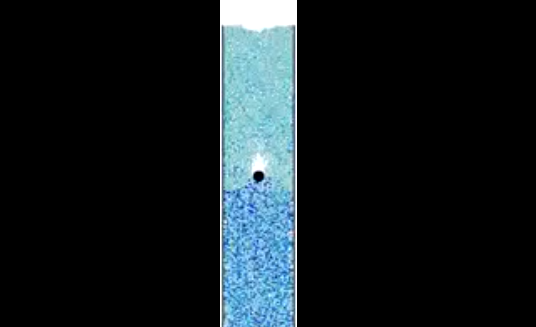
Reaching Terminal Velocity in a Granular Medium Yeah, it's possible.

A team of Mexican and Cuban researchers have made a somewhat mind-bending discovery. They’ve shown that objects crashing through a granular medium don’t necessarily lose energy and come to a stop, as you might expect, but can attain a terminal velocity and continue sinking indefinitely into the material. It’s a property that has never been observed or, to the researchers’ knowledge, even predicted before.

Specifically, the team used a set of 18 weighted ping-pong balls ranging from 15 to 182 grams (that's not even a half-pound at the high end), and launched them into a large tube filled with polystyrene beads. One would imagine, normally correctly, that a ball would enter the polystyrene medium and begin to lose velocity via friction and the beads' resistance to the force of the ball, eventually coming to a stop depending on how heavy it is and its velocity upon impact.

But it turns out that this is not a universal rule. We know that objects falling through a fluid can reach a terminal velocity because molecules in fluid move aside easily under an applied force. Granular materials don’t share this property; their grains don’t move as easily under an applied stress. This is why bocce balls don’t sink straight into a sandy beach and why meteors that impact planets or moons covered in a granular crust rapidly still stop at a relatively shallow depth.

But in their study, the ping-pong balls that surpassed a certain critical mass--in the case of their granular polystyrene medium, this mass was about 82 grams--traveled all the way to the bottom of the tube. Moreover, their velocities leveled off, reaching a constant velocity just as they would if falling through a fluid.

Through simulations, the researchers showed that the heavier balls would fall indefinitely through the granular medium if they were allowed to. From a physics standpoint this actually makes some kind of sense, though it seems to run counter to intuition. We think of things losing energy in granular media because they usually do. In order to hit that terminal velocity, the upward drag force and the pull of gravity (dependent on the objects mass) have to balance. This is why mass is critical, and why we don’t tend to see this in the natural world.

For instance, in order for a weighted ping-pong ball to fall indefinitely through the sand of an average beach, it would need to weigh about 31 pounds. That requires a really dense material, denser than we find on this planet. More details for the curious via PhysOrg below.

[PhysOrg]

10 Comments

Well, the measurements only took into account the pressure of just so many granuals in the test granular medium. Suppose the depth were several miles what would happen then? Possibly the pressure from holding up all the other granules would create a force between the granules sufficient to stop the ping pong balls.

"We think of things losing energy in granular media because they usually do."

This implies that they don't lose energy in the granular medium here, but the dropped object still does. That's why it is a terminal velocity, otherwise it would continue to accelerate. The rate of kinetic energy addition due to potential energy from lost height being converted is equal to the rate of kinetic energy subtraction due to friction/drag. That energy gets converted to heat. In summary, the object had more energy before being dropped into the medium. The medium gained some of that energy in heat. The ball would definitely have dropped faster and at an increasing rate if it had been dropped in a vacuum instead.

cool. i hope someone uses this discovery for something good.

So they proved if an object is heavy enough and reaches terminal velocity it will keep falling... I could have told them that. What did they think terminal velocity ment? Am I misunderstanding something they "discovered"?

they "discovered" that the object keeps falling.

I have an idea.. to see how much energy is lost you can take the height the ball bounces in this test and judge it against the height the wall bounces when its dropped in air. If the wall doesnt bounce with the same amount of energy then it proves that it wont drop forever because energy is lost.

Get testing that.. I want the resaults on my desk by next monday.

"Weighted ping pong ball"...

Why didn't they use an Aperture Science Weighted Storage Cube®?
It probably would've worked even better!

If you had a sea of polystyrene beads, eventually the ping pong ball would reach a depth where the mass of the beads above the balls would exert a pressure force (times the surface area of the ball) equal to the mass of ping pong ball and the ball would "float" in equilibrium.

If you extrapolate this idea, maybe the Earth's oceans have a thin layer of naturally produced deuterium oxide (heavy water)at a calculable depth.

i would believe it; if they can drop an object that surpasses its critical mass with respect to the earth, and observe that object go down to the earth's core.

this "discovery" sounds like common sense to me...


June 2013: American Energy Independence

Five amazing, clean technologies that will set us free, in this month's energy-focused issue. Also: how to build a better bomb detector, the robotic toys that are raising your children, a human catapult, the world's smallest arcade, and much more.


Online Content Director: Suzanne LaBarre | Email
Senior Editor: Paul Adams | Email
Associate Editor: Dan Nosowitz | Email
Assistant Editor: Colin Lecher | Email
Assistant Editor: Rose Pastore | Email

Contributing Writers:
Rebecca Boyle | Email
Kelsey D. Atherton | Email
Francie Diep | Email
Shaunacy Ferro | Email

circ-top-header.gif
circ-cover.gif
bmxmag-ps