How the once-in-a-lifetime photo-op came to be
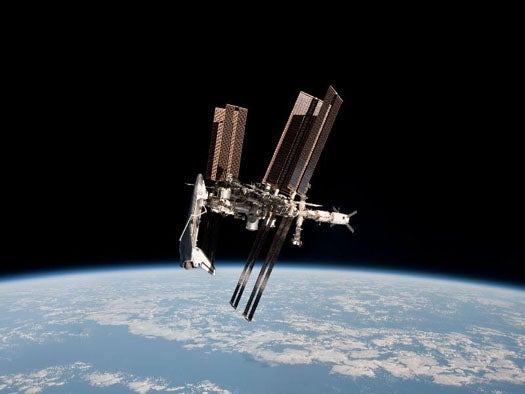
ISS Shuttle Docking NASA

After a 5-month stay at the International Space Station, Italian astronaut Paolo Nespoli snapped one-of-a-kind photos of the Space Shuttle docked at the ISS, on his way back to Earth in a Soyuz craft. This is the very first time photos have captured an American orbiter docked to the International Space Station.

See the gallery.

The photo-op arose because, by sheer coincidence, the Soyuz capsule was scheduled to come home while Endeavor was docked. Two such ISS missions have never overlapped before, said a NASA spokesperson. Realizing the rare opportunity, the astronauts and space agencies arranged a photo shoot.

After the Soyuz capsule took off on March 23, Mission Control Moscow rotated the ISS 130 degrees to provide Nespoli with an optimal view of the docked shuttle. With the capsule paused for a few minutes at 600 feet away, the astronaut managed to take video footage and dozens of photographs.

The images are likely to be not only the first but also the last of their kind, since NASA’s final shuttle mission flies in July.

[via NASA via BBC]

15 Comments

The end of an era. Great shots!

Higher resolution original images are to be found here:
http://www.nasa.gov/mission_pages/station/multimedia/e27depart.html

This is not true.

Some amateurs (astronomers) have taken pictures of the shuttle docked to ISS from earth.

These are much better of course.

An amazing shot to prove it:

http://www.esa.int/esaCP/SEMTFDPR4CF_index_1.html

Space Shuttle Atlantis docked to the ISS on 19 June 2007 at 02:14 UTC at an estimated altitude of 350 km. This image was captured from a ground telescope.
Telescope: 0.64M f/9.6 Ritchey-Chretien at F=12.200mm

Copyright © 2007 Ron Dantowitz & Marek Kozubal

As I often seen pictures of the space station, I have often wonder why the various solar panels are tilted in different directions. I would have thought they all have the same tilt; attempting to gain the rays of the sun at the same time. So, does anyone clue?

I am no authority on the matter, but it makes sense that they are oriented that way because the ISS rotates as it orbits. It maintains a horizontal latitude, but it still locally rotates while orbiting Earth. So the solar panels are angled that way so the space station can always gather energy regardless of its orientation.

@BubbaGump, excellent observation and a good question.
If you look at it close enough, it almost appears like the top two sections are folded. Perhaps they do this when the shuttle docks?

There is also quite a large shadow cast on the panels which brings up the question of how shadding affects the performance of the panels. Then again, these are NASA panels so there is probable some advanced tech that has yet to be declassified.

breathtaking pictures. these shots will be viewed for a long long time after we are gone.

@JediMindset Are we going someplace? Maybe you are gone? When are you leaving? Actually have you arrived? Who will view them after we, you or me is gone? Why would they care to view them? Exactly how far in the future are you refering to, when we are gone and they are viewing this shots. Might they have something better to do; say looking at the new shots of the new spacecenter, sometime in the future when the earth is gone?

@BubbaGump...at times i strongly dissagree with your comments but i LMFAO at your latest, poor JediMindset, but i guess in his dilusional state he wouldn't know...i believe these are once in a lifetime photos taken from orbit, hey popsci, could you clarify?

@Bubbagump
LMAO!! funny. i was referring to when the people that took it and most of us are dead. im referring to 200 years in the future. with future technology we could in theory live to be 200. but who knows.

@drchuck
delusional? why do you say that? explain yourself.

re-read some of your posts

@drchuck1
you obviously have something against my views. thats ok. you must be another one of those sheep that believes every single thing that your government feeds you. its ok. open your mind.

you came up with that from my post, sure sign of a paranoid delusional state

@drchuck
weak minded fools like you will continue being controlled.


138 years of Popular Science at your fingertips.

Innovation Challenges


Popular Science+ For iPad

Each issue has been completely reimagined for your iPad. See our amazing new vision for magazines that goes far beyond the printed page


Download Our App

Stay up to date on the latest news of the future of science and technology from your iPhone or Android phone with full articles, images and offline viewing


Follow Us On Twitter

Featuring every article from the magazine and website, plus links from around the Web. Also see our PopSci DIY feed


March 2012: The Future of Medicine

A 10,000-rpm, no-pulse heart is completely revolutionizing how we think about transplants. Plus: rapid-response virus hunters, a shocking cure for migraines, the world's youngest person to have achieved nuclear fusion (in his parents' garage!), and much more.


circ-top-header.gif
circ-cover.gif