Researchers Entangle and Observe Eight Photons Simultaneously, Smashing the Previous Record
Like a long-distance romance, quantum entanglement is a fragile interaction; one moment, two particles can be sharing that special bond...
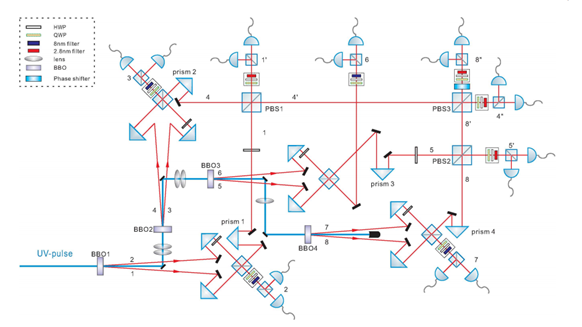
Like a long-distance romance, quantum entanglement is a fragile interaction; one moment, two particles can be sharing that special bond in which they are essentially one and the same, even when separated by vast distances. Then, just like that, the link can be broken. So the fact that Chinese researchers have set a new record by entangling eight photons at the same time–and then manipulating and observing them–is nothing short of amazing.
As Technology Review’s KFC cleverly points out, “getting eight photons exactly where you want them at the same time is the quantum mechanical equivalent of herding cats (clearly of the Schrodinger variety).” Manipulating individual particles at this level is difficult enough, and that’s before you create that quantum link. Once you’ve entangled two or more particles, manipulating the entangled system without breaking the link is even more daunting.
How do you entangle this many photons? You start with one photon from a high energy beam, and you split it with a nonlinear crystal. You now have two weaker photons that are entangled–any exertion on one will affect the other. You put one photon aside in an apparatus and you then split the other, put one of those aside and split the other, etc.
But each split weakens the beam, and previously it was difficult–and time consuming–to produce to a manipulable eight-photon entangled system, so difficult that it hadn’t been achieved. The Chinese team, from the University of Science and Technology of China in Hefei, used a much brighter UV laser capable of churning out more entangled pairs much faster than smaller lasers. Then they figured out how to manipulate them.
That’s significant on a variety of fronts, not least of which is quantum computing. An eight-photon system would allow researchers to probe the quantum world at higher resolutions than was previously possible, demonstrating key pieces of the technology puzzle that should someday enable quantum computers to work as we’ve envisioned them.
For more, check the arXiv.