A new kind of oscillation could be the key to life, the universe, and everything
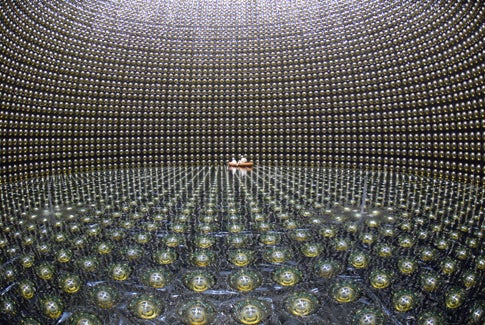
Super-Kamiokande Built in an abandoned mine, the "Super-K" neutrino detector surrounds 50,000 gallons of super pure water with 11,200 photomultiplier tubes. To give an idea of the scale, that object in the distance is two men in a rubber raft. courtesy of the Science and Technology Facilities Council of the UK

Japan’s “T2K,” one of our favorite neutrino experiments (we’re keen on several), might have just cracked the mystery of why matter triumphed over antimatter after the Big Bang (they should have canceled each other out). The international experiment’s data from earlier this year--before its science was interrupted by the earthquake in March--indicates that muon neutrinos can transform into electron neutrinos.

A primer on neutrinos and why we should care about them: Neutrinos are one of the fundamental building blocks of matter, though they interact very weakly with normal matter (innumerable neutrinos kicked out by the sun pass straight through the earth at any moment, rarely pausing to interact with the planet). They come in three flavors: muon neutrinos, electron neutrinos, and and tau neutrinos. And for the aforementioned reason they are very hard to detect.

Nonetheless, via detectors like T2K (for Tokai-to-Kamioka, as these are the origin and terminus of the nearly 200-mile experiment) we are able to detect and study neutrinos every now and again. T2K fires a beam of muon neutrinos straight through the ground from Tokai on the east coast to the Super-Kamiokande detector 183 miles away. And recently at Super-K, some of the neutrinos detected were electron neutrinos, indicating that they has had shifted mid-flight.

We already knew about two different oscillations (that’s a change from one flavor of neutrino to another) but we’ve never this new, third oscillation: a muon turning into an electron neutrino.

This is significant, because it means that normal neutrinos could have different oscillation characteristics than their antiparticle counterparts (antineutrinos). It’s an example of what physicists term a CP violation, and it could explain why, when all of our models show that the Big Bang should’ve created equal parts matter and antimatter (which would annihilate each other instantly), an excess of matter clearly survived to make up the universe.

That’s big news, but nothing is yet certain. Repairs are underway at T2K’s accelerator, and the experiment will begin churning out data to corroborate (or disprove) the finding later this year.

[BBC]

6 Comments

"...but we've never this new, third oscillation: a muon turning into an electron neutrino."

I think you accidentally the verb.

But anyways, fascinating stuff, if only I had even the foggiest idea of *how* neutrino oscillations could explain the matter/anti-matter imbalance.

certainly cool stuff; would love more info as it becomes available

@SteveMcQwark

You're right, they didn't really explain it well. But the overal idea is this.

Anti-matter is made of seemingly identical subatomic particles with oposite charges (negatively charged protons, and positively charged electrons). When matter and anti-matter come together, they annhialate, instantly convering 100% matter to energy.

So the Big Bang Theory predicts equal amounts of matter and anti-matter were created at the begining; there is no aparent advantage or difference between anti-matter and normal matter. It should have all collided and turned into energy.

(I assume you know this Steve, or you wouldn't have pointed out the question, just a general overview for others)

However, for an unknown reason there is a preponderance of matter. For some reason [all] the anti-matter in our universe has been anhialated, and a decent amount of "normal" matter remains. Since the only way we know of matter to come into being is with an anti-matter counterpart, this doesn't make sense. There should be, atom for atom, an equal amount of matter and anti-matter.

The concept of this new neutrino oscilation is that neutrinos -- that are produced in energy releases(exactly how I'm not sure, but I think its a componenet from fusion/fision/matter-antimatter reactions)-- can turn into matter. If neutrinos cannot turn into anti-matter at the same rate, then we have an explanation for the imbalance; neutrinos oscilated into electrons, which annhialated with the anti-matter in place of some of the matter.

Overal, neutrinos could be a font of normal matter that comes from energy and that created the imbalance between the two polar types of matter. It would help explain how the anti-matter can be gone and have matter remaining. Up until now, we have found no real fundamental difference between matter & anti-matter, so something that favors one over the other is big news.

Without difference there is no point of which to say something exists...

I pray they may not have any errors and possibly suspect it as a new particle or previously invisible particle.

Thanks to the Tevatron, I can't believe the claims about new particles.

@brian144
saying that "the only way we know of matter to come into being is with an anti-matter counterpart" does not quite make sense to me.
How do we know/theorize the relationship between matter and anti-matter, when matter is created? Have we observed any evidence of this relationship or is this theoretical?
Just wondering as I am interested to learn more on the subject!


June 2013: American Energy Independence

Five amazing, clean technologies that will set us free, in this month's energy-focused issue. Also: how to build a better bomb detector, the robotic toys that are raising your children, a human catapult, the world's smallest arcade, and much more.


Online Content Director: Suzanne LaBarre | Email
Senior Editor: Paul Adams | Email
Associate Editor: Dan Nosowitz | Email
Assistant Editor: Colin Lecher | Email
Assistant Editor: Rose Pastore | Email

Contributing Writers:
Rebecca Boyle | Email
Kelsey D. Atherton | Email
Francie Diep | Email
Shaunacy Ferro | Email

circ-top-header.gif
circ-cover.gif