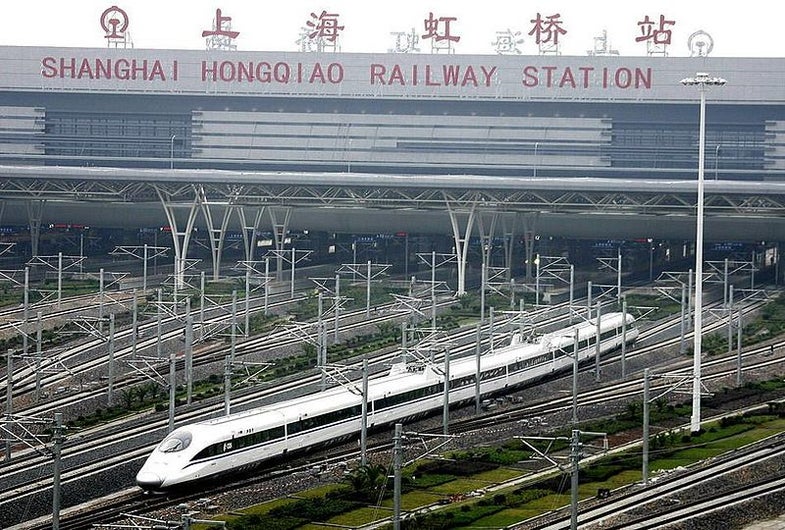
Just three years after breaking ground, China will open the crown jewel of its high-speed rail network to the public this week. The 186 mile per hour (and that's regular operating speed) Beijing-Shanghai link takes just four hours and 48 minutes to traverse 820 miles of Chinese countryside.
Let’s break down this little infrastructure project by the numbers. It was deemed “shovel ready” just 39 months ago. In that time, Chinese engineers and workers have erected 288 bridges and punched 21 tunnels through China’s often difficult terrain. Some 80 percent of the track is laid 40 feet above the surrounding terrain on concrete pylons, circumventing the need for dangerous roadway crossings. Cost: roughly $34.2 billion.
That’s one big project. But it’s a completed project (that’s one way to manage costs--create a plan and execute it quickly) and one that should serve China well, at least if you are among the upwardly mobile Chinese that can afford train fare. Before its high speed rail boom is over, the Chinese government wants to network the whole of Asia together and eventually run trains all the way across the continent to Europe. An international link to Laos is the beginning, but a dedicated link between China’s two key eastern population hubs also marks a symbolic achievement.Meanwhile, Americans might have a HSR link between Los Angeles and San Francisco by 2020. That is, if the Chinese help us build it.
Five amazing, clean technologies that will set us free, in this month's energy-focused issue. Also: how to build a better bomb detector, the robotic toys that are raising your children, a human catapult, the world's smallest arcade, and much more.


Online Content Director: Suzanne LaBarre | Email
Senior Editor: Paul Adams | Email
Associate Editor: Dan Nosowitz | Email
Assistant Editor: Colin Lecher | Email
Assistant Editor: Rose Pastore | Email
Contributing Writers:
Rebecca Boyle | Email
Kelsey D. Atherton | Email
Francie Diep | Email
Shaunacy Ferro | Email
I've heard they dialed back on their speed a bit on other routes because maintenance gets to be expensive. Slowing down even a little bit can save a lot of money in maintenance. I want to see faster and more passenger rail in the US, but I don't think it will ever be anything on the scale of China's system because long distance is time prohibitive compared to air travel. When you have a large population that can better afford to take an extra day than pay for air fare, then that's a good case for long distance passenger rail.
Exciting technology and it would be fun to ride one. Unfortunately high-speed rail is not a profitable venture and virtually every one is funded by taxpayers. In other words, it's a net drain on the economy of the countries that have it. In the U.S. it makes even less sense because of the high cost of land. If it were an economically viable mode of transportation you would see privately built high-speed rail lines popping up all over. Passenger jets are far more practical for moving lots of people lots of places very quickly and cost-effectively.
For 1/10th to 1/30th the cost you could build airports and buy passenger jets to haul more people over the same distance in half the time. And it would make a profit.
@laurenra7
Where are you getting your numbers? I think they were going to spend that much just to build a third runway at Heathrow! The only tough thing about high-speed rail is that the infrastructure has to be built from scratch but once it's in place, rail should be far more efficient than air travel.
to slow for me. Maglev train beats this hands down
the current main advantage by rails over planes is that, these could run on electric. the drawback of rails is that it takes up too much space.
but rails are generally better used for transporting large amounts of heavy cargo anyway. so a highspeed underground railroad cargo system would be totally awesome.
hmm.. or better yet.. why bother using rails at all? a circular tunnel can be traversed by autonomous trains with wheels surrounding it. if properly weighted, it can maintain it's upright position, allowing electrical lines to be run down along the tunnel system to power it. or whatever..
i just thought about that just now..
at logengrim, and the cost of build whether proof fullt encapsilating tunnels, AND building brand new trains and cars to meet this new tunnel, is better than using standaradized, proven, current train tech is better how? And more importantly how is it cheaper?
@laurenra7
". Unfortunately high-speed rail is not a profitable venture and virtually every one is funded by taxpayers. In other words, it's a net drain on the economy of the countries that have it." I don't understand where you got the idea that it would be a net drain, but building tranportation infrastructure is almost always a net plus to the economy. People and goods moving easier never hurt the economey(mostly talking about people in this case). " In the U.S. it makes even less sense because of the high cost of land." In the US land is relatively cheap. It also takes less land to build a railroad than giant 8 and 10 lane highways. "Passenger jets are far more practical for moving lots of people lots of places very quickly and cost-effectively." Then why do many people drive do cost of flying?
@lanredneck: you're making it sound like i'm suggesting a complete revamp of all available railway systems. while i simply blurted that out as a simple thought experiment.
which is a gross misunderstanding of my point.
there will always be room for rails for transporting commuters back and forth.
but what i suggested was an automated underground network for the highspeed transport of heavy cargo in bulk, where human passenger comfort is no longer a factor in the train design.
obviously that's just an idea on my part (for all i know someone came up with the same idea ages ago), but if anyone decides to try out the feasibility of this idea then go right ahead. i just laid mine down on the public domain.