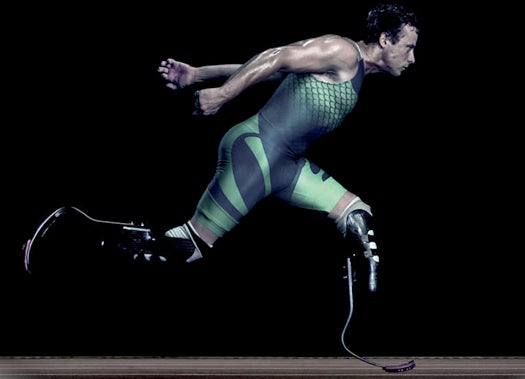
Sports are supposed to be pure—that’s why there are rules and referees; that’s why the first Olympians competed in the nude. It’s also the reason that the federal government is spending millions and millions of dollars investigating a famous cyclist who has, after a decade of denials and countless drug tests, returned to the center of sports scandal. It must be summer, since Lance and doping have returned to the national discussion.
It’s only natural that when we discover our heroes have injected chemicals into their veins for a competitive edge (and I’m not saying Lance has, only that it’s looking increasingly difficult for him to prove that he hasn’t) we find them tainted and strip them of medals and put an asterisk by their names. Doping is ugly for fans but it goes beyond betrayal. Performance enhancers turn a contest between athletes into a competition among scientists and engineers. This is the best argument against enhancers. It’s also the best argument for them.
Let’s pretend, for a minute, that a separate league exists. Let’s call it the Asterisk League or, better, the League of Extraordinary Medicine. Drugs are legal but regulated. Athletes get educated about the risks, long term and short, of everything they introduce into—or onto—their bodies. Fans know exactly who is taking what and tracking their performance accordingly. Labs and scientists are inexorably linked to athletes’ rise and fall. Chemist versus chemist doesn’t sound like it would make great television, but the field would quickly advance to the point were records were broken daily and feats of crazy strength became the norm. Chemist versus chemist would become superhuman versus superhuman. Broadcasts could include expert scientists in the booth describing the limits of the human body and how these chemical enhancements get around that, or don’t. The League of Extraordinary Medicine is more honest, its regulation more sensible, since outlawing drugs just does not work—we’ve got a forever War on Drugs to prove it. And our tests for drugs still aren’t very good.
Through this openness the league creates an environment where cutting-edge science is discussed daily, and celebrated, alongside athletic triumph. Better still: legitimizing enhancement would make the enhancements better. More drugs hit the market, more treatments become available, and this would trickle down to non-athletes. Would all this openness and advancement foster a more honest, inviting, even wholesome environment? Maybe. Creating a separate league where drugs are legal would, without a doubt, make competition safer for athletes. Matthew Herper, who has covered science and health (and, by extension, athletes and drugs) for a decade at Forbes, says as much.
“To me, the most obvious solution has always been to legalize those drugs that work, and to experimentally monitor new entrants, including dietary supplements, for both efficacy and safety. Biological improvement would be treated much as athletic equipment like baseball bats and running shoes. This could improve both athlete’s performance and their health, and would be a lot better than having everybody trying whatever additive they can sneak, attempting to stay ahead of drug tests, and trusting anecdotes as a way of measuring safety and efficacy.”But perhaps most importantly, by keeping advances off the field, we’re holding back possibilities. A few years ago I visited Hugh Herr, the director of biomechatronics at MIT’s Media Lab, who had just invented a robotic ankle that would soon revolutionize prosthetics. We ended up discussing the ankle a little bit, but mostly we talked about science in sports. Herr is an athlete. As a young man he was a world-class rock climber. A week before my visit, he had been busy trying to convince the International Association of Athletics Federations to allow South African runner Oscar Pistorius to compete in the Olympics. Pistorius has no legs below his knees and runs using Cheetah Flex-Foot carbon fiber limbs which, arguably, gives him an unfair advantage. Herr is also a double amputee, and walks and climbs using prosthetics. That day in his lab, while he showed me his improved ankle and described his work with veterans, Herr told me that he sees no reason why we can’t make “disabled” people stronger and faster than the rest of us. In fact, we already are: just look at Pistorius. The IAAF agreed and, weeks later, decided to ban the South African from competition.
One of the best arguments for pushing, even uncomfortably, the boundaries of science and the human form was voiced by Joe Rosen, a controversial plastic surgeon. Rosen (the subject of a profile in Harper’s) sees endless possibilities when the human form and science meet. But this makes people very uncomfortable. A colleague asked: “If a patient came to you and said, ‘I want to you to give me wings,’...would you actually do it?”
“Who here doesn’t try to send their children to the best schools, in the hopes of altering them?” Rosen responded. “Who here objects to a Palm Pilot, a thing we clasp to our bodies, with which we receive rapid electronic signals? Who here doesn’t surround themselves with a metal shell and travel at death defying speeds? We have always altered ourselves, for beauty or for power, and so long as we are not causing harm what makes us think we should stop?”
Five amazing, clean technologies that will set us free, in this month's energy-focused issue. Also: how to build a better bomb detector, the robotic toys that are raising your children, a human catapult, the world's smallest arcade, and much more.


Online Content Director: Suzanne LaBarre | Email
Senior Editor: Paul Adams | Email
Associate Editor: Dan Nosowitz | Email
Assistant Editor: Colin Lecher | Email
Assistant Editor: Rose Pastore | Email
Contributing Writers:
Rebecca Boyle | Email
Kelsey D. Atherton | Email
Francie Diep | Email
Shaunacy Ferro | Email
"We have always altered ourselves, for beauty of for power, and so long as we are not causing harm what makes us think we should stop?"
Morality, one would wager, though obviously you are quite unfamiliar with it.
@Ultra-Humanite
What is the point of throwing around empty words without elaboration? Do you think you're Yoda? Surely you have more to say than calling the author immoral.
I wonder of those in support of using performance enhancers, reality-check-drugs, will be supportive of the people using them as they die of heart attackes and other health related issues or do they just wish to be entertained by the sports event itself?
if one could take a drug that made ones skin as tough as kevlar and theres only a side effect of say, constipation and irritabiiity
whered be the moral issue there? a persons body is theirs to do with as they please
people have known about the risks of steroids forever, if they could get doctor help with doseing and rec use the risks might be minimallized
@Ultra-Humanite
Morality? What do you even mean? Besides, you have to be a fan of physical performance enhancement, you're Ultra-Humanite after all. I'm having a hard time thinking of someone or something more performance-enhanced than UH.
@BubbaGump
That is the real issue. Since many of current performance enhancing drugs present a serious risk to the athlete's health, I'm not sure it would be wise to establish a competition out of their use. Athletes would be forever pressured to use the newest and most hyped drug, and consequences would often be disastrous.
I think this kind of league is something to keep in mind for the future, but it is too dangerous at current level of medicine.
One's body is one temple. What's the difference of an athlete injecting themselves with steroids to become stronger and someone digesting Big-Mac's, cigarettes & beer to become happier?.
Steroids are illegal, but the latter 3 are legal. Both are in a moral grey area.
As long as steroids pose a health risk to pro athletes, they should be banned / monitored....but if steroids can be developed with limited side effects...by all means let them use them and let's see how far they can push the human body...speed records, strength records, PPG records will be all up for grabs.
I typically get pretty frustrated with professional athletes who get caught using performance enhancing drugs because it is cheating when the majority of your peers are not using drugs to their advantage. However, this idea of a leage of super athletes is pretty wild and pretty damn cool. It could bring forth much bigger and better advances in performance enhancers. Sure there is some risk, and sometimes alot of risk but the benefits that could come out of it would be worth it in my book.
From a military standpoint I've always wondered why we are not allowed to take performance enhancers(steroids, speed) during certain combat operations, particularly invasion. When you are moving that fast into hostile territory trying to advance a line with little food, little sleep and stress beyond belief those two drugs could pose a definate advantage to stave off muscle loss, retain more strenght and endurance, improve vision and alertness. If the military was behind it I'm sure better product can be made that is several times more safe for the body and reduce the side effects. Supposedly DARPA is looking into these kinds of advancements that would also include extending the amount of time a human can hold their breath under water(targeting 1 hour), increase their endurance threashold etc. I'm very game for this.
Same goes for performance enhancers for the mind. Did anybody here see the movie Limitless? If that drug existed I would take it without a second thought. Even if the major side effect was it would cut my life expectancy in half. Could you imagine all we could accomplish in such a short amount of time if we could access 100% of our brain power?
Evolution of our species doesn't have to take another 10,000 years if we can force our own evolution through our advanced sciences. Chances are we wont even make it another 1000 if we can't move faster so lets gets moving!
To the questions, because altering ourselves for beauty and power are always done with the noblest intentions in mind.
Also, as the quote is from the plastic surgeon, my comment was obviously a response to him and not the author.
@ Siromar
I agree that there needs to be more research before preformance enhancement is integrated into sports however consider the money that would be invovled. There is no way that a team spending $100 Mil+ on an athlete would risk injury because of hype. It is also impossible to say that the results of preformance enhancement would "often be disastrous".
I hope this becomes a reality soon. If drugs that improved athletic preformance were not shunned but heavily researched and supported it could be very beneficial. Also, people with prostetic limbs deserve to have the very best technology that we can offer. I can't imagine how devasting a permanently disfiguring injury is. If research funded by sports yields better prostetics and similar technology, I am all for it.
Enhancing an athlete's performance without significant risk/side effects sounds great. This would also be appealing to many amatures, including myself. However, what I am more interested in is improving human genetics. Does anyone remember the PopSci article about altering an adult monkey's DNA to increase his muscle mass? Further research into improving our genetics or the genetics of our offspring will yield great benefits for mankind.
Considering the prevalence of hereditary diseases (like cancer), we need to take care to maintain and improve the health of the human gene-pool. Remember, as society advances, the natural selection forces are reduced and 'survival of the fittest' has reduced ability to promote the health of the human gene-pool. What do you all think?
There will always be people that when in a competitive environment cheat to get ahead even at the expense of their own health and safety. Allowing and promoting these enhancements would never change the need for testing (and shaming) because there will always be a harmful and illegal drug one could use to beat the competition.
The change in doping rules would help to further science but at the expense of the athletes by creating an environment in which for one stay competitive s/he would have to give into becoming a human guinea pig. I say lets keep the testing limited to the lab animals and those willing to endanger their bodies and careers for now instead of requiring it for athletic success.
Finally its just not economically viable. For the most part sports are a test of natural skill, level of training, and luck. It's what most people enjoy watching and competing in. Because of this, doping up sports will probably lead to financial ruin for anyone who tries to pull it off and any sport that moves in that direction.
It would be interesting to see teams of scientist competing like the teams in f1, but I don't think we're quite there yet.
@slackline,
Exactly. Some people might see it as immorale to change human genetics but thats what evolution does over thousands of years. As a species though our evolution has slowed since we don't have any natural predators anymore save for disease. We are getting taller, and some people like me are born with only 2 wisdom teeth but other than that we are stagnent. If we have the means and knowledge to make ourselves stronger, faster, smarter, more resistant to disease and illness then why not?
@clay,
The advancements in prosthetics is pretty awesome and this would help further develop the progress. It's gotten to a point now where if I lose a limb due to combat(God forbid) it's not the end of the world or my career anymore. With recent advancement in robotics reality may be what we have seen in the scifi movies over the last couple decades.
I see the potential benefits of this. However,I am sure that the boundaries will be pushed too far, the human life is not expendable. Each team will try to outdo the last making more an more potent drugs that will have horrible affects on the users. And the spectators wouldn't care.
I thought the whole point of the Olympics was to see how far you could go WITHOUT drugs, and other modifications. after all, if you use that, of COURSE you going to do better, but it's not only more entertaining, but more rewarding to do extremely well, break and set records, and win gold in events that some can't even do poorly; all WITHOUT performance enhancers. now, if you want to do so, strictly for the sake of doing so, and not in any official events, then as long as you know the risks, knock your self out. (not literally, though.)
OK seriously I think everyone missed the point of the article. The author wasn't trying to say we should use our currently harmful performance enhancers. What the article was getting at is make using enhancers legal, but keep a close reign on them. regulate them and have all the enhancers used tested to make sure they are safe. I know there will always be those few who never follow the rules, but there can always be strict rules and punishments in order for them. The idea is to use sports and athletes to further the development of this aspect of science. May that be chemical, technological, or body augmentation. The possibilities endless. Think of all the money that gets poured into the NFL and the NBA from the fans. Now imagine just a fraction of that going to bettering science as a whole every year. OMG that would be groundbreaking to the scientific world. That would be an ungodly amount of funding they would be getting to not only improve the new sport but also inevitably improve the human race.
I think the issue is if we allow stuff like steroids then you will see woman whom are men and men who look like the hulk. Not everyone wants to destroy their bodies with heavy hard hitting drugs that shorten your lifespan heaps by destroying body orders such as liver and heart etc...
So I think there will still be some limits on certain drugs but in time as robotic limbs and such get into play then allot of bans will probably haft to go, or create a unrestricted version of the sport.
Problem is when allowing normal people to compete against a super pumped up chem athlete, its kinda not very fair. I personally think sports has moved from a fun national activity to a ultra aggressive national activity which is not good for society in the long run. Need to break from this pattern!!! Must...
Why not, as long as the "athletes" are whell informed of the dangers. And by the same rules why drugs that alter mind state are not legalized. What so wrong about it as long as they are used by well informed adults.
I'm for legalization of sport drugs as well as psychotropic drugs.
A sprinter can get disqualified when the "doping" tests prove that he/she smoked marijuana which as we know greatly assisted the athlete in breaking that record. It is OK for us to watch boxers, MMA fighters and refrigerator sized football players pummel each other to unconsciousness but we should not allow them to take any harmful drugs. Even if they all took them they would still be cheating. If you take EPO you will be disqualified and the journalists will write thousands of words about your spectacular rise and fall but if you can afford your own hyperbaric chamber you will be a celebrated athlete and a true winner.
This is sanctimony, not morality.
We need the League of Performance Enhanced Athletes. And it will be many times more interesting than any other league.
"@jayabikos"
My thoughts exactly.
Could work equally for surgery as well as medicine.
I'm a leftie, and I broke my right arm years back, and it was set and healed "wonky" (bent; no longer symmetrical to my left arm). Since healing, it is significantly stronger than my left arm (opposite to the old days). My best guess is that the non-straight bone healing gives my muscles more leverage, hence the extra "strength".
Want to see what happens when you don't regulate performance enhancers?
Take a look at the IFBB (international federation of bodybuilding) Steroids, insulin, HGH, etc are not regulated by the federation. Competitors are huge muscular beasts.
And everything is great. Fans go crazy for them and athletes are not in poor health.
@Ultra-Humanite
05/26/11 at 11:57 am
'"We have always altered ourselves, for beauty of for power, and so long as we are not causing harm what makes us think we should stop?"
Morality, one would wager, though obviously you are quite unfamiliar with it.'
--------
Morality is, in short, to maximize benefit and minimize harm. Therefore anything that does not cause harm is moral, and your comment is self-contradictory.
Indeed, it can be argued that by actively inhibiting the advance of science, we're limiting the expression of our creative potentials and doing harm to our civilization, and therefore have a moral obligation to express human creativity and further the limits of science.
The challenge should never lie with the definition of morality, but rather the definition harm. Nothing we do is quite black/white harmful or harmless but exists in shades of immeasurable grey.
Don't listen to the haters. I'd mortgage my house to buy organs that don't wear out or muscles enhancements that cause muscle tissue to self-generate and I'm not alone.
How many guys out there work 60 hour weeks and would pay thousands for some of the enhancement techniques that these athletes are pioneering?
Why not create a new category for athletes that WANT to use performance enhancing equipment/drugs. It's not fair for them to disqualify someone with no legs because he's 'too fast'. His mistake was performing too well too early. If he'd pretended he was the same speed as everyone else, THEN in the middle gone on to win the gold, they would have let him keep it. As it was they turned millions away when they wouldn't let the man with no legs compete.
Therefore, all countries should have a league of extraordinary juicers? Do you realize if that Timothy Leary reality ever came into being how it would trickle down into every avenue of human culture. Performance enhanced religious experiences? Performance enhanced spelling bees? Can you imagine a team of scientists working on little jimmy from the womb? Juicing him up so he's climbing the walls and shooting spider webs out his john thomas at puberty? Ever thought that maybe you're a little too much into instant gratification if any of that seems appealing to you? What about that cherry on top? Make Juicing Mandatory!
This sounds appealing but my only reservation comes from the situation created when things go wrong. And, as with any cutting edge technology, things will go bad from time to time. In this case, the result could easily be the death of an athlete...and it would be while providing "entertainment" to the rabid sports masses. I've always held the opinion, as a competitor in auto racing, that no one should give their life for the entertainment of others. That was some potent motivation to keep my operation and track time safe or at least, survivable. Sensationalizing the death of even one soul simply isn't humane. I agree that there is informed consent and that this undertaking carries no guarantees. There's an assumed risk and we still have the freedom (for now) to do as we please. I'm more leery of the media living up to it's bloated image of itself and turning a tragedy into ratings fodder.
The regulation better be very stringent. Otherwise the athletes would be in danger of side effects.
But it has promise. Look at the tech progress that resulted from even pre 1945 motor racing and arms races.