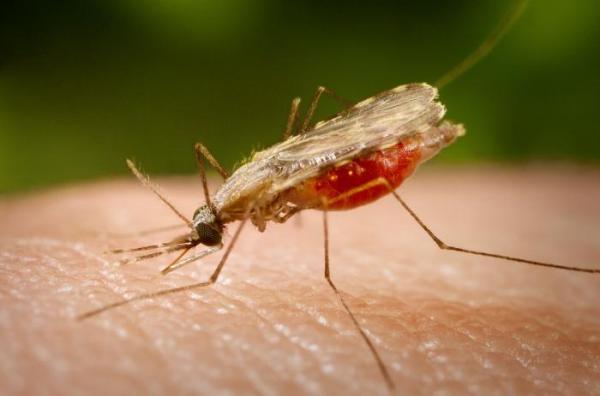
Mosquito James Gathany/CDC

Researchers at Vanderbilt looking for better ways to control the spread of malaria have stumbled across an insect repellent that is thousands of times stronger than DEET. But it doesn’t just work to confuse malaria-carrying mosquitoes. This new compound works against all insects, including flies, ants, and moths.

The compound known as VUAA1 was borne of recent discoveries about the fundamental way that mosquitoes smell. Just a few years ago, it was thought that the basic sniffing mechanism for mosquitoes was very similar to that of mammals--that is, that odorant receptors (ORs) sitting atop nerve cells are tuned to different molecules, and when a receptor comes in contact with its target molecule it notifies the brain via the nerve.

But mosquitoes’ olfactory senses works a bit differently. It turns out their ORs rely on a sort of nerve switchboard, a co-receptor called Orco. When an OR detects an odorant molecule, it activates while the other ORs on a given antenna remain deactivated. The Orco acts as a sort of switch that tells the brain which OR is activated, and thus what molecule is being detected.

VUAA1 is basically a molecule that triggers the Orco directly rather than the ORs seperately. Like a sort of universal signal, it stimulates all OR-Orco connections, essentially simulating the effect of all the different receptors on an antenna firing at once. For the mosquito, this creates sensory overload, like tasting something that tastes like every possible flavor at once. In the presence of VUAA1, mosquitoes basically can’t smell anything, which confounds their ability to sniff out blood or anything else.

Now the obvious question is: what else does VUAA1 do? The Vanderbilt team is working to better characterize the compound and to strip away any parts of it that don’t contribute to its effectiveness. They will then start testing it for toxicity and other attributes that might have negative impacts on people or the environment.

The good news is that even if there doesn’t happen to be a safe commercial application for VUAA1, the science is still there. Having found this unique means to overwhelm the common mosquito could lead to better future repellents that keep mosquitoes and other pests at bay (without being deadly/toxic), be it in malaria-prone regions of the world, in agricultural settings, or simply in the backyard.

[Science Daily]

13 Comments

Backpacking in Burma finally available to the common entomophobic.

Fascinating possibilities, depending on whether the testing finds it to be an environmental and/or health risk! On another note, I'm sorry for being a grammar nag, but "separately" is spelled incorrectly in this sentence in the article: "VUAA1 is basically a molecule that triggers the Orco directly rather than the ORs seperately." I'm an English teacher; can you tell?

not that DEET worked too well in the first place...

I remember traveling in India in the 80's. We were there for about 3 months. Some areas of southern India were absolutely infested with mosquitoes. Being very aware of the malaria risk we donned the 100% DEET formula to any exposed area, especially to our clothes. It was amazing how well it worked. It was rated for 8 hours. That was just about right. The mosquitoes swarmed me but did not land for about that long. After that, they started to land. Never got malaria!

side-effect: also repels the opposite-sex human.

I wonder if its targeted only to mosquitoes or if it also affects other insects and if so would that alone be basis to consider it environmentally damaging.

"This new compound works against all insects, including flies, ants, and moths." says the very first paragraph.

...And I am not spamming, Popsci spam filter!! If I were, i'd mention the softness of Bounty towels, the fun my family has in Disney, and the cool, refreshing taste of Sunny D.

...contains 5% juice.

sure, but what about bed bugs?!

Well said sir. Why no tool-tip?

OK, why is there a "link to this comment" option that does not in fact link to "this" or any other comment? something seems broken.

My previous was directed at Black hat guy. Though ontherok has a point. MRSA is scary.

LibertyTreeBud - I live in 'tic' world and when I say that I don't say it lightly. I can pick a tic just going to and from my mailbox. I've had tics fall out of the trees onto me. Some of them are half the size of a flattened poppy seed and smaller than that. Of course the two biggest vectors are the deer and raccoon and they aren't culled, to my knowledge. In my almost sixty years of life, I've never seen such an infestation of tics. Get something for tics and I'll be impressed.

I just got back to CAN, for an Eng conference in India, still sh/tting water and vomiting every 1/hr (almost didn't get let on the plane in Germany). Someone please expedite the commercial production of this. Although what I have is most likely some kind of e.coli.

What a colorful description to go along with such a pretty picture, Katie. :)


June 2013: American Energy Independence

Five amazing, clean technologies that will set us free, in this month's energy-focused issue. Also: how to build a better bomb detector, the robotic toys that are raising your children, a human catapult, the world's smallest arcade, and much more.


Online Content Director: Suzanne LaBarre | Email
Senior Editor: Paul Adams | Email
Associate Editor: Dan Nosowitz | Email
Assistant Editor: Colin Lecher | Email
Assistant Editor: Rose Pastore | Email

Contributing Writers:

Kelsey D. Atherton | Email
Francie Diep | Email
Shaunacy Ferro | Email

circ-top-header.gif
circ-cover.gif
bmxmag-ps