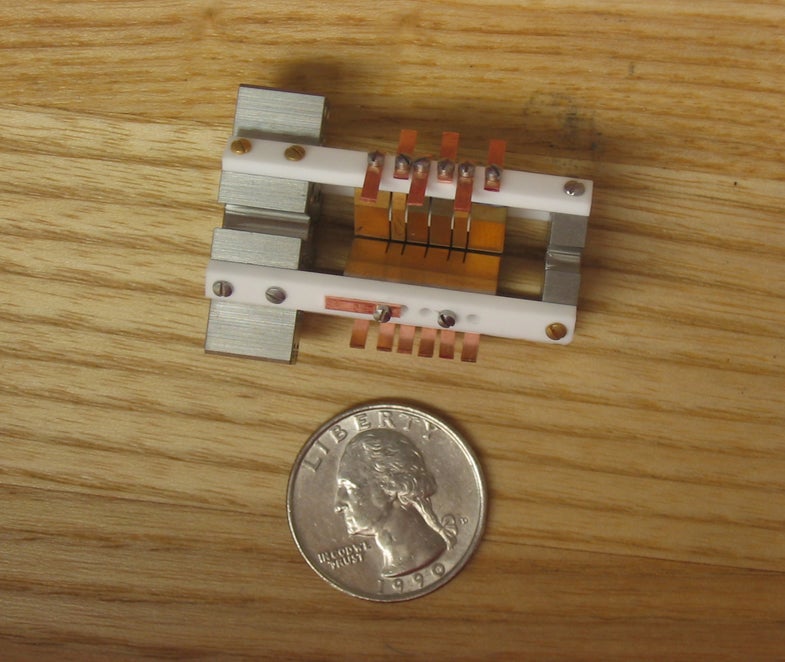
Quantum Logic Atomic Clock The ion trap where the main action takes place in the NIST aluminum ion clock. The aluminum ion and partner magnesium ion sit in the slit running down the center of the device between the electrodes. NIST

The slightest whisper of warmth induces miscalculations in the world’s most precise atomic clock, researchers say. Accounting for this effect can make future clocks even more precise, eventually leading to atomic clocks that lose only one second every 32 billion years — about two and a half times the age of the universe itself.

Hyper-sensitive atomic clocks are used for GPS navigation, communications between space probes and Earth, and quantum computing studies, among other uses. Timekeepers keep building clocks that are more and more accurate, meaning it takes them longer and longer to “lose” a second through small uncertainties.

Right now, the most accurate atomic clock is an aluminum quantum-logic clock, which is based on atomic energy levels in a positively charged aluminum ion. Its uncertainty rate is such that it will be off by one second 3.7 billion years from now.

Atomic clocks define seconds based on the oscillations between the nucleus of an atom and its orbiting electrons. If anything affects those electrons, their oscillation rates could change, making the clock less accurate. Researchers at the Joint Quantum Institute found that heat radiation can do just this — even when atoms are completely isolated and protected, as is the case in atomic clocks.

Any object at any temperature releases some warmth, whether it’s the sun, yourself or a perfectly radiant object called a “black body.” Temperature is tied to the speed and distance at which electrons orbit the nuclei of atoms — in very general terms, colder objects move more slowly and warmer objects move faster. Black body radiation enlarges the size of the electron clouds of an atom, which affects their oscillations. This BBR effect is one part in a hundred trillion, but when you want something to stay the same for 32 billion years, that adds up to a lot.

Now that scientists have figured this out, they can calculate how much the aluminum ions’ energy levels will change because of black-body radiation.

Current clocks are actually more inaccurate than the changes induced by BBR effect, according to a news release from NIST. But the next generation of atomic clocks will have lower uncertainties, so knowledge of the BBR shift will make them even better.

[ScienceDaily]

18 Comments

Why does this matter!?!?!? Making a clock slightly more accurate. Hurrah??? How about instead, we spend our time and effort curing the world from disease, hunger, and violence??
Priorities, PopSci...

@d.r.w.

Really??? You say that like popsci is actually funding this. All they do is report things like this which relate to technology and obviously this is and advancement in technology.

just wonder if nist has checked that maybe temp does affect time(in addition to gravity)...just a thought...

Making more and more accurate clocks is pointless. You can have a perfectly accurate clock, but the earth's rotation and revolution will still vary.

We wouldn't have GPS if people thought like d.r.w and Scythe (not to mention your wristwatch or pretty much anything else in the world you take for granted).

1) The idea that all money should go to "disease, hunger, and violence" is such simple minded thought, I almost can't believe it. It is on the order of your shouldn't have a TV, Car, telephone, ... because they don't directly change "disease, hunger, and violence".

2)"Making more and more accurate clocks is pointless." So you think that GPS is worthless? After all it is the accurate clocks that have made them possible, and not fact the "earth's rotation and revolution will still vary.", which a pointless for making a GPS work. A GPS would work on Mars and it is nothing like Earth, so what?

Having clock on you watch so that you are not late to a meeting isn't going solve the world's problems, but it does solve the problem of getting to the next meeting on time.

The super accurate clock will allow people to do things that they can't currently do even it you don't see the value in other people's jobs and pursuits.

@drwmathscience

Oh my god you are @#$%ing clueless. Without standards based on these hyper-sensitive clocks to measure chemical processes and physical properties any "disease, hunger, and violence" cures wouldn't be possible. Case in point without a hypersensitive clock at its core the electron microscope would not exist. And without the treatments discovered your imbred @ss would have probably been stillborn.

@Scythelord

While not angered by your comment, i find it disappointing in someone that would read popsci. Planetary rotation and orbital revolution would only affect traditional mechanical and astronomical clocks. Nuclear "Atomic" clocks measure the oscillation of individual atoms, on which the affects of gravity would be negligible.

sweet, now i will know the exact time to get to work

@drwmathscience and Scythelord

As mankind seeks to understand and control processes that are at the limits of our current knowledge and capabilities, advances in the measurment or control parameters of the experiment/process need to be made also. Time is one of these parameters.
Weather the measurment of time to such an accuracy is necessary depends on what one is doing. One field of study where very, very accurate measurments in time are necessary is the field of “Femtochemistry”. Below is the link to an introduction to this subject
//en.wikipedia.org/wiki/Femtochemistry
“Femtochemistry is the science that studies chemical reactions on extremely short timescales, approximately 10–15 seconds (one femtosecond, hence the name).”

Also here are some links to applications of this field of study:

“Photophysical and photochemical applications of femtosecond time-resolved transient
absorption spectroscopy”

//chemistry.asu.edu/laser/NewUser/Foggi%20Pump-Probe%20and%20data%20analysis.pdf

“Femtosecond Photoinitiated Nanoparticle Surface Chemistry”

http://www.bnl.gov/chemistry/programs/Nanoparticles.asp

Is this clock portable? I mean can it take vibrations, noise, cold etc... . I do not think my fridge needs this clock though.

Opps... A misprint occured when I pasted the Wikipedia quote in my previous post
-------
approximately 10–15 seconds (one femtosecond, hence the name).”
------

That should be 10 to the negative 15 power...10^-15.

it seems the popsci webpage does not recognize the same text characters as wikipedia and I did not catch it in the proof read before I posted it.

@tcolguin - Very well put. You hit the nail right on the head.

I don't know what to call it. Ignorance, simple-mindedness, ill-informed - what have you - some of these comments are really depressing.

To think there are people out there who think the understanding of TIME and the increasing ability to accurately MEASURE TIME is a waste need to learn a little something about time. Time is NOT the same in all inertial reference frames! (w/ respect to relativistic physics, of course). This means that the time you spend observing a high speed event ( such as the collision of subatomic particles ) is NOT the same amount of time the particles 'experienced'. And understanding how the particles 'view' time is fundamental to our understanding of how the universe REALLY WORKS and how we came to be.

Do you bashers really not find that mind-bending and intriguing? Time - something we thought was definite and determined - we're finding is really very 'flexible.'

To "understand" what this means:
Imagine you played a basketball game and the clock on the scoreboard ticked from 10:00(minutes) to 0:00(minutes). What would you say if the other team came up to you and said, "Hey, that was a fun seven minute game of basketball!" You would surely be confused. This is obviously a 'stretch' of this situation, however the fundamental idea is there. Would that make any sense? Of course not. But that's the way our universe works.

Some of you really need to read a book ( or watch the show "The Universe" ) and stop thinking we understand everything about the universe. And also - stop thinking we are "above" the universe. It could wipe us out in half a blink of an eye. FOR ETERNITY.

yes we as a life-form still have a long way to go. perfecting time isn't really gonna help humanity but in the long run it might.

Questions made in regards to the importance of making time more accurate are made because the commentators do not know the importance of such studies in their daily lives, but instead of bashing these people they just need more information this article really does not supply. Not everyone reading this article is a "rocket scientist". Consider the possibility of a lack of information instead of lack of intelligence after all they are making the attempt to read the article in the first place instead of spending time in an endeavor that does not broaden the mind at all.

I agree with you, RAM. A couple of comments were a bit harsh. Not everyone is aware of how everything works, so just let them know. The first thing I thought of when I read this article was GPS and other satellites, but I wouldn't have known the need for precise clocks had I not read those news clippings. Spread knowledge, but don't make people afraid of questioning.

For the last 15 years I’ve been doing engineering and implementing atomic clocks into telecom networks. The ones we install today are based on GPS / Cesium / Rubidium and deliver an accuracy 1E-11 or better. And there are thousands of them installed on each network. Without them it wouldn't be possible to transmit at the actual rates (10, 40 Gbps) without errors!

BTW, each GPS satellite have a couple of Cesium clocks

It's unfortunate that this is how clock accuracy is expressed. If someone came to you and said their goal in life was to create a clock that would not lose a second in the next 32 billion years, you might have them committed. The title of this article elicits such reactions so try to be nice. Keep it civil!

This stuff works. A while ago did a device that sensed temperature and "pulled" a crystal to compensate based on the individual temperature curve. Turned a 40 part per million crystal into less than 1 ppm. The big difference here was that the 40 ppm was a couple of dollars, while the 1 ppm was a grand.

Made a gigantic difference in communications -- if you're sending at one frequency and sure of the frequency to which you are setting your receiver, some neat things happen.

@ Nighthawkich
ooooo, you're a nasty one indeed!
Everything you said could have been said in a manner in which no one was offended. Everyone has their opinion. Why don't you respect that? You could have stated your opposition in a more civilized manner and then maybe you wouldn't have come off looking like some of those words you used.
IMHO....of course.


138 years of Popular Science at your fingertips.


Popular Science+ For iPad

Each issue has been completely reimagined for your iPad. See our amazing new vision for magazines that goes far beyond the printed page


Download Our App

Stay up to date on the latest news of the future of science and technology from your iPhone or Android phone with full articles, images and offline viewing


Follow Us On Twitter

Featuring every article from the magazine and website, plus links from around the Web. Also see our PopSci DIY feed


March 2012: The Future of Medicine

A 10,000-rpm, no-pulse heart is completely revolutionizing how we think about transplants. Plus: rapid-response virus hunters, a shocking cure for migraines, the world's youngest person to have achieved nuclear fusion (in his parents' garage!), and much more.


circ-top-header.gif
circ-cover.gif
bmxmag-ps