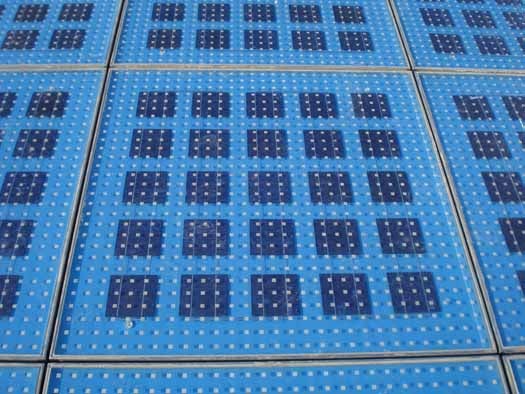
One of the major barriers between solar energy and solar-derived electricity is solar cells themselves--commercial solar cells aren’t very efficient at converting sunlight to electricity, but they are the best thing we’ve got. Now, a team of University of Michigan researchers have potentially devised a better way to convert solar energy into electricity: get rid of the semiconductor-based solar cells altogether and tap into the magnetic effects of light.
The researcher say the’ve essentially found a way to make an “optical battery” by extracting a very strong magnetic field from light, which generally exhibits weak magnetic effects. Those effects are generally so weak that until now scientists ignored them altogether. But the Michigan team found that by running light through a non-conductive material at the right intensity, the light field can generate magnetic effects 100 million times stronger than previously thought.
That’s more than a few orders of magnitude, and plenty to make those once-negligible magnetic effects quite interesting from an energy standpoint. By focusing this magnetic field on a material, it can be used to separate the positive and negative charges within the material, setting up a voltage. The discovery could lead to a new kind of solar cell that dispenses with semiconductors, instead relying on cheap and abundant glass for most of the components.The technique is not perfect. To work, the sunlight must be focused to an intensity of 10 million watts per square centimeter. That’s pretty intense--way more intense than natural sunlight--but the researchers are looking for other materials that could work at lower intensities. With better materials--and the researchers think they are out there--the technique could achieve 10 percent efficiency: on par with today’s commercial semiconductor cells, minus the costly semiconductors.
The incredible innovations, like drone swarms and perpetual flight, bringing aviation into the world of tomorrow. Plus: today's greatest sci-fi writers predict the future, the science behind the summer's biggest blockbusters, a Doctor Who-themed DIY 'bot, the organs you can do without, and much more.


Online Content Director: Suzanne LaBarre | Email
Senior Editor: Paul Adams | Email
Associate Editor: Dan Nosowitz | Email
Assistant Editor: Colin Lecher | Email
Assistant Editor: Rose Pastore | Email
Contributing Writers:
Kelsey D. Atherton | Email
Francie Diep | Email
Shaunacy Ferro | Email
political and captial might is the death of anything cheap and abundant.
We could've had cheap and abundant hydrogen cars since the 70's... but they literally killed that idea.
I would envelop the material in low-density hyperspace energy which has a low speed of light of 1 meter/second. Since electromagnetic fields are subject to the Lorentz transform, as shown by Feynman, the magnetic field could be increased substantially.
Seems impossible to literally kill an idea.
Now were talking 'cold fusion' theories again here folks with promises that have not been proven and so why waste our time?
@trueperspective, the government didnt really do away with hydrogen cars. they are just plain dangerous. hydrogen cells, if they explode, are extremely dangerous and explode violently. THATS why we dont have "cheap and abundant hydrogen cars"
The reason we do not have hydrogen cars is two fold. The first is storing enough material portably to make an engine run for an acceptable period of time. The other is the BTU per mole of hydrocarbon far surpasses that of pure H2. Fuel cells may eventually cause H2 to be an acceptable fuel but we are not quite there yet. Also it takes a lot of energy to make H2 from hydrocarbons and is not a very green process. H2 from electrolysis of water is not efficient enough to be cost effective at the present. Many road blocks still exist but the explosiveness is no worse than gasoline. The issue there is a H2 fire cannot be seen. It is utterly invisible at normal atmospheric pressure. This is what makes it more dangerous than gasoline.
Sounded pretty good until I got to the point where the light has to be focused to 100 million times concentrated beam in order to get that 100 million times stronger magnetic field. That is a seriously difficult challenge, especially to do it cheaply.
There are other interesting variations. GE has been working on an array of nano-scale antennas to do the same thing and Rosestreet Labs is working on solar cells that are 50% to 70% efficient.
@wltstab1: You are seriously both ignorant and irresponsible to spread FUD.
In tests required by law, hydrogen has routinely shown that it is far safer then gasoline. Hydrogen is lighter then air, and in most tests the flame rises safely above the car. Not the case with gasoline.
Next, hydrogen is not explosive unless it is mixed with pure oxygen. Without pure oxygen, it just burns (really well).
Finally, the number reason we do not have hydrogen cars can be broken down to a simple 3 letter acronym "ROI". Yes; Return On Investment.
The people that have invested *trillions* of dollars in our infrastructure want to earn their share of profits before they invest in a whole new multi-trillion dollar infrastructure.
Its one thing if you are misinformed or ignorant, and quite another to spread Fear, Uncertainty and Doubt (FUD). If you don't know what you are talking about, please STFU.
There are many reasons for not using hyrdrogen cars, but I'll quote one person "The inherent inefficiency of the entire hydrogen fueling process, from generating the hydrogen with that electricity to transporting this diffuse gas long distances, getting the hydrogen in the car, and then running it through a fuel cell—all for the purpose of converting the hydrogen back into electricity to drive the same exact electric motor you'll find in an electric car." Thermodynamically, each additional step in the conversion process decreases the overall efficiency of the process."
Simply put, it's must easier to use electricity which is everywhere and put money into better batteries instead.
For those saying that the government or big business is evil because they're trying to stop it is pure conspiracy theory.
And of course if there's a reason any new technology isn't being made, it's because no one can make money off of it. Which should be obvious since that's how the economy works.
I recently watch a episode from 60 minutes, where a USA company is developing the ability to make perfect diamonds, with consistent diamond characteristics, any size and shape. I wonder to myself if this technology combine with this technology of this article could make a big leap in solar energy development. My imagination wonders, hmm.
@JohnStClair,
"I would envelop the material in low-density hyperspace energy..."
1) wtf are you smoking...
2) instead of "woulding" it, go F'ing do it then.
On Topic; I remember being pretty impressed with U of Michigan's solar car and that they had a couple novel approaches. I won't be one to say that it can't be done; especially with all the advances in materials science lately. It's quite possible that their needed material medium is out there somewhere. It could well be sitting in another university somewhere in the form of a custom crystal they grew, but couldn't use for some reason. There are a lot of them out there.
There are many hydrogen cars running the roads. GM has several different types built over three decades. Honda also has several working models. Norway has a stretch of highway 500 kilometers long with hydrogen fueling stations. Japan builds several models to sell in Norway. The guy that owns "Lumber Liquidaters" is putting hydrogen fueling stations at his stores from Maine to Florida.
Hydrogen is the lightest element. It is so light that it travels up through our atmosphere at a lightening speed. If you should shoot a tank of hydrogen you would cause a stream of blue flame to shoot from the tank directly upward that would last just a few seconds. There would be no bang, no explosion. Hydrogen is cheap and can be produced in several ways anywhere at anytime of day. A small windmill and a finger size stream of water will do, but General Electric and many other companies have several machines they've been building for more than thirty years. Norway has been producing hydrogen since the 1920s.
The reason we aren't driving hydrogen cars is because we have the Oil, Gas, and Coal industries and all the pension funds owning lots of their stock. You start talking hydrogen and they send out their army of misinformation talking heads and bloggers.
The science community is dragging its heels wanting to perfect the hydrogen systems before we build them in mass - If we followed the same thinking with other things we would not have cars yet or home heating systems, TVs or any other human made thing - we don't do perfect very good. The first gasoline's had an octane rating of 11 to 15 now that's 87 or above. We've always improved things on the go.