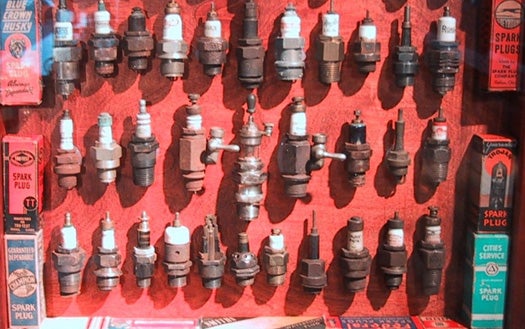
Spark Plugs Could Go the Way of the Hand Crank Chris 73 via Wikimedia

The spark plugs driving combustion in your car may soon be getting an optical upgrade, thanks to a team of Japanese researchers. Laser ignition systems, which are exactly what they sound like, could replace spark plugs as the primary means to ignite the fuel-air mix in engines, boosting fuel efficiency and cutting down on carbon emissions.

In a conventional combustion engine, the fuel-air mix is compressed by a piston and ignited by a spark plug seated in the top of the cylinder. That spark is generated by electricity arcing between two electrodes, which is a good enough way to ignite fuel but also limiting in what kind of fuel you can burn.

With spark plugs, the fuel-air mixture has to contain a certain amount of fuel, otherwise the spark won’t ignite it. A hotter spark will ignite leaner fuel-air mixes (mixtures with more air, less fuel), but hotter sparks will also degrade the electrodes. An ideal engine would run on leaner fuel and supply a hotter spark, and that’s where lasers can deliver. And hotter ignition is just the beginning.

Laser ignition can be finely tuned to be more precise than spark plugs as well. If you were to slow down the four-stroke cycle you would see that the exact timing of the spark plug ignition is erratic and difficult to predict. Laser could provide better timing, making the combustion more efficient and improving overall economy.

Further, lasers can be focused to provide ignition anywhere in the cylinder (spark plugs generate their ignition at the top, opposite the piston). Laser ignition could focus the ignition in the center of the compressed fuel-air mix, allowing the controlled explosion to spread out more evenly within the cylinder, deriving even more bang from each stroke. Laser can even ignite the fuel in two places simultaneously, creating an even more efficient explosion.

Previously lasers with the power to do all of this were possible but unfeasible. They were large, unwieldy, and unstable. But new high-powered ceramic lasers developed by the Japanese team are just 9 millimeters in diameter and capable of the finely tuned nanosecond-duration blasts necessary for precision engine timing. Until we figure out that whole smart grid/hydrogen economy thing, laser ignitions could go a long way toward trimming fuel costs and otherwise making conventional engines more carbon efficient.

[The Register]

12 Comments

OMG I WANT

Will this directly replace spark plugs, or will we have to replace a good part of the ignition system?

You know, I have one simple request. And that is to have sharks with frickin' laser beams attached to their heads!

Sounds like a great idea

If you have to replace your whole system (as amccue asked) then it will have trouble catching on imo. I'd love to get some though if they're a direct replacement.

Typical ignition system in a car puts out upwards of 20,000 volts, would probably be enough to run a laser too.

It's not just about the voltage that a car's ignition system puts out... unless this were to be a rudimentary one shot laser system. If they were going to implement the features they mentioned in this article, firing two laser shots at once to ignite the mixture in multiple places, or adjusting the angles and depth of fire on the fly, there would have to be added computer controls to regulate the system. Which could be added without necessarily replacing your engine, but it would be much more in depth than simply replacing your current spark plugs with laser plugs.

this is great. i bet lasers are safer as well. plus they have pinpoint accuracy. we are really living at a good time in technology.

I think the IC engine will be abandoned due to the fact that it is most likely a major carcinogen.

Lasers are a very inefficient way to transfer energy. The laser also has to hit somewhere and the target would deteriorate with hundreds of high temperature hits a second just like the spark plug. I'm not sure what you're gaining here.

yeah a laser idea doesn't sound so great. Any sort of buildup on the front of the laser could really mess with the beam. I'd be willing to bet people will take those high temp lasers out to play with though.

By the time these became really well tuned and available, I wonder if each plug could contain an integrated computer control to read the conventional ignition coil pulses.

Plus, can't you design a laser to have a short-range focal point? Beyond that, the beam would diverge, diffusing the heat concentration on the far wall of the cylinder.

Premium performance offered by Bosch platinum plus and also has excellent value while the Bosch platinum-Ir fusion delivers ultimate in spark plug performance and long service life.
http://autoplicity.com/manufacturer/95-bosch-spark-plugs.aspx?categoryid=53


June 2013: American Energy Independence

Five amazing, clean technologies that will set us free, in this month's energy-focused issue. Also: how to build a better bomb detector, the robotic toys that are raising your children, a human catapult, the world's smallest arcade, and much more.


Online Content Director: Suzanne LaBarre | Email
Senior Editor: Paul Adams | Email
Associate Editor: Dan Nosowitz | Email
Assistant Editor: Colin Lecher | Email
Assistant Editor: Rose Pastore | Email

Contributing Writers:

Kelsey D. Atherton | Email
Francie Diep | Email
Shaunacy Ferro | Email

circ-top-header.gif
circ-cover.gif