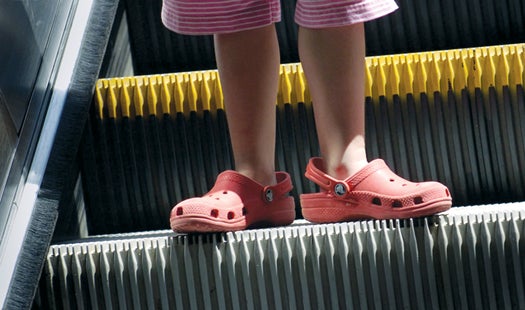
The escalator was patented in 1892, and the design hasn’t changed much since then. The landing platforms make entry and exit dicey endeavors—particularly when the moving stairs disappear beneath them, and all manner of clothing and body parts can get stuck. In recent years, escalators have torn the big toe from a Croc-wearing child in Singapore, bucked dozens of riders in Washington, D.C., and strangled a tipsy sushi chef when the hood of his sweatshirt got caught in the gap between the stairs and the landing platform.
One of the worst escalator accidents in modern history occurred in 1987, when a London Underground station escalator exploded, billowing flame into the ticketing hall. Thirty-one people died. The cause was found to be pounds of “fluff”—bits of paper and lint—and grease that had collected in the inner workings and undercarriage of the machine.
Since then, deflector brushes, emergency stop buttons and automatic sprinklers have been added to many escalators. In 2002, New Delhi’s Metro system opened with escalators that featured modified landing platforms and trays to collect hair, dust, water and oil and keep them from entering the gears. The platforms also prevented sari-wearing patrons’ clothing from getting caught.
David Chan, the director of the Centre for Information Leadership at City University London, says escalator design hasn’t changed radically because there is “no incentive for escalator manufacturers to do anything different.” What’s in place is safe enough, and, he says, the international standards make systemic change very difficult to implement. Four companies (Otis, Schindler, ThyssenKrupp and Kone) dominate the market.
Last year, Chan and Jack Levy, a mechanical-engineering professor at City University, unveiled a moving staircase called the Levytator that doesn’t double back on itself like a conveyor belt. Instead it loops so that a single installed escalator is actually two moving stairways, up and down. In between the stairways, the Levytator levels out as a moving walkway. There doesn’t have to be a landing platform, so it’s safer. And, Chan says, repairs are far easier, because only a stair or two needs to be removed at a time. Regular escalators must be entirely dismantled.
There’s an alternative, of course: plain old stairs. But nearly 12,000 people die in the U.S. every year after falling down a staircase. Moving up and down, it seems, always has its risks.
Have a science question you've always wondered about? Send a tweet to @PopSciFYIGuy or email to fyi@popsci.com.
138 years of Popular Science at your fingertips.
Each issue has been completely reimagined for your iPad. See our amazing new vision for magazines that goes far beyond the printed page
Stay up to date on the latest news of the future of science and technology from your iPhone or Android phone with full articles, images and offline viewing
Featuring every article from the magazine and website, plus links from around the Web. Also see our PopSci DIY feed
A 10,000-rpm, no-pulse heart is completely revolutionizing how we think about transplants. Plus: rapid-response virus hunters, a shocking cure for migraines, the world's youngest person to have achieved nuclear fusion (in his parents' garage!), and much more.
The best part (not that the accidents are good) about one Croc-wearing accident is that someone is trying to sue the shoe company for not having "safety features" in their shoes.
Google: Parents Sue Crocs After Child's Foot Is Maimed in Escalator
I love the 12k people who die in the U.S. every year! Guess I'm using the elevator... Seriously?
Anyone else thinking of that scene from Mallrats?
"I can't believe it! That kid is back on the escalator again! I hope her pants get caught and a bloodbath ensues. Don't get me wrong; I don't wish the child any harm. I just think her parents should have to suffer that horrific ordeal to learn how to better manage their child!" -Brodi
@combatko Ha! Mallrats, haven't seen it in years. Seriously though, this article is not worth the 2442 bytes it was published with. At least give one comparative stat!
FYI, this is the best I could find:
"Worldwide, there are 10,000 accidents on escalators every year, including several deaths. On two occasions I've seen people piling up at the bottom of an escalator and had to press the emergency stop button." -Jack Levy, professor of mechanical engineering at the City University in London
Ah, that's why there are no numbers given, the deaths/rider-mile is so insignificant it's not worth mentioning. Useless filler of an article IMO.
When will people realize you just can’t engineer out Natural Selection...
At the mall down the road from me, a kid fell off the escalator and fell on the glass display of jewelry and later died at the hospital. I was actually in the mall when it happen but in a different part, had no idea it happened. I even walked through the store later and saw all the caution tape up. Later on the news I heard what happened. Poor kid.
From a retired Elevator/Escalator journeyman from NYC: Having worked on ecalators in constuction & maintainance I know from experiance that most of the accidents are caused by misuse, or the desire to collect money in phony law suits. Some of the legit ones are caused by curious children not being watched over by their parents. In one case a parent allowed her chubby cheeked child in shorts to sit on a step as it entered the "Comb plates" He required many stitches! Some parents belong in jail. Watch them in airports, paying no heed to children playing at the luggage turntables and putting them at risk to losing their arm, fingers or even life. I had a elderly lady climb over barigades to ride a moving DOWN esclator which had several steps taken out inorder for us to work on it. She would have been hamburger if she'd stepped into the hole. Her husband had walked down the adjacent stairs and admonished her.