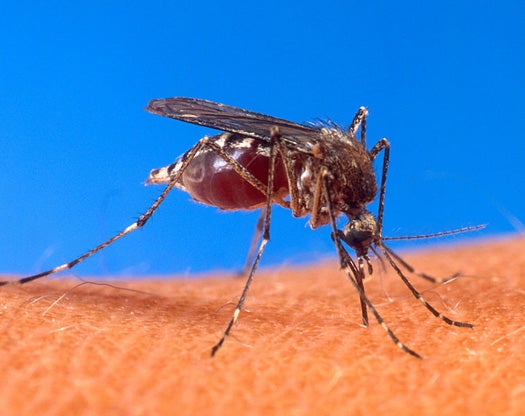
Scientists have taken a big step toward curbing the impact of malaria across the globe, but the breakthrough didn’t occur in a pharmaceutical lab. A collaboration between researchers at Imperial College London and the University of Washington has produced a gene that the team was able to effectively spread from just a few mosquitoes to most of a population in just a dozen generations. Armed with malaria inhibiting characteristics, such a gene could combat malaria at the source.
Genetically modified mosquitoes are a touchy subject in some corners of the world where malaria is most rampant, but they could be the most effective way to slow the spread of the malaria parasite in the wild. But before GM mosquitoes can be effective, researchers have to find a gene that will survive through generations. If the gene offers no evolutionary advantage, it will likely die out.
The researchers circumvented this problem by inserting a gene into the mosquito genome that is quite adept at staying alive. Homing endonuclease I-Scel makes an enzyme that cuts DNA in two. When it does so, the cell’s repair mechanisms kick in, using the gene as a template when repairing the DNA. This cycle repeats itself, each time producing a copy of the original gene.In this way researchers were able to create male mosquitoes in which every sperm they produce carries the gene. Their offspring carry the gene, and so do their offspring. In laboratory experiments, the team inserted just a handful of GM mosquitoes into a population. Twelve generations later, half the mosquitoes were carrying their modified gene.
If researchers can now “weaponize” the gene to inhibit the development of malaria, GM mosquitoes could be released in malaria-prone locales to mingle with wild populations, killing malaria bugs in the cradle. That opens up a whole new conversation about the dangers of GM organisms and the law of unintended consequences. But it’s nice to know that, if called for, we can wage genetic warfare on an illness that generally kills at least a million people per year, most of them children.
[BBC]
Five amazing, clean technologies that will set us free, in this month's energy-focused issue. Also: how to build a better bomb detector, the robotic toys that are raising your children, a human catapult, the world's smallest arcade, and much more.


Online Content Director: Suzanne LaBarre | Email
Senior Editor: Paul Adams | Email
Associate Editor: Dan Nosowitz | Email
Assistant Editor: Colin Lecher | Email
Assistant Editor: Rose Pastore | Email
Contributing Writers:
Rebecca Boyle | Email
Kelsey D. Atherton | Email
Francie Diep | Email
Shaunacy Ferro | Email
The gene therapy that effectively controls the spread of those pesky humans is just around the corner. Wormwood
This won't ever happen no matter how perfectly safeguarded and studied it is. People are to scared of genetic modification and honestly don't understand that we naturally do it through mating or through cultivation of crops. It's not direct manipulation but still results in the same thing.
If it wasn't for the whole "messing with the natural order of things" I would suggest this is a good idea. They don't have to totally get rid of mosquitoes, but if their genetic work saves lives, that would be a good thing.
But now they have to take their time to see what, if any side effects may occur. Hopefully, they will be minimal or non existent. But that's probably wishful thinking.
I always said that it would be cool if they could use genetics to get rid of, or somehow alter the Pine Beetle that is ravaging the forests of northern British Columbia. However, the same problem of messing the natural order is still a roadblock.
I believe that this is a good idea. We have to mess with the order of things responsibly. People who believe otherwise should come up with the solution to ease the suffering of others. In the end naysayers only want things to be the way they are with out coming up with a solution to the problems that we face. GM products are sometimes the only thing i believe that can cure hunger and disease. If you can GM a crop to grow in Africa in its harshest conditions and save lives there will still be haters that believe it shouldn't be done. Yet those on the other side almost never have a solution. We have to stop accommodating to dumb people because ultimately dumb people never accommodate to us. I live in Malaysia where we released GM mosquitoes to combat Dengue fever. So far so good. No one turning into zombies yet.
The Law of Unintended Consequences here is mute, because the consequence is known and intended. If you stop Malaria, a very preventable and treatable illness, then the population of 3rd World countries in the tropics will soar - leading to resource competition driven war, famine, and destruction of natural resources.
These kinds of "cures" help with class guilt, but they do not change the paradigm of quality vs. quantity of human life.
The Consequences of anything action are never fully known, especially when is comes to a process as technical as this, at least not all of them, and i completely agree with the issue of a sky rocketing population, just because we can stop death doesn't always mean we should, thats were the true balance of nature is, not genetic mods. We have had no problem throwing natural selection, for humans at least out the window, but for some reason play god with genetics freaks everyone out.
There are more effective ways of which are cheaper and produce wealth for the infested area. Research Charles Campbell eradicated malaria in his local around 100 years ago. One bat can eat 1000 insects per day while producing fertilizer, bat guano, for crops.
I'm not against genetically modification.. just pointing out cost effective alternatives. The bat population has been devestated due to mining expansion without regard to replacing housing for the most effective mosquito predator.
Somewhere down the line, this will be patented. Then anyone surviving childhood in those danger areas will have to pay a fee for *not* getting ill and die.
@toret: this would be a horrible product for profitability. As soon as even 1 GM mosquito was released the process would begin and good luck stopping it them. It's not the kind of product an individual buys.
As for the comments that saw we should do it because of potential wars and resource shortages...one step at a time. The world is far from perfect but that does not mean we should give up on humanity. This is but 1 example of people trying to help people; who does your pessimism help?
we are messing with the planet at every turn, this is not any different, if it works use it, we are already messing with the genetics of the planet by deciding what lives or dies (mostly dies), lets see...do you think maybe third world countries have more children than developed countries because less of their children survive? they will have fewer children when their survival rate goes up
As long as the gene would not inhibit the growth of the mosquitoes and ONLY prevent the Malaria parasite from developing in them, I'm 100% for this. However, killing off mosquitoes is not the solution, because they are pretty low on the food chain, supporting a huge amount of higher life forms. Other insects, mammals, and birds all depend on the abundant mosquito population in many areas, whether directly or indirectly.
Keep mosquitoes themselves out of the crosshairs - as long as they don't carry disease, they're basically harmless, and they support everything that eats them or eats things that eat them.
can someone please summarize this..