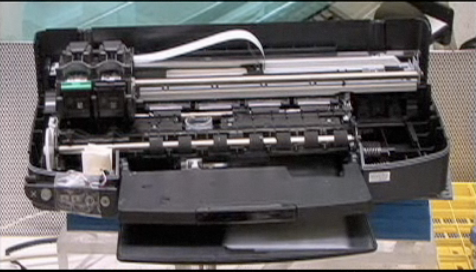
Anthony Atala wows the crowd

Tissue Printer via TED MED

Updated: One of PopSci’s favorite regenerative medicine specialists, Anthony Atala, printed a biocompatible model of a human kidney on stage at the 2011 TED conference Thursday, in a technique that could someday be used to create new organs from a patient’s own tissue rather than relying on donated organs.

“It’s like baking a cake,” Atala said.

A few years ago, Atala figured out how to produce human tissue with a desktop inkjet printer, using cells as the printer ink. In a TED talk last year, he described printing heart valves and other tissues. This week at TED, he brought one of his patients on stage. When he was 10, Luke Massella was among the first people to receive a re-engineered organ — he was born with spina bifida and received a new bladder grown from his own tissue. Now he’s a healthy college student.

The organ-printing process employs scanners that collect a 3-D image of the organ that needs to be replaced. A small tissue sample seeds the printer, which replicates the tissue layer by layer to build a new organ, all in about six or seven hours. It would use the patient’s own tissue, so it avoids any organ rejection issues.

During Atala's talk, a specially designed printer was about three hours into printing a kidney model built out of biocompatible materials. He also brought a completed model to show to the audience.

Initial reports suggested Atala had printed a working kidney, but it was actually a kidney-shaped mold with no internal structures or vasculature, according to Wake Forest University Baptist Medical Center, where Atala is a regenerative medicine specialist.

He said someday, scanners and printers could conceivably be used to treat wounds. A flatbed scanner could scan a patient’s wound, while a printer adds the right types of tissues to fill it back in. “You can print right on the patient,” Atala said, according to a report on the talk at Fast Company.

Atala also described using a patient's failed organ as a scaffold for a new version, filling it with new tissue. This could help address the challenge of building blood vessels, which remains one of the greatest challenges in tissue engineering.

Atala said about 90 percent of people on organ transplant lists are waiting for kidneys, but donors are few and far between. Meanwhile, patients must undergo painful and complicated dialysis treatment. And mechanical replacements are still a few years away. Atala said regenerative medicine could one day solve the organ shortage crisis, replacing failing body parts on demand. 


[via Independent Online]

Correction: An earlier version of this post cited coverage by the Agence France-Presse newswire, among other sources, which incorrectly reported that Massella had received a printed kidney 10 years ago and that Atala printed a functional kidney onstage. In fact, Massella received a re-engineered bladder, and Atala printed a dummy kidney mold to demonstrate how the technique could provide transplantable organs someday.

27 Comments

Why in the world is this not being further explored and put into production you freaking kiding me talk about saving lives give this guy a medal and all the money he needs. I mean seriously

I am confused. Such technology exists? I mean, right now? At this very moment, you can print working organs? A successful printed organ was implanted 10 years ago? WHAT?

Why is this not being used? What is going on here? Why isn't project given all needed funding to fast track its development?

@Siromar

You've heard it before, There's no money in Cures.
They get in your wallet one time for a cure.

But to prolong your life with medication is where "they" make there chunk.

WOW!

Agreed, if this technology works NOW, then why in the world are people still dying waiting for organ transplants?!

I am sure he is in no need for money but full testing of this takes time. Yes this is a great step taken and now it's developed enough to show it to the media but don't let the shock value let us get ahead of ourselves. If its not been released yet I assume it's because Atala is just being thorough.

I know that time is against some people but you don't want to start rolling it out and find out something obscure that causes major problems. (note next is not true or scientific for that matter but it's a decent example that's easier to understand) Say when your body goes to replace the cells in the organ something goes wrong and it becomes inflamed. Your immune system attacks the printed cells. Since they're the same as your own cells it begins to attack other parts of your body.

When you deal with the human body like this you have to be right.

Good job Atala and good luck!

And actually this will make companies more money that the treatment. You have to have the surgery anyway. Now instead of a donated Kidney they can charge you for it.

Just like fission and perpetual machines... It's all kept under wraps by the pharmaceuticals and oil giants by buying the patent and just putting it in the "round" file... If such technology got released the rich will get poor and the poor would be healthy and happy... But hey this is America, land of the ignorant and home of the backstabbers

This would be all over the regular news if a viable kidney was printed. So, obviously only a kidney shape from kidney tissue was printed.

Another method would be a campaign the elderly people to donate a kidney. Some internal organs have a much larger life span then the rest of your body. Because the elderly have a very short life expectancy the extra kidney is less of a needed back up. Plus kidney rejection is rather large any way. So, more kidneys are more life.

Uh...wow. This guy's going to single handedly affect an enormous leap in life expectancy. Not to mention cosmetic surgery (scrape of the face and print a new one?)

This has to get approval from the FDA before it is allowed to proceed out of the experimental stages.

This can take a LONG time.

To give you an idea Darpa is getting the FDA to fast track something so it should only take 4 years.

If the FDA had better funding they could hire more people to work on things like this. However their funding is often cut to save budgets.

That kid got a bladder not a kidney.

The FDA is too busy banning harmless substances that cause great harm to the moral fabric of this nation. Please leave a message and they will get back to you as soon as they feel like it.

thats sick and ill!!! for sick and ill people...

if you can print a fully functioning organ can you print a fully functioning pearson? kinda like cloaning... yes i know it a touchy subject but w/e.

or maybe print a fully functioning body without a brain and just implant a dying persons brain into it if their other body is too old or w/e.

man Id like a fresh body! eventhough im not that old.

"sometimes it takes a thousand notes to make one sound"
-Buckethead

“You can print right on the patient" Can I print skin on my new sex doll?

@tmarti69, careful with that logical, common sense approach otherwise you will hear talk of death panels...

This is either bad science or bad reporting. I know it's a third-party article, so it's not PopSci's fault. There are so many problems with this that I don't know where to begin.
- Desktop inkjet printers print in two dimensions. A kidney is a complicated three-dimensional object.
- The resolution of inkjet printers may be high, but not good enough to duplicate the intricate microstructures of living organs.
- Inkjet printers print by either boiling liquid or forcing it through jets with piezoelectronics. Both forces will destroy living cells.
- A desktop scanner can't scan in 3-D.
- Consumer hardware is far from hospital-quality, never mind sterile enough to use to create tissues.
I'd love to hear about the "real" breakthrough in a "real" article and dispense with this fantastic hype.

and we thought colored ink was expensive...

@gsearle

1. A modified printer like this is capable of printing a 3d object. It does so by depositing a layer by layer of material in pattern, in this case human cells. That is how 3d printers work you can buy a fully functioning one for home for around 1000$ us now from HP.

2 Actually the resolution needed can be achieved as they are not printing out individual cells, just the structures of veins and capillaries using the cell as an ink.

3 that is a very simple mater of changing the design of the print head on the cartage. you can do this as a DIY project at home if you want.

4 You would not use a standard bright light desktop scanner for 3d organ structure scanning. You would use a high resolution 3d laser scanner to do that. They are commercially available and are used daily in many industries, From medicine, engineering, even video game design.

5 Hospitals use consume grade hardware all the time in every aspect of medicine. as far as sterility that is a mater of cleaning not something that is inherent in the equipment.

This is not new information the Dr. has been able to do this for a while. if you want more information please go to the TED website. or do more research.

As for the normal media, they do not cover this sort of thing. There is no Charlie Sheen angle and no Justen Beeber, also this does not fit conveniently in any political theme or narrative so it is non news according to our media.

That is why Pop Sci exists. To get this sort of information to people.

We can reexamine our tools and elements for an organ printing approach. Hydro gel creates a growing space for veins and is not rejected by the body it is heat resistant, but is mostly fluid. Silicone is not rejected by the body and can vary in density and strength. Bio plastics can be made to dissolve in the body at a controllable rate are strong durable, but plastics require a heat process.

So, we find the balance use hydro gel next to cells and melt bioplastics next to hydro gel. The hydrogel will protect the cells from heat damage from melting bioplastic. Create a 3d cell, hydro gel printer, and a CNC heat based Makerbot like bioplastic printer combined. Basically we create temporary veins and arteries out of strong bioplastics coated with hydro gel. The thickness of the plastics control how slowly they dissolve. The hydro gel allows for new vein and artery cells to grow in them while at the same time preventing blood clots.

The main problem preventing organ printing is creating a vasculature I think they will solve this but kidneys will still be the bulk of the organs needed and that has constriction cells that form variable membranes. I don’t necessarily see any easy solution for the complexity of kidneys.

The reason this isn't being used to solve the problem with patients waiting on organ donors is because kidneys are vastly more complicated than something like a bladder. A bladder essentially only uses two types of cells, and those are organized in a way that's not difficult to model. A kidney uses many more types of cells, and due to how they're arranged in the organ, it's far more difficult to make.

Even still, the technology is pretty amazing. I've toured his lab myself, and seen some of the diagrams of the organs they were trying to create. That was a just a couple years ago, and at that point he hadn't succeeded in making a model yet, so he seems to be progressing quite quickly. I'd be surprised if this technology isn't available within a decade.

This really is a breakthrough, much works needs to be done, but this is such a promising technology...way to go!

Hmmm. You know somebody did the same thing to a mouse heart useing the "scaffolding" of the tissue of the mouse they took a xerox printer filled it with the "scaffolding" printed out a heart, took live tissue of the mouse and implanted in the mouse heart let the muscle tishue grow all while outside the mouse. once the muscle grew the actually made it beat. Watched it on NOVA,

STUPID DRUG COMPINIES, MONEY HUNGRY PIGS!!! I know dam well they could make a cure for most ailments and serious illnesses but nooooo, they see a profit on sickly people. (not dissing hopitle people)

@Ak_ninja49

I wish i saw your comment before i posted the other one all well...... Anyway i know what your saying, to many good folk are dieing or are dead because the big people who were once at the bottom swore to make the world a better place but got stuck looking up so they forgot the people on the bottom.

Nope. Not gonna happen. People get the organs they need, they live longer. They live longer, they collect more social security and use more medicare. Therefore, they cost the government more money.

Not to mention that the drug companies will lose billions.

It is a shame though. It sounds like a very promising technology to be swept under the rug.

@tmarti69:
You may be on to something though. There may be a market for seniors kidneys. Pitch the concept to Pfizer. If they have constant kidneys to keep doling out, it may be as profitable as Viagra!

People it's not about money! I'm sure he has plenty of support and probably even more people giving his research money as well, but these things take time. The intricacies of the blood vessels is the main problem. Then add on to that the politics of stem cells. Just think about it, he could have been doing this demonstration during the G.W. Bush's presidency if it hadn't been for the stem cell restrictions.

If you want to watch the TED talk that is mentioned you can see it now on hulu.
Or if you want to learn more about engineered organs there's an episode of Nova Science Now at the PBS website titled "Can we live forever?"

@sephiroth2906 Actually, I think they'd do it because we would then be able to work longer and with replacement pancreas, one of the most expensive chronic diseases, diabetes, would be curable.
As for other weaknesses the elderly might suffer, in a different episode of Nova Science Now, there is a part of the show called "Marathon Mouse" and it talks about Ron Evans of the Salk institute creating a drug that essentially turns "couch potato mice" into marathon runners.

It's interesting to see how many people think that "the man" is holding down science and technology here. The big drug companies typically don't play here because it has nothing to do with small molecule treatment. In short, it's outside their technical expertise.

More importantly, if this technology was ready for prime time, you can believe that Dr. Atala would have a start-up already going (I'd be willing to bet he's received offers for venture capital). Likewise, Dr. Atala would probably be interested in a Nobel Prize - I doubt he's saving the technology as an ace up his sleeve. Just because something can be printed on stage doesn't mean it's ready to be implanted.

There are tremendous advances here, but getting something to work in the body upon implantation can be just as a significant a leap than the initial discovery.


June 2013: American Energy Independence

Five amazing, clean technologies that will set us free, in this month's energy-focused issue. Also: how to build a better bomb detector, the robotic toys that are raising your children, a human catapult, the world's smallest arcade, and much more.


Online Content Director: Suzanne LaBarre | Email
Senior Editor: Paul Adams | Email
Associate Editor: Dan Nosowitz | Email
Assistant Editor: Colin Lecher | Email
Assistant Editor: Rose Pastore | Email

Contributing Writers:

Kelsey D. Atherton | Email
Francie Diep | Email
Shaunacy Ferro | Email

circ-top-header.gif
circ-cover.gif
bmxmag-ps