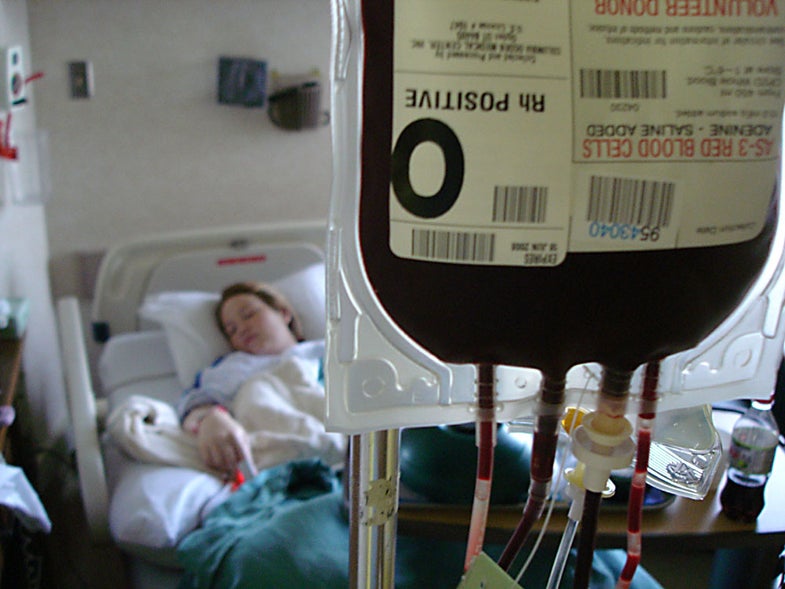
Blood Transfusion makelessnoise via Flickr

Anyone who has ever donated blood has learned his or her blood type, such as AB, O negative, etc., which will be matched to a recipient with the same blood type. If blood types do not match, a recipient’s immune system could reject the transfusion, a potentially fatal proposition. But a new method masks the type of donated red blood cells, possibly eliminating the need to test types and making it easier to give and receive blood.

There are eight common blood types, based on four major groups, which classify red blood cells based on antigens that are found on the cells’ surface. Foreign antigens can trigger a serious immune response. Type A has only the A antigen, Type B has the B antigen, and so on.

People with type O blood are considered universal donors, because they have neither A nor B antigens on their red cells, so a recipient’s body would be less likely to reject the blood.

The new method masks the antigens so there would be no immune response. It involves cloaking individual blood cells inside polymer shells, which hide the cells’ identity from the immune system. But oxygen can still penetrate the shell, allowing the cell to do its job.

Scientists have long tried to create an all-purpose red blood cell, one that doesn’t rely on typing tests or the kindness of donors with just the right type. Other efforts have involved polymers that can behave like blood, and DARPA has been funding research into blood pharming, which involves genetically engineering an organism to produce large quantities of synthetic blood.

Turning blood banks into universal stockpiles could be another solution. The study appears in the journal Biomacromolecules.

10 Comments

So... does the polymer wear off over time? And if so, is it going to be a really bad reaction? Or will it happen in such a spread out fashion that one "bad" cell every now and again won't be a big deal?

My question precisely. What is the lifespan of the polymer and what chemical composition is the polymer made of? Will the chemicals present an issue when/if they are broken down in the body? Do they accumulate in cells or does the body flush them? Will they interact with other substances causing a reaction?

No, the polymer is on for the life of the RBC. The main problem facing researchers is how to bind polyethelene glycol (PEG), the mystery polymer, to all the antigen receptors on the red blood cell...among many many many other concerns.

The "polymer" referred to in this article is actually known as polyethylene glycol (PEG) aka MiraLAX or for those who have had the pleasure of having GI surgery or a colonoscopy, GoLYTELY. Adding PEG to a drug has been around for a long time, the process is known as PEGylation. PEGylating drugs can help them last longer in the body, make them more water soluble, and as described in this article, make them less toxic or allergenic. PEG has been well studied and is readily metabolized by the body. There are several medications on the market currently that are known to be PEGylated, including antiviral medications used in hepatitis.

PEGylating a red blood cell (RBC) does not mean they literally coat the entire red blood cell in a candy shell like an M&M. PEG is a very tiny molecule that binds to protein receptors (antigens) on the RBC. Think of a RBC having protein tentacles that cover the entire surface, PEG simply attaches to these tentacles changing the way they look. To the body a foreign RBC looks like a scary tentacle monster, once PEGylated the RBC looks like a cute tentacle monster with mittens.

Giving blood is a very dangerous procedure with many risks. These risks can range from simple itching and slight fever to uncontrolled bleeding with kidney failure, to anaphylactic shock with death. Intentionally giving a person mismatched blood that has been “neutralized” will take much more research and procedural perfection of the PEGylation process before being fully accepted by the medical community.

Would it not be more efficient to induce erythrocyte specialization from stem cells?

Putting a coating on the donor's blood just doesn't seem practical to me. Its like adding another variable to the equation. I feel it will just complicate things.

Experience: none yet...just a student. =)

“Would it not be more efficient to induce erythrocyte specialization from stem cells?”

Depending upon what you are actually referring to I have two answers.

We can stimulate erythropoiesis by giving a drug known as Procrit aka epoetin. We can also assist the body to produce its own blood cells by treating diagnosing and treating the cause, for example an iron or protein deficiency. This is very time intensive, think in terms of weeks here.

The second answer to your question refers to if you are asking why we cannot use stem cells to grow the patient some blood. In order to do this we need to pull stem cells from the patient first and send it to a lab, wait a few weeks to a few months and then receive a product…if those capabilities even existed. The problem is time, most people who need blood need it now, within hours. Despite popular media stating to the contrary you cannot inject a person with someone else’s stem cells and hope for anything but a massive fatal allergic reaction. The donor cells still have to match…if they match why not just take some blood? This brings us back to the question, where do we get the stem cells from?

“Putting a coating on the donor's blood just doesn't seem practical to me. Its like adding another variable to the equation. I feel it will just complicate things.”

True, that is what worries me too. PEGylating blood does have two very big advantages that I have not previously mentioned. Reducing the antigen receptors can help to decrease the amount of adverse reactions from normal matched blood, remember that the ABO blood typing is only a hand full of many many many many antigens that can cause an adverse reaction.

The second great advantage is possibly being able to use non matching blood during a crisis or shortage. Think of a plane crash and 85 people suddenly hit a hospital(s) all at the same time, all requiring blood…lots of blood. There simply would not be enough to go around so the use of PEGylation would allow hospitals to fudge the matching a bit and administer not so compatible blood to patients.

Hi dear sirs. I can present an approach to the implementation of it. If you are still interested in my offer, please contact me: katin@mail.com
Sincerely,
Best regards!

I have worked in the Blood Bank industry for 22 years. While transfusion has risks to discribe it as "very dangerous" is just plain ignorant. We are a highly regulated industry and there are educational requirements as well as certification requirements to work in a transfusion service laboratory.

Mistakes happen, but fatal transfusion reactions are blessedly rare and the vast majority of them are caused by misidentification of the patient at the bedside and not related to testing the blood for compatibility. Testing for transfusion transmitted diseases has also dramatically reduced the risks of transfusion.

The benefits here are for urgent transfusion, which is why the military is so interested in it. As for the hospital market the need is far lower. We can almost always find adequate supplies of blood when we need it and no one is dying because we are out of blood. If someone bleeds to death it is because we cannot transfuse fast enough not because there is no blood to transfuse.

Lastly, in the current climate of wanting to reduce costs why are we even talkiing about adding what sounds like it could be as much as $10 per unit of blood to treat the cells? There are 14 Million donations per year. Do we really want to increase the aggregate cost of health care by $140,000,000 or more for something that offers little real benefit? While I can think of some extreme circumstances where such a blood product would be very helpful I cannot see the cost for the whole blood supply.

It's a cool idea and possibly a good niche product. And a quick google search shows that they have been working on it since befoer 2000 when they said they would have it perfected by 2005. Obviously there are a lot of issues that are still unresolved.

As for growing blood cells with stem cells, DARPA has been funding research in that area too. It costs about $5000 per unit of blood compared to about $200-250 for collecting and testing a donated unit. The miltary says that if they can get the cost down to $1000 it is good enough for them. That's nice but don't expect your insurance to pick that one up any time soon.

What is the title of the study as it appears in the journal Biomacromolecules?


June 2013: American Energy Independence

Five amazing, clean technologies that will set us free, in this month's energy-focused issue. Also: how to build a better bomb detector, the robotic toys that are raising your children, a human catapult, the world's smallest arcade, and much more.


Online Content Director: Suzanne LaBarre | Email
Senior Editor: Paul Adams | Email
Associate Editor: Dan Nosowitz | Email
Assistant Editor: Colin Lecher | Email
Assistant Editor: Rose Pastore | Email

Contributing Writers:
Rebecca Boyle | Email
Kelsey D. Atherton | Email
Francie Diep | Email
Shaunacy Ferro | Email

circ-top-header.gif
circ-cover.gif
bmxmag-ps