Unseen Currents: A Blind Oceanographer Chases Undersea Storms
On the Labrador Sea, the scientific crew of the research vessel Knorr hunts for underwater storms, sinks a two-mile mooring--and gathers clues to the planet's fate
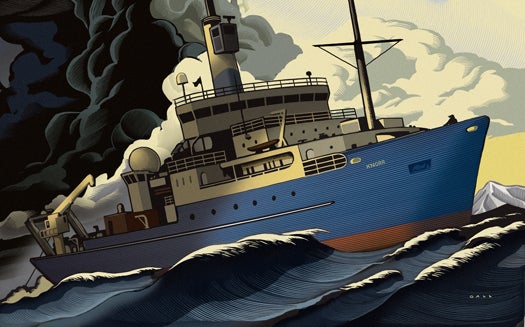
As we pass through the Strait of Belle Isle and emerge from the shelter of Newfoundland’s lee, the first mate pipes instructions from the bridge: Lash down or stow all belongings. Rough weather ahead. Two decks below in the main lab, Amy Bower loads onto her extra-large monitor what appear to be abstract paintings, giant red and orange blobs in a field of yellow, as her computer reads text aloud in a robotic voice. Nose almost touching the screen, she searches for clues in the colorful abstractions, which are in fact oversized topographical maps of the Labrador Sea.
A senior scientist at the Woods Hole Oceanographic Institution in Massachusetts, Bower is the chief scientist on the first leg of voyage 192, as it’s officially called—a search for the hidden weather that roils beneath the sea. She also happens to suffer from not one but two congenital diseases: macular degeneration and retinitis pigmentosa. She is legally blind. But in her 22 years as an oceanographer, she’s confronted winter storms on the North Atlantic and Somali pirates in the Gulf of Aden. With the help of her computer and other instruments, Bower can see the ocean far more clearly than most of us.
Weather permitting, voyage 192 will take us to Nuuk, Greenland, just south of Davis Strait. There, at 60.6°N, 52.4°W, we will deploy a “densely instrumented mooring,” a kind of underwater weather vane almost two miles long in waters two miles deep. Then, if all goes well, Bower will use the mooring to gather intelligence on Irminger Rings, a variety of “mesoscale eddy” spawned by the Irminger Current, a remnant of the Gulf Stream. Mesoscale eddies are underwater storms, submarine cyclones the circling currents of which attain a “swirl speed” of around one mile per hour—the speed, in other words, not of a hurricane or a gale but of a breeze. You can’t see mesoscale eddies, or feel them. You could be sailing on calm seas, at Beaufort-force 0 (“sea like a mirror”), and the underwater storm of the century could be swirling slowly beneath. Irminger Rings raise a bump on the ocean’s surface dozens of miles in diameter but just six inches taller than the surrounding water.
Mesoscale eddies may seem like the sort of thing only a scientist would care about. No one names them, after all, or watches them on the Weather Channel. They’ve never caused a ship to sink or a sailor to drown. Few people outside the world of oceanography have ever heard of them. Nevertheless, they are as much a cause and effect of the climate as floods and hurricanes. In their slow-moving coils, mesoscale eddies can transport up to 69 trillion cubic feet of water, along with flora and fauna and flotsam, seaweed and krill. If warmer than the water through which they swirl, as Irminger Rings are, they can also transport a great deal of heat. How much heat Irminger Rings transport, no one yet knows. That depends how many are out there, how long they last, how far they travel and where—obscurities Bower hopes her data will illuminate. Of one thing, however, she and other oceanographers are already certain: Irminger Rings exert a profound if subtle influence on the weather of the Labrador Sea and therefore of Greenland and therefore of the world.
The Labrador Sea isn’t only the birthplace of Irminger Rings. It is also the birthplace of icebergs, 41 of which, according to Canadian ice charts, are now loose on the Labrador Current. Two seamen begin standing watch instead of one, scanning the horizon with night-vision goggles. Over the PA system, the first mate gives the order to shut the lids of all portholes; night-vision goggles work best in total darkness. One by one, the ship’s bright windows wink out.
“Tie That Down!”
In the last chapter of The Sea Around Us, published in 1950, Rachel Carson writes that the benighted cartographers of the Middle Ages had thought of the ocean as the “dread Sea of Darkness.” Over the centuries, little by little, explorers and then scientists had pulled the veil of darkness back. “Here and there, in a few out-of-the-way places, the darkness of antiquity still lingers over the surface of the waters,” Carson writes. “But it is rapidly being dispelled, and most of the length and breadth of the ocean is known; it is only in thinking of its third dimension that we can still apply the concept of the Sea of Darkness. It took centuries to chart the surface of the sea; our progress in delineating the unseen world beneath it seems by comparison phenomenally rapid.” Carson didn’t end her story on a triumphant note. Prophetically, she added this: “Even with all our modern instruments for probing and sampling the deep ocean, no one now can say that we shall ever resolve the last, the ultimate mysteries of the sea.” Which brings us to mesoscale eddies.
In 1959, aboard a ketch called the Aries, an English oceanographer named John Swallow sailed northeast out of Bermuda into the Sargasso Sea in search of a vast, deep and altogether hypothetical northerly current. Into the water he lowered neutrally buoyant floats soldered together from aluminum scrap. Then he lowered his hydrophone and listened for pings. His floats sauntered extravagantly, first one way, then another. They spun. They described arcs. They meandered. They doubled back. Not one of them drifted steadily north, as Swallow had expected. His floats hadn’t charted rivers in the sea. Instead they had revealed watery breezes, watery winds, watery storms, and this revelation fundamentally changed the way scientists think of the ocean.
There are still oceanographers preoccupied by the ocean’s third dimension, but a growing number—perhaps even most—are thinking about its fourth and darkest dimension: time. Just as geographers and cartographers mapped the earth, so the physical oceanographers of the 19th century set out to map the sea—to chart its currents and fathom its depths. As Swallow’s discovery made clear, the geographic analogy turned out to be a poor one. What the ocean resembled most was the skies. Indeed, the “ocean-atmosphere interface” is far more permeable than it looks. The climate of the planet stretches all the way, oceanographers tell us, from the depths of the Mariana Trench to the outer edge of the stratosphere.
The Sea and Tech
For the first time since we left Woods Hole six days ago, the Knorr‘s captain, Kent Sheasley, appears in the main lab. At 36, Sheasley is young to be in command of a ship. He dresses casually, in tattered khakis and an old rugby shirt, and speaks little. By 9 p.m. we will reach our destination, just west of Greenland’s continental shelf, he says, but sea conditions have continued to deteriorate. Clouds of drizzling rain have lowered around us. The second mate spreads weather maps on a workbench, and we gather around. The winds right now are blowing 31.5 knots out of the north—out of the Arctic. Through the portholes we can hear them scream. By tomorrow morning, the winds will be 40 knots: gale force.
In three days, in Nuuk, the capital of Greenland, the first leg of voyage 192 is scheduled to end and the second leg to begin. The second leg’s scientific team, flying out from Seattle, is already on its way to meet us. There’s no time left to wait out the storm. Sheasley’s recommendation: we deploy tonight. “You OK with that?” Bower asks deck boss Will Ostrom.
Deep crow’s-feet have formed at the corners of Ostrom’s eyes, and black crescents of grease have collected under his fingernails. His wardrobe consists of old blue jeans and old flannel shirts, the sleeves of which are always rolled up. The bosun of another research vessel once drew a caricature of Ostrom depicting him as a little devil in a red jumpsuit, pricking deckhands in the rear with a pitchfork. Ostrom says he loves this drawing.
Three days ago, out on the fantail of the Knorr, back in the temperate climate of the Gulf Stream, when sea conditions were, as he put it, “flat-ass calm,” Ostrom had conducted a crash course in mooring deployment. Working with a skilled team of specialists, he can deploy 10 moorings in a single day, one after another, even in rough seas. But Bower couldn’t afford to pay the usual team to spend nine days in transit and one day at work deploying a single mooring. She could barely afford Ostrom, who was therefore obliged to press-gang the available able-bodied members of the unusually small scientific crew. There were only three of us: Kate Fraser, a science teacher from the Perkins School for the Blind, in Watertown, Massachusetts, who was helping Bower develop oceanographic curricula for visually impaired teenagers; Dave Sutherland, a 28-year-old doctoral candidate from North Carolina; and me, a writer who had come along to learn firsthand what oceanographic fieldwork was like.
“I’ve been doing this for 34 years,” Ostrom had said to us. “When I started, I was 21 years old, 20 years younger than most guys. I was this little guy.” At 55, he was still a little guy, with windblown white hair and a two-tone beard, white on his cheeks, black around his mouth. “The guys who taught me,” he’d said, “most of them were military. They’d been in World War II, Korea. Now I’ve got to train guys like you”—he shot a glance first at Sutherland and then at me—”so that (a) you won’t kill me and (b) you won’t lose the mooring.” For the next hour, he had introduced us to the basics of marlinspike seamanship, teaching us how to cleat and clear a tag line, a rope that keeps hoisted objects from swinging wildly around; how to tie a bowline and a clove hitch; how to coil a rope properly, letting it drip from your fingers to the deck in a clockwise ellipse; how to operate the diesel-electric winch; how to follow commands flashed in the semaphoric language of crane signals.
“Look, it’s crappy out there,” Ostrom says now, in the main lab, tapping his greasy fingertips on the weather maps. “But this is what you’re going to see for the next three days. The sooner we do this, the better. This sea state’s just going to keep filling over the next five hours. I mean, it’s not going down.” At her computer, Bower posts an audio postcard on a website for the visually impaired: “Two hours from the mooring site,” her podcast begins. “We’re in a race with the weather.”
Sea Sights at Night
In the half-century since Swallow set sail on the Aries, oceanographers had used one of two methods to study underwater storms. Some, following Swallow’s lead, had sailed out, searched for a mesoscale eddy and, if they were lucky enough to find one, tossed a float overboard. This is called the Lagrangian method. Others had anchored data-collecting moorings in waters where eddies are known to propagate and waited for one to swirl past. This is called the Eulerian method. One day over lunch in the Woods Hole cafeteria, Amy Bower had struck on a novel way to combine the two methods. “Suppose we were to launch a float from a mooring?” she’d wondered aloud. As it happened, one of Bower’s colleagues had recently invented a device—a submerged autonomous launch platform, or SALP—that in theory, at least, could do just that.
A few days before the launch of voyage 192, I’d attended a lecture during which Bower had played an animation of the experiment that she had spent two years orchestrating. On the lecture-hall screen, the two-mile-long mooring appeared, one end anchored to the seafloor by a one-ton cylinder of solid iron, the other tugged toward but not quite to the surface by a yellow sphere, a subsurface buoy. Strung onto the half-inch-thick steel cable that linked the anchor and sphere were eight Aanderaa current meters, nine Seabird SBE 37-SM MicroCATs (devices that measure salinity and temperature), and a pair of SALPs custom-built at Woods Hole in a machine shop as large as an airplane hangar. Each of the two SALPs resembled the cylinder of a colossal six-shooter. Into their combined 12 chambers would be loaded 12 profiling floats. Once fired into the sea, these floats, noses pointed to the sky, could recalibrate their own buoyancy by filling or emptying a hydraulic bladder, and in doing so they could profile the water column at various depths.
Onto the lecture-hall screen there appeared a lethargic tornado of blue water, a cartoon Irminger Ring. The ring caught the yellow sphere and towed it along, and pressure gauges on the SALPs registered the disturbance. Another sensor registered temperature anomalies indicative of Irminger Rings, which are one to two degrees warmer than the frigid water through which they swirl. On detecting a ring, the uppermost SALP tripped a burn wire and, a moment later, spat out a single profiling float painted the bright yellow of a rubber duck.
Down the cartoon float swooped into the cartoon eddy’s watery coils. For the next several months, it would travel wherever the storm carried it, surfacing every few days to beam its findings home. If all 12 of Bower’s floats successfully launched, they would together allow her to study 12 different Irminger Rings remotely for as long as two years, even during the brutal Labrador winter, when sea spray freezes on contact to a ship’s bulwarks, shellacking them in ice. With the data her floats collected, she would be able to tell an Irminger Ring’s story from birth to death.
At 10 P.M., Sheasley instructed the helmsman to idle the engines and turn on the exterior lights, which gave the aft deck a theatrical brightness. Underneath the A-frame crane that straddled the stern, there gaped an opening in the bulwarks. Until an hour ago, a safety chain had stretched across it. Now the chain had been undone, and there was nothing between the deck and the sea; walk through the portal of the crane, step into the yawing darkness, and you’d fall into water two miles deep. Every so often, a wave came crashing up over the stern, glazing the deck with a slippery veneer that went rippling out the scuppers. This was the stage, the turbulent precipice, on which the night’s action would play out.
The Blind Oceanographer
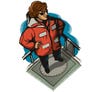
It was raining, not heavily, but painfully—a cold, needling rain. The deckhands all wore rubber boots with steel toes, hard hats and orange, insulated waterproof jumpsuits decorated with high-visibility reflective tape. I wore a hard hat too, and waterproof pants that I’d purchased from an army-surplus store on Cape Cod, along with knee-high rubber boots, a yellow PVC slicker over another raincoat made out of recycled plastic bottles and, under that, an insulated coat, and over the slicker a life vest. On my hands I wore gloves and, under the hard hat, a wool cap. The gloves, it became clear, weren’t waterproof.
Bower stood in the lee of the main lab, helping Kate Fraser enter data into the mooring log—”the diary of the balloon,” Will Ostrom called it, in honor of the yellow, balloonlike subsurface buoy. Ostrom was in charge now. Even Captain Sheasley was under his command. In the staging area between the winch and the stern, Ostrom transformed into an angry dynamo, darting around the heaving deck in his red jumpsuit, shouting orders and flashing crane signals to the deckhands manning the ropes and rigging and heavy machinery with which, expensive instrument by expensive instrument, the mooring would be unspooled. “Tie that down!” Ostrom shouted at Dave Sutherland, who was manning a slip line. “Hold it fast! Clear it! I said clear it!” He pointed at me: “You! On the winch!” I climbed up to the control panel and watched Ostrom through a grid of steel, there to protect me from the backlash of a snapping cable. “Pay it out! Pay it out!” Ostrom barked, pointing down. With cold fingers, I pushed the little toggle forward, and with a diesel-electric moan the wire on the drum began to unspool. “Stop!” Ostrom commanded, flashing a fist, but I was slow to react. “I said stop!”
Over the next several hours, I would come to appreciate that cartoon depicting Ostrom as a devil in a jumpsuit. There was nonetheless something beautiful about his grace and expertise. He was an adept of improvisational physics, judging by sight the weight of an object that had been hoisted into the air, anticipating its swing. We began with the great yellow sphere, the subsurface buoy, which sat on its trellis by the starboard rail. It measured 64 inches across. Its buoyancy would exert 2,832 pounds of upward pressure. On top of it were a satellite transponder and a beacon. Sutherland climbed up on the trellis and switched them on. The beacon began to flash, once every 10 seconds. Deckhands undid the sphere’s lashing. From the winch, the cable now ran up through the A-frame’s block and then out around the starboard rail, where the bosun cotter-pinned it to a grommet at the sphere’s south pole. Sutherland, obviously better at this job than me, took over on the winch.
My new task was to keep the line from fouling on the rail. As I leaned against the cold steel and stretched my arms out over the water in a seemingly beseeching gesture, cable slack across palms, the waves heaving past seemed close enough to touch. They had been gray all day, but up close, in the glare of the deck lights, they were turquoise, crystalline and luminous.
Now a deck crane lifted the yellow sphere into the air, dangling it like a colossal Christmas tree ornament, then swung it over the side and let it fall. The splash was tremendous, a great crown of droplets bursting from beneath. The cable came alive in my hands as though I’d hooked an enormous fish, and I pulled it taut. The sphere drifted out and then aft, and I drifted with it, following it to the stern, keeping the cable clear of the rail, until Ostrom gave the yell, “Let it go!” and I set the cable free. Away the sphere went over the waves, beacon flashing. I felt a curious exhilaration. Its yellow form was bright against the blue waves. It was the only bright thing out there.
Measured in meters and minutes, the night slowly unspooled. My hands grew numb and the sphere’s flashing beacon grew faint as it receded behind the intervening waves, a distant star that you had to wait to catch a glimpse of. Then the flashing light went out. It was impossible to stay warm and dry. The cold rain and the cold wind snuck in at my collar and cuffs. Water blurred my vision, fatigue blurred my mind. A foot or two from the stern’s edge, the men in jumpsuits wrestled instruments onto the black cable—the current meters, the thermometers, the SALPs loaded with yellow floats. Every so often, Ostrom would yell commands in my direction—”Donovan, man the air tugger!” “Donovan, up on the winch, give Dave a break!” “When I point down, you pay it out, goddammit!” These were the easy jobs, but in my numb, sleep-deprived inexperience, they seemed hard enough, and grew harder as the night wore on.
Unlike the rest of us, Amy Bower never wearied. Stationed out of harm’s way, in turtleneck and parka, happily sipping hot cocoa from her mug marked with a knotted rubber band so that she could identify it by touch, she asked Fraser questions—”The second SALP is over now?”—and Fraser, as best she could, narrated the action playing out before Bower’s unseeing eyes. I was standing beside her, sipping coffee, when Bower made a chipper remark: “Look at that,” she said. “It’s first light!”
She was right. Without my noticing, the sky had gone from black to charcoal gray. A moment later, I could begin to distinguish the grayness of the water from the grayness of the sky. When, a little before 6 A.M., the mooring’s one-ton anchor tumbled overboard, there was no sense of finale, only relief.
Out of gratitude and pride, I stayed up to help Bower enter data from the mooring log into her computer, reading it aloud. The winds were now gale-force, just as the forecast had predicted. Under steam again, the Knorr was rolling more steeply than ever. As it rolled, the portholes in the main lab seemed to fill with sea, and it took a surprisingly long while before they began to empty. Even there, inside, I couldn’t stop shivering, and my head had begun to throb.
“I think I need to sleep,” I told Bower, and she apologized for keeping me.
The View From the Ship
In case we happened on an unexpected eddy, Bower had kept one of her 12 floats in reserve, and on our last day at sea, we found one, an Irminger Ring, or so the satellite maps on Bower’s computer alleged. The discovery was anticlimactic. The seas had calmed. Yet below us, if the satellite data was to be believed, there raged a watery storm. We human beings are visual creatures, and yet to comprehend invisible if observable phenomena—mesoscale eddies, rising CO2 levels measured in parts per billion, rising sea levels measured in millimeters, the waves through which cellphones and satellites communicate, electrons, dark matter, quarks—we must learn to perceive the world the way Amy Bower does, obliquely, with the help of fallible instruments and imperfect knowledge.
Out there on the fantail of the Knorr, on the last day of our voyage, trying in vain to detect some trace of the watery storm below, I couldn’t help but feel a bit envious of the naturalists of centuries past, those scientific voyeurs who, with microscopes and telescopes, made discoveries everywhere they looked, perceiving ecosystems in drops of water, cosmologies in the dying rays of intergalactic light.
Bower’s 12 yellow floats are just a small part of a global fleet. Oceanographers have seeded the oceans with more than 3,000 of these underwater sensors. Profiling floats can’t descend into that third dimension any farther than 6,500 feet, however. And they can’t ascend into certain Arctic latitudes, where sea ice makes it impossible for them to communicate via satellite. The data they gather won’t banish darkness from the deep.
Our late Irminger Ring spotting turned out to be a false alarm. Someone at Woods Hole had sent Bower an out-of-date map. By the time we cast her float overboard, the underwater storm had already passed. Such failures are to be expected, especially at sea. Back at Woods Hole, Bower keeps taped to her office door a slip of paper bearing a typewritten motto: “Theory is when you know everything but nothing works. Experiment is when everything works but you know nothing. Most of the time nothing works and no one knows why.” Nevertheless, all but one of the floats on Bower’s mooring did eventually launch. And slowly, by dint of great effort and expense, the information they gather will help us catch at least a glimpse of the ocean’s fourth and darkest dimension—that is, of the world to come.