Planetary Natal Disc This artist’s impression shows the disc around the young star T Cha. The disc has two parts, a narrow ring close to the star and the remainder of the disc material much further out. A companion object, seen in the foreground, has been detected in the gap in the disc, which may be either a brown dwarf or a large planet. European Southern Observatory

Scientists think they have seen a baby planet swirling to life around a very young sun-like star, about 350 light years from Earth in the southern constellation Chameleon. If they can confirm their discovery, it would be the earliest picture yet of a natal planetary system, further illuminating how planets are born.

Using the Very Large Telescope, astronomers were looking at a star called T Chamaeleontis, or T Cha, which is surrounded by a disc of dust and gas. They noticed a gap in the disc, and in two new studies, they say it could be a coalescing planet.

They had to use a special instrument at the VLT to blot out the star’s light enough to see the gap. They found the signature of a large object about 620 million miles from the star, a little further out than Jupiter’s distance from the sun. It is much smaller than T Cha, leading astronomers to believe it’s either a brown dwarf or a budding planet. It is too soon to tell, so they plan look again in a month to see if they can make out any more details.

Planets form from the discs of gas and dust around young stars, but scientists believe it happens pretty quickly, so it would be hard to catch in action. Researchers are trying to learn more about the physics of planet formation by studying how objects collide.

Scientists have already seen other protoplanets forming from these stellar discs, but this finding would mark the earliest stage of planet birth that has ever been seen — a cosmic first.
If there are as many planets as current research suggests, however, it may not be the last.

Both papers are being published by the journal Astronomy & Astrophysics.
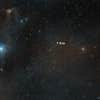
T Cha's Place in the Sky:  European Southern Observatory

[ESO via CBC]

5 Comments

"Planets form from the discs of gas and dust around young stars, but scientists believe it happens pretty quickly, so it would be hard to catch in action."

What does "pretty quickly" mean? 2 weeks? 2 years, 2 million years?

My ADHD doesnt deal with stellar timelines well.

@hilfest - From a quick search, here's what I found. The first stage of formation for rocky planets is called "runaway accretion", and takes 10,000 - 100,000 years.

So yeah, it's pretty quick on a cosmic timescale. I agree that a bit more relevant info in the article would have been nice, though.

The next stage is oligarchic accretion, where all the little (1,000 km diameter or less) protoplanets start to merge. A few hundred thousand years later, there's about 100 planetary embryos uniformly spaced. When they get big enough that they start affecting each others' orbits, the final merger stage begins. Some merge with each other, and some are ejected form the solar system. This takes 10 - 100 million years, and leaves an average of 2-5 rocky planets.

@aleph13, With those numbers (in which I concure are accurate) it sure would make those famous (infamous?) first 7 days pretty damn long days lol.

@CodeZero

I take it you've never studied the subject. Because your mockery is mockable.

@bagpipes100 you've no clue as to what I have or have not researched (and yes I've researched religion quite a bit) Born and rasied Catholic, got in trouble quite a bit for asking questions that there were no answers for, ever had your knuckles busted open by a Nun for asking a religious question? I have. What's mockable is religion as a whole. Say what you will, and keep changing your story as the "holy stories" get rewritten over and over to keep up with what we learn to be truth.

All Holy books were written by man, to try to make sense of what they could not understand. End of story.


June 2013: American Energy Independence

Five amazing, clean technologies that will set us free, in this month's energy-focused issue. Also: how to build a better bomb detector, the robotic toys that are raising your children, a human catapult, the world's smallest arcade, and much more.


Online Content Director: Suzanne LaBarre | Email
Senior Editor: Paul Adams | Email
Associate Editor: Dan Nosowitz | Email
Assistant Editor: Colin Lecher | Email
Assistant Editor: Rose Pastore | Email

Contributing Writers:
Rebecca Boyle | Email
Kelsey D. Atherton | Email
Francie Diep | Email
Shaunacy Ferro | Email

circ-top-header.gif
circ-cover.gif
bmxmag-ps