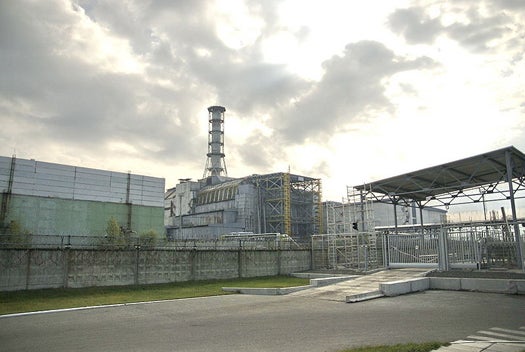
Chernobyl's Reactor No. 4 Redrat72 via Wikimedia

If the typical beach vacation – the one where you spend several days on the beach reading bad fiction and soaking up sun – has lost its allure, the Ukraine would like to make a suggestion: come soak up radiation and some real human drama at Chernobyl, the site of the worst nuclear disaster in history. Starting in 2011, the Chernobyl nuclear power plant site and the surrounding “exclusion zone” will be opened to tourists for the first time since the plant’s reactor No. 4 exploded on April 26, 1986, blanketing the area in radiation.

The Chernobyl disaster, for those who aren’t old enough to have watched it unfold, left a large part of northern Europe under some degree of radiation threat. The worst-hit areas, of course, were the ones closest to the reactor itself; a 30-mile radius around the site was declared an “exclusion zone” and was evacuated and sealed off. All visits to the area were prohibited, and is access granted solely to a small maintenance crew of about 2,500 that work in shifts to maintain the site.

But the Ukraine is now developing safe routes that it plans to open to tourists, offering them a firsthand look at one of the greatest man-made disasters of the nuclear age. The U.N. Development Program seems to be on board, saying it could be a great opportunity for Ukraine to raise some money while driving home an important lesson about nuclear safety.

Ostensibly included in the tour would be a view of the new containment dome that Ukraine hopes to have completed at the site by 2015. The original concrete dome, quickly erected over the reactor shortly after the disaster, is failing structurally and threatening to collapse. The new dome will be a site to see in and of itself: 345 tall, 853 feet wide and 490 feet long, weighing some 20,000 tons and costing more than $1.1 billion.

There's no set date for when the site will begin receiving tourists, but in the meantime you can always visit Chernobyl via Call of Duty 4: Modern Warfare, but remember to stay low and preferably in the shadows.

[AP]

21 Comments

The glowing sky and rusted metal are very Fallout... sign me up.

These Russians and their silly tricks

Um. I really hope the tour is considered *contingent* on the little detail of whether or not there's a containment dome, as opposed to said dome being a possible bonus, as implied....

I will skip on this one. I will let Vice Guide go in my sted. I would love to travel to North Korea and Antarctica, but I will skip on this one.

@jfh1864
there not Russian, there Ukrainian, my Ukrainian girlfriend would get made if you called her a Russian lmao

www.pixelvortex.org - 3D Modeling Blog

Isn't that place still on the poop list for like 90 more years?

As soon as I saw Chernobyl I thought Cod 4...

Not for short visits - though you still wouldn't want to live there.

Great job Ukraine! It takes 250,000 years before radioactive areas are safe to enter without causing deformation and death to humans and animals. What do you want humans and animals to look like in the next hundred years - like the actors who played in the movie "Wrong Turn" or "The Hills Have Eyes"?

You are out of step, and if allowed to continue, you will cause great harm to human and animal life.

Well, time to start searching for the Wish Granter! Let's just hope we don't have the same fate as our friend Strelok.

I'm a bit mad that everyone associates it with COD4 though, as STALKER is a much better series in which actually focuses on the exclusion zone.

Anywho, I'd love to visit Pripyat and Chernobyl, there simply isn't enough documentation on it to understand the gravity of the situation as it stands. I would be worried about radiation level though, I'm assuming that even today and extended day of exposure would result in some harsh radiation poisoning.

I wonder if they sell Geiger-counters and Hazmat Suites in the gift shop?

@twobrain, agreed. I thought they still had high levels of radiation contamination. Radiation contamination? That reminds me of something... Oh yeah! Conjunction Junction... What's your function...

If they had crazy mutant beasties I would go visit in a heartbeat, but the only exotic lifeform I've heard about is a fungus that gets metabolic energy from the radiation. That will still get mycologists excited, but for me it's a two-headed cow or nothing!

Actually, it might be neat to see how nature "reclaims" towns after they are abandoned by people.

@JamesDavis please explain to all of us where you get this number? I hate to tell you but I have stood right on top of a "nuclear area." On my motorcycle cruise last summer I rode across the very bridge (now rebuilt) that a NUCLEAR bomb exploded just 20 meters above. I got off my bike and walked around a nuclear area where a tiny little city called Hiroshima is now sitting. Everyone was horrible mutants so I could not tell if there was any side effects. You do realize that different materials have different half lifes. and levels of radiation and TIME of expose ALL have an impact on what is "safe."

yeah Chernobyl has a short dangerous half life than 250,000 years. As I stated in the second post it is somewhere near 90 years. Courtesy a question in College algebra.

From my math book introductory & intermediate algebra (Blitzer) pg 508

"The 1986 explosion of Chernobyl nuclear power plant in the former Soviet Union sent about 1000 kilograms of radioactive cesium-137 into the atmosphere.( pronounced new clear, not newk ya lur)

y= 1000(1/2) ^ x/30

models the amount, y, in kilograms, of cesium-137 remaining in Chernobyl in 1986. If even 100 kilograms of cesium-137 remain in Chernobyl's atmosphere, the area is considered unsafe for human habitation."

What that means in short is that 90 years from 1986 (2076) there will still be 125 kilograms of cesium-137 in the air. 120 years from 1986 (2106) the amount of cesium-137 in the atmosphere will be 62.5 kilograms.

in the portion of the formula represented as x/30, 30 represents the number of years for each phase of half life.

To give those that are unaware of what happens with exposure. (Taking in of the material, not sure how many routes will cause this) According to my chemistry professor the element cesium-137 makes your body use cesium in place of calcium for bone production. While the cesium may not have a short term effect, having it in your body in place of calcium for extended periods will give you long term exposure to the radiation internally.

I would imagine 25 years of weather/rain/snow, leaves falling and creating new layers of soil, etc would have skewed those calculations a bit. (Yes I realize plants get their water and nutrients from tainted sources but I'd imagine it degrades or filters some) I have a feeling you're doing projectile motion without drag.

I know researchers check it out periodically, I doubt they show up in full radiation gear though.

Might be ok to take a drive through, but that's probably about it. Someplaces are probably worse than others. It's probably mainly dependant on exposure time.

Come to Chernobyl and get a tan ... from the inside!

@twobrain
90 years? More like 90 billion years. Uranium 238 half life is about 4½ Billion years. The radioactivity contamination is about as bad as it was the day it went boom. The only reduction would be where they remove contaminated materials, like buildings and top soil etc.

http://www.iaea.org/NewsCenter/Features/Chernobyl-15/cherno-faq.shtml

The IAEA disagrees. No mention of Uranium-238...

It's not like people don't already go there.

And the radioactivity isn't ANYWHERE near as bad as the day it went boom, specifically not on several types of objects (specifically concrete asphalt, and other hard surfaces). The soil, plants, and wildlife are where the primary radioactivity is, not the roads, buildings, or other materials.

Visit:
www.kiddofspeed.com for a story and images of a woman who rode her motorcycle throughout the areas surrounding the plant.

I imagine the tourism would be similar in feel and story.

Yea!! they sell the radiation suits and geiger counters at the gift shop on the way out....The suits have that old Ukranian saying." I went to Chernobyl and all I got was this lousy radiation suit without a sleeve for the 3rd arm I'm growing"


June 2013: American Energy Independence

Five amazing, clean technologies that will set us free, in this month's energy-focused issue. Also: how to build a better bomb detector, the robotic toys that are raising your children, a human catapult, the world's smallest arcade, and much more.


Online Content Director: Suzanne LaBarre | Email
Senior Editor: Paul Adams | Email
Associate Editor: Dan Nosowitz | Email
Assistant Editor: Colin Lecher | Email
Assistant Editor: Rose Pastore | Email

Contributing Writers:

Kelsey D. Atherton | Email
Francie Diep | Email
Shaunacy Ferro | Email

circ-top-header.gif
circ-cover.gif
bmxmag-ps