Biologists have isolated a bacterium that can use a deadly chemical in place of one of life’s key building blocks, in a finding NASA says could have major implications for astrobiology and our understanding of life on Earth.
In the study, researchers examined a bacteria living in a very salty and arsenic-heavy lake in northeastern California, not far from Yosemite National Park. It is not a space alien, nor is it “new life” — it’s an existing bacteria that lives in a difficult environment and was deliberately manipulated in a lab.
But the results are interesting because nothing like this has ever been done before. All life as we know it depends on six key ingredients — carbon, hydrogen, oxygen, nitrogen, sulfur and phosphorus. This bacteria can switch from phosphorus to arsenic — usually a deadly toxin — and not only survive, but thrive. It can swap arsenic for phosphorus so completely that arsenic is incorporated into its DNA and other biomolecules like ATP, according to the study. This is a first, and it upends our assumptions about how life works.
Updated: "I don't know about a new textbook, but certainly some paragraphs and sentences are going to have to be rewritten after today," said James Elser, a professor at Arizona State University.
What this means for astrobiology is pretty speculative, however. When looking for life in other worlds, especially promising places like Saturn’s moon Titan or in the Martian soil, scientists look for telltale signs of life as we know it. That means carbon-based life, respiration with oxygen and carbon dioxide, amino acids, and so on.
This finding tells us that we should ditch these assumptions and broaden our horizons. If a humble Earthling bacteria can live on a poisonous chemical, then who knows what might lurk elsewhere in the solar system? We’ll have to recalibrate our mass spectrometers."I find this result delightful because it may have to expand my notion of what environmental constituents might enable habitability," said Pamela Conrad, an astrobiologist at NASA's Goddard Space Flight Center and a principal investigator on the new Curiosity Mars rover, which will carry experiments designed to look for signs of life. "The implication is that we still don't know everything there is to know about what might make a habitable environment on another planet. We have to increasingly broaden our perspective."
In terms of its metabolism, the bacterium — a proteobacteria called GFAJ-1 — is actually not very interesting, according to Felisa Wolfe-Simon, a scientist with NASA's Astrobiology Institute and lead author of the paper released today. It is not a chemosynthetic bacteria, for instance, using chemicals instead of light to produce food. In that way, it's less exciting than well-studied extremophiles that live near superheated hydrothermal vents or the unforgiving sulfur lakes of Yellowstone National Park.
But it's interesting because it's a chemical mutant. In an arsenic-enriched environment in Wolfe-Simon's lab, its very DNA changed. It swapped arsenic for phosphorus in the nucleic acids that make up the backbone of DNA, and that's a revolutionary result, Elser said.
"Every living thing uses phosphorus to build its DNA," Elser said at a press conference Thursday. "The fact that I am sitting here today discussing the possibility that that is not true is quite shocking."
At the very least, that is interesting for our understanding of microbes, Wolfe-Simon said. Microorganisms are the oldest and most prevalent form of life, and this study shows that we know less about them than we thought. There may be many other species of microbes that can tolerate or thrive with arsenic, for instance. This is just the first time anyone has really ever tried to find one.
Wolfe-Simon said she had been thinking about chemical substitution for several years. Back in 2006, while she was a postdoctoral fellow at ASU, she proposed looking for life forms that can survive even substituting various chemicals for the building blocks of life. It's not a wild hypothesis — there are a few previous examples of trace metallic elements substituting for one another, including the switching of copper for iron as an oxygen carrier in some mollusks, for instance. The swapped elements share some chemical similarities, making the transition simpler.
Arsenic and phosphorus are also chemically analagous — arsenic is directly below phosphorus on your periodic table, and the elements have the same number of electrons in their outer shells, which makes them behave similarly. So swapping arsenic for phosphorus makes sense on paper. Wolfe-Simon wanted to find out if it worked in practice, and she went looking in a likely place — California's Mono Lake, which teems with life despite containing high levels of arsenic and a salinity level three times that of the oceans.
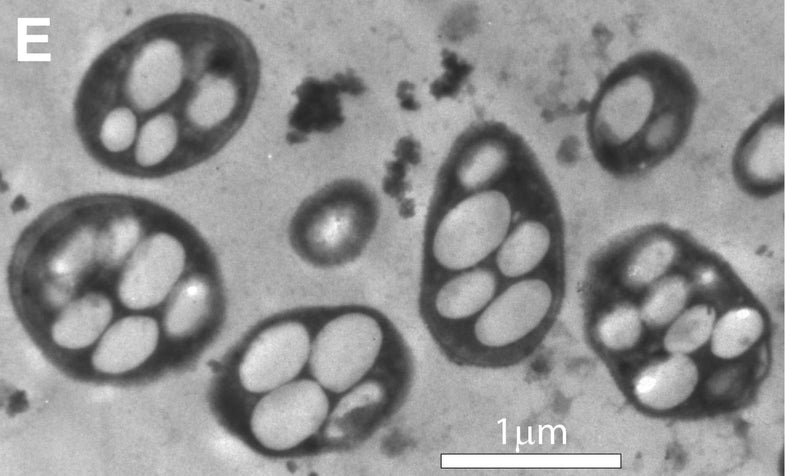
Wolfe-Simon and colleagues took core samples from the lake and brought GFAJ-1 into the lab. They simulated the lake environment and diluted the natural phosphorus until the mixture was rich in arsenic instead. The microbe thrived, and grew 1.5 times its previous size — its cells developed internal vacuole-like structures that account for some of that growth. Conrad, at NASA, said it makes sense that a life form's structure would change in response to its environment.
The team used various types of analysis to show the microbe accumulated arsenic in its DNA. It still contained some phosphorus, too, but not nearly enough to account for its growth, Wolfe-Simon said.
She is already working on an updated study to determine what the microbe will do when it can replicate with both arsenic and phosphorus as DNA ingredients. It will likely be the first of many studies to determine what the microbe can do — and how it can be used. It could help clean up arsenic-laden toxic waste, for instance. In a world with diminishing energy supplies (and dwindling phosphorus supplies) it could even conceivably lead to non-phosphorus-based sources of biofuel. But for now, that's largely science fiction, Elser said.
And, despite the hype over this little microbe, alien life remains firmly in that category as well.
Five amazing, clean technologies that will set us free, in this month's energy-focused issue. Also: how to build a better bomb detector, the robotic toys that are raising your children, a human catapult, the world's smallest arcade, and much more.


Online Content Director: Suzanne LaBarre | Email
Senior Editor: Paul Adams | Email
Associate Editor: Dan Nosowitz | Email
Assistant Editor: Colin Lecher | Email
Assistant Editor: Rose Pastore | Email
Contributing Writers:
Rebecca Boyle | Email
Kelsey D. Atherton | Email
Francie Diep | Email
Shaunacy Ferro | Email
SICK!
We should put these in a big jar mimicking an alien environment and see what evolves! Of course this would eventually lead to a super creature replacing Humans as the dominant animal on earth. I for one, welcome our new Arsenic-Based Overlords.
This is interesting and certainly opens the door for possibilities of life to look for in other places, I am disappointed that the "discovery" was not naturally occurring though.
its very interesting about arsenic. Arsenic doesnt work with this specific strain of proteobacteria. Thank you for this news.
I can't wait till we find Silicone based life... THAT will be the game changer ;)
@ThisNameTaken
I was just thinking how cool it would be to find the Horta in a cave somewhere in North America.
At this point (with an over populated earth) is finding life out there so vital? Could we try the spred of life, to say like the moon or mars. Make it grow and thrive there. I understand it adds great understanding to science but if we dont do something soon...its not gonna be just our "mass spectrometers" we need recalibrating. Then again I dont care.
All this shows is that intelligent life (humans in a lab) can produce intelligent life (Out of pre-existing life)... Yeah that's kinda what we've been sayin the whole time. Congratulations at proving that it takes intelligence to produce "evolution."
The wool must be REALLY thick for alot of people.
Why don't they take carbon, hydrogen, oxygen, nitrogen, sulfur and phosphorus and smash them all together, strike them with lightning, or cause them to swish around and see if the chemicals self assemble.... Does anyone really believe life is possible without a Creator God?
I can't even believe we are still having this debate in the 21st century.
I'm disappointed. When I read the first article about this, I thought the bacteria was naturally arsenic-based. Now I find out it just switches from phosphorus to arsenic when you force it to in extreme environments.
:(
@trueperspective: I'm sorry, but you need to re-read the article. Nowhere did the experiment produce or even attempt to simulate evolution. It just made the bacteria develop vacuoles and grow--NOT evolve. And yes, many people (myself included) believe life is possible without a "Creator God". In fact, the majority of scientists who study the origins of life are atheists...
-IMP ;) :)
Can you believe someone created a crazy t-shirt: "Arsen-itch: the Arsenic Bacterial Creme"?!?!
It's at cafepress.com/arseniclifeform
...insane.
@icemetalpunk just as a reminder... many scientists (Yes its true most are not those that study the origins of life) are now accepting that the universe might have been created by a higher, intelligent, power. And another reminder Charles Darwin believed in intelligent design. And for all the things that we see "evolving" are changing to be able to survive the new conditions. Do we really see monkeys insects birds or any other species getting smarter every generation? no! ten generations? no! 100 generations? no again no! have dolphins gotten any smarter throughout the centuries? no... we just teach them to do stuff we consider intellegent...
@trueperspective: leave it to a creationist to create an argument by mentioning something that had NOTHING to do with the article. I'll of course take the high road...
this is definitely an interesting find and shows the variety of chemicals that can be used by life to survive, thus broadening the likelihood of life elsewhere in the universe.(or rather, the range of places it may be found.)
Honestly I'm not that surprised really. I mean who would be? Who ever said that life has to live and survive just like we do?
@trueperspective: I find your name on this site and your beliefs a little ironic. Kind of funny, really.
This discovery wasn't all that surprising, but it's always nice to see the fundie's coming out of the woodwork. I have a question though. Why comment on this article with such unless you are somehow threatened by this discovery. Perhaps you think it's another "test" to your faith. It's not that hard to read you people, honestly.
Keep marching on, Science. Show the truth no matter what.
@trueperspective:
Some question though: would the said bacteria call us "god", are we omnipotent, omniscient, or omnipresent? How do you know that religions' "god"s isn't analogous to the bacteria's "god". Besides, we didn't create anything, just modifying, like we had been doing by domesticating animals and physically altering their habitats. Like logiacl_aethiest said, what you said seemed unrelated to the article.
But I am glad that we have made this found, this will broaden the scope of search for life. But this also means that we know less about life than we thought we knew. More work for us then!
@jupiehamster-you shouldn't be mis-leading with your comments...actually dishonest...mainstream science dismissed long ago intelligent design as having 0 evidence to support it and just another attack on science by creationist...you should be ashamed of yourself
While this was a lab manipulated environment, they did not tinker with the bacteria themselves. Thus, should natural occurances have shifted that body of water to leach out phosphorous and increase arsenic, then the result from the bacteria would have been the same in the wild - to adapt to the change in water chemestry.
The real walk away "wow" here is that a natural creature can, within its lifetime, adapt to such basically fundamental changes - so fundamental that it affects even the basic building blocks of life.
This is like raising a child on a high iron, no calcium diet and getting a child with an iron skeleton. It shouldn't work, but this bacteria pulls it off.
Also, anyone who believes in a God, and yet believes that their opinion is "trueperspective" aparently believes in a rather simplistic diety. I know I am sufficiently humbled by a all powerful being to not vaunt my perspectives as His.
In the same vein, any who thinks they are "logical-athiest" have not yet learned the difference between "logical" and "skeptical." Someone who is skeptical about the existence of God based on the current evidence is wise enough to hold no set opinion on the issue until more conclusive evidence is presented. Any who leap to the belief that there is no God due to the lack of evidence is being anything but logical - an equivalent statement might be "there is not life in the universe outside of Earth's orbit because there is not concrete evidence of it in my lifetime."
Those who believe in God should be marked by humility and those who are skeptical should be marked by cautious wisdom. Those who are neither fall short both in fidelity to faith and adherience to reason.
Haha, I think we will find life based on many many materials. But i think the rarest ant coolest organism would be humans that are based on this cool stuff called GENEROSITY and HONESTY haha. I KNOW, experts have tried to put those two together time and time again, and they say it just cant be done. But I have a dream that anything is possible! I wont give up hope! Well, I'll give up if you pay me enough. WHAT, dont judge me! 1 out of 2 aint bad!
@jupiehamster,
You clearly do not understand how evolution works.
The point of evolution is not to create "smarter" and "smarter" creatures--it's to create creatures most suited to survive in the specific environment.
Doesn't matter how "smart" you are, if I throw you into the ocean you will drown to death while "stupider" fish continue to thrive.
Actually @ all
This article DOES have everything to do with evolution. This bacteria did not "evolve" to use arsenic, nor did it spring up naturally as a new life form. So how could they possibly conclude that this type of lifeform could exist eslewhere. Just like nothing today macro-evolves, yet people blindly claim its been going on all along.
Why do you chose ignorance over wisdom? I know why, do you?
@IceMetalPunk and @logical_athiest
I'm not saying this proves intelligent creation but doesn't the article state that the bacteria rewrote it's own DNA? "It can swap arsenic for phosphorus so completely that arsenic is incorporated into its DNA and other biomolecules like ATP, according to the study." Doesn't that qualify as evolution?
At both of you who wish to contradict me... one i said many scientists not mainstream or even what percentage, do not judge what you don't understand... and yes i understand evolution i believe certain scientists are completely idiotic for they believe that an organism can evolve to become smarter and smarter. i do believe in evolution in the sense of natural selection in that a bird with a small beak will adapt if it (the species) needs to rely on a new resource for each bird that has a long enough beak will be better enabled to survive and reproduce until the time when the bird with a tiny beak has now ,through out the years (most likely 100s of years), grown a much longer beak...
I am excited. <3
@puevigi: No, evolution only occurs between generations, not within the lifetime of a single creature. Changing the DNA is only evolution if that changed DNA is incorporated into future generations.(which depend on many variables.)
Okspar77777: I have since regretted the arrogance that my user name suggests. I am skeptical of god's existence.(not totally ruling out the possibility.) but at the same time I have my reasons for why i think he/she/it doesn't. which is an un-related subject and i wont go into it. I am generally cautious when it comes to evaluating new knowledge due to the lack of supporting evidence that more well-developed ideas do have. Your analogy is 100% correct and i have since learned better. It's exactly your type of person i respect greatly.
biofiltration. cool. what about a biochemical battery?
Just when you think humans have discovered everything on earth, a new story proves me wrong. Now I'm starting to think humans still have a lot of discovering to do just on earth. Its interesting because we are spending so much money on new discoveries in space but are still learning new things on earth every day :)
ill bet adaptable life forms like this, live in every deadly nook, and toxic cranny of the earth, waiting for conditions to be right. When they are it will rise from its pool of toxic arsenic, or deadly surfer to evolve and take over the world. If you think about it it only makes sense if something wiped out 99.99% of all life and left earths surface covered with poisonous arsenic, we would all die, and they would inherit the earth. Ill bet theres probably a bacteria for every situation.. it sure would take alot to wipe out life on earth...
99.9999999999999% of an atom is empty space
NASA billed this as "extra-terrestrial" or "alien" life. Wrong. The fact that other ways to support life, other than our carbon-based system, exist theoretically made it a matter of time before something was discovered. Silicone is also possible, but my money's on something else - no idea what. Next time, however, a report of "alien life" should be confined to alien life. If it exists here, it ain't alien.
And if your answer to it all is creationism, you are welcome to your beliefs. Just don't try to pass them off as the only argument.
Ten years after THX1138
Why is NASA doing this with taxpayer money. Arsnic eating bacteria may be okay in a salt lake but I sure would hate to see what would happen if it got on some plants or someones flesh. Why are these people looking for hungry bacteria. What is the benefit or purpose. The money and research could be better spent on robotics and engine research. They need to stop playing around and get serious. Who cares about aliens. There is nearly limitliss mineral resources in the asteroid belt and the rest of our solar system. We need to target projects that have an immediate payoff. Man cannot mine these asteroids because they cannot survive out there long enough for lack of gravity. Remotely controlled and atonomus robots can.