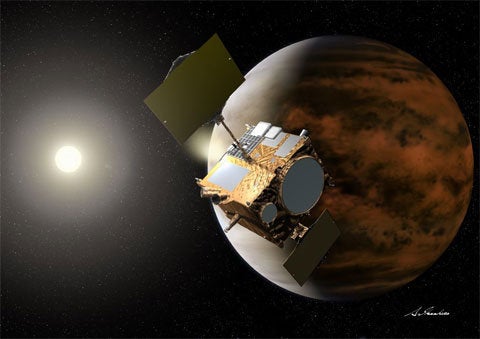
The failure of a Venus probe to reach orbit last week will likely prompt the Japanese space program to take a more cautious tack, according to scientists attending the American Geophysical Union fall meeting this week. The Akatsuki probe — meaning “dawn” in Japanese — is shedding light on the perils of space ambition on a shoestring budget, according to Space.com.
“Our score is zero wins, two losses,” Takehiko Satoh, of the Japan Aerospace Exploration Agency (JAXA), told Space.com last week. “We have to be more conservative to plan our next planetary mission, so it will never fail in any aspect.”
After a nearly eight-month journey to the second planet, Akatsuki was supposed to fire its thrusters for eight minutes Dec. 6 to insert itself into orbit around Venus. But a pressure drop in the fuel line caused them to burn for only two and a half minutes, and the probe overshot the planet. Mission managers don’t know what happened to cause the pressure drop, Satoh said. They hope to try again in six years, the next time Akatsuki will be close enough to try an orbital insertion.Meanwhile, it’s a second interplanetary setback for the space agency, JAXA, which tried a Mars mission in the late 1990s but abandoned it after several problems.
Despite a budget many times less than the U.S. or Europe, Japan has set high goals for space exploration, including a lunar bipedal robonaut by 2015 and a robotic moon base by 2020. But the Akatsuki miss will likely prompt more conservative missions in the near future, Satoh said.
On the other hand, Japan’s Hayabusa mission shows it’s also possible to achieve great success after expected failure. Hayabusa survived damage from a massive solar flare, problems with its thrusters, landing issues and communication problems that forced a three-year delay in its return to Earth, but in the end, it successfully brought asteroid dust back home — the first samples returned from a celestial body other than the moon.
Satoh said Akatsuki’s team now shares Hayabusa’s never-give-up spirit. Nevertheless, Japanese scientists will probably be more cautious next time, he said, adding JAXA might seek more collaboration with ESA and NASA to learn from their successes.
Five amazing, clean technologies that will set us free, in this month's energy-focused issue. Also: how to build a better bomb detector, the robotic toys that are raising your children, a human catapult, the world's smallest arcade, and much more.


Online Content Director: Suzanne LaBarre | Email
Senior Editor: Paul Adams | Email
Associate Editor: Dan Nosowitz | Email
Assistant Editor: Colin Lecher | Email
Assistant Editor: Rose Pastore | Email
Contributing Writers:
Kelsey D. Atherton | Email
Francie Diep | Email
Shaunacy Ferro | Email
What about a HUMAN moon base...oh I forgot NASA never went to the Moon.
@Aldrons Last Hope
You do realize that there were multiple missions that successfully landed on the moon with different people. We are talking about HUNDREDS of people involved in the nasa missions to the moon who undeniably do not dispute it. Only ignorant people who insist on conspiracy seem to think otherwise. it's a shame people spit on such a great human achievement.
This latest failure [ by the Japanese ] highlights just how difficult these long shots are . Its like the largest game of billiards humans play , or mabey more like "frisbee golf" haha , but seriously the technical ability required is massive and the financial investment is also equally as massive
@steve28 I dont think these long shots are all that difficult. It is MATH. someone screwed up, or the machine did not function correctly. Just look appollo 13. They had to sling shot around the moon. They had to come up with thoes calculations on the fly. they didn't have YEARS to test them and use super advance computers to check the numbers. They do INSAINLY precise manures in space every single time something is launched. look at all the probes we send out. Cassiins does about a 100000 billion close fly byes. sling shots around this moon, goes around another, fly past Saturn, slingshots here and there. Did it not just come with in what was it 48 miles of the surface of one of the moons. talk about close???
Also 2 loses, zero wins? does this guy work for JAXA? what about the solar sale mission? that was a success? um... they have a satellite in orbit of the moon. Lets not forget about the space staion. I know they made one entire module. Those are just a few things I can think of. zero wins???
lets not forget they landed on a fricking comet!!! (or was it asteroid. sorry.. little rusty, but not as rusty as Takehiko Satoh)
I believe when he said "two losses" he was referring to planetary missions, like the article says.
It has been said (Hayabusa)that even a blind pig finds an acorn once in a while. Maybe the probe was built by Toyota...
If only the Japanese would shape their space probes like harpoons...I am sure they could hit Venus then.