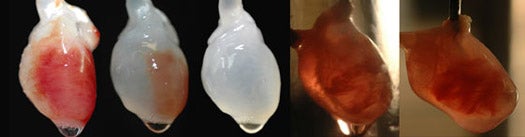
Decellularized Hearts A heart is washed of its cells, leaving behind only the structural skeleton that gives the tissue its shape. Courtesy of University of Minnesota

Research presented at Sunday’s American Association for the Study of Liver Diseases in Boston marked a preliminary but potentially groundbreaking development in the search for the lab-engineered organs of the future. Scientists at the Institute for Regenerative Medicine at Wake Forest University Baptist Medical Center have engineered the first functioning miniature livers from human liver cells ever created in a lab setting. The technique could open up new avenues for engineering a range of vital tissues in the lab.

To create the mini livers, the team took animal livers and washed out the animal cells with a mild detergent, a method known as “decellularization” that leaves behind only the cellular scaffold that gives the organ its structure. They then piped human cells into place via the natural vessel network that remains in the liver after the decellularization process. Connected to a bioreactor – a machine that mimics the conditions inside a living body by feeding nutrients and oxygen to the organ – the human cells began to form human liver tissue, albeit in miniature stature.

The final goal of this research, of course, is to find a means to engineer donor livers in the lab to close the supply-demand gap between those who need livers for transplant and the shortage of donor organs on hand. But engineered livers could also be used to test drugs for safety and efficacy in the lab.

Animal livers have been created in the lab using this process before, but it was never clear if researchers could do the same with human cells. Now that they’ve demonstrated the ability, the next step will be to get one into a living animal and see how it functions. Then, ostensibly, they’ll try to grow larger, more complex organs equivalent to full-grown human organs. As such, the era of made-to-order livers is still a ways off. But this important step forward for bio-engineering could contribute not only to lab-grown livers, but also to other engineered tissues that are in short supply, like kidneys or pancreases.

12 Comments

Flash cloning here we come!

And I had a thought just now. If we can use "scaffolds" from other animals, might it be possible to find a species with a more efficient liver and grow those instead? The same for other organs? Or is it the tissue itself that does the work, rather than the structure?

Wouldn't pig organs (on almost any level) be absolutely ideal for a procedure like this?

This work is just so awesome!!!

Sierra 34
useing animal cells to make a more efficiant liver would be like transplanting that animals liver I think, the cells would face the same rejection problems as just placing the entire organ.

char_is_red
pig organs would probably be ideal for this in most cases, I could see it being used to make heart valves and such with less chance of rejection, and if the cells are donated by the transplant recipiant then they may need no antirejection drugs at all.
one possability is useing a printer system to make the scafolding then infusing it with human cells, as the scafolding is not living tissue they could make and store them for future use :)

the future looks so bright makes me wish I was born a couple hundred years in the future :)

Come on Chuck ... the ladies tell me size doesn't matter. They wouldn't lie to us would they?

Clifford please read the article and his Sierra43's actual comment, decellularization is involved and hence, theoretically no rejection.

Fishermen say that it's not about how long your line is, it's all about how you wiggle your worm ;)

I too wish I was born a couple hundred years into the future . With the exponential rate of advancement in technology the difference between what was possible a mere 30 years ago , no internet , no digital cameras , no cell phones ect .

If I cant make it a couple hundred into the future hopefully my kids can , who I havnt had yet , but if I wait until Im 40 before I have my first kid I can , if I live to be 100 that would mean Im dead in 2077 and if my kid lives to be a hundred him/her may be alive in 2117 but most certainly will be alive to see the 2100 roll around and that would be a sweet thing indeed .

Oh My... this could be greatly beneficial to victims of alcoholism and those in need of a new liver... transplants will be a thing of the past after this technology is mastered.

Why does this remind me of Repo! The Genetic Opera...? Organ transplants will become fashion statements.

Come to think of it, I WOULD like a set of digital corneas like Blind Mag's....

I saw the same thing ChuckLiddel is talking about. I think that really is the way to go. I just hope they get it into practical use before I start needing organs. The growing a bigger "package" thing isn't a bad idea either. Unless your already ample enough what guy wouldn't at least consider it?

Liver problem is big disease especially.But Now There is work on this disease and this experiment is alive example for this problem.And this experiment has proved by other scientist.
http://www.healthproductreviewers.com/leanspa-acai-review.html


June 2013: American Energy Independence

Five amazing, clean technologies that will set us free, in this month's energy-focused issue. Also: how to build a better bomb detector, the robotic toys that are raising your children, a human catapult, the world's smallest arcade, and much more.


Online Content Director: Suzanne LaBarre | Email
Senior Editor: Paul Adams | Email
Associate Editor: Dan Nosowitz | Email
Assistant Editor: Colin Lecher | Email
Assistant Editor: Rose Pastore | Email

Contributing Writers:
Rebecca Boyle | Email
Kelsey D. Atherton | Email
Francie Diep | Email
Shaunacy Ferro | Email

circ-top-header.gif
circ-cover.gif