Forget invisibility cloaks. Researchers at Imperial College London have demonstrated – on paper, anyhow – a metamaterial “space-time cloak” that can conceal entire events from view, making a viewer see one thing while something entirely different takes place behind the cloak. Paging DARPA.
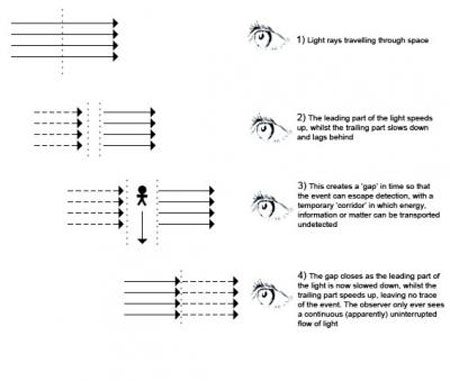
Just as metamaterial “invisibility cloaks” manipulate photons to conceal their subjects or otherwise change visual perception of an object, a space-time cloak would rely on light manipulation to achieve its aims. But unlike other metamaterials, which bend light around an object to render it invisible in certain wavelengths, the space-time material would accelerate and slow photons to create gaps in visual time.
To borrow an analogy from one of the researchers on the project, think of the photons like steady traffic flowing down a freeway. You want to create space to cross the freeway, so you accelerate the traffic. Simultaneously, you slow all the traffic beyond a certain point on the freeway and decelerate all the traffic approaching that point to create a space between the accelerating and decelerating segments of traffic.
Paul Kinsler, Imperial College London
Once you cross, you allow the leading traffic to return to a normal pace and the accelerating traffic to accelerate to catch up to the leading traffic. You’ve just crossed the freeway, but to a person observing the traffic a mile down the road, the gap you’ve created is not visible; the traffic flows by seamlessly.
A space-time cloak would do this with protons, accelerating some, decelerating others, and essentially editing out some in the middle. As such, someone could – and this is an example rather than a suggestion – fool a security camera buy manipulating the photons that reach it. Ostensibly, a safecracker could set up a space-time cloaking device, enter a room, empty the safe, close the door, and make his or her grand escape while a security camera fixed on the safe would see nothing but the closed safe. (You know, like the camera looping scene from Speed, except slightly more believable.)
But the technology doesn’t just serve to enhance the lives of career jewel thieves. This kind of optical manipulation could enhance signal processing and optical computing techniques. And who knows, if someone were to spend some time thinking about it there might be a defense application or two for such technology as well.
Five amazing, clean technologies that will set us free, in this month's energy-focused issue. Also: how to build a better bomb detector, the robotic toys that are raising your children, a human catapult, the world's smallest arcade, and much more.


Online Content Director: Suzanne LaBarre | Email
Senior Editor: Paul Adams | Email
Associate Editor: Dan Nosowitz | Email
Assistant Editor: Colin Lecher | Email
Assistant Editor: Rose Pastore | Email
Contributing Writers:
Kelsey D. Atherton | Email
Francie Diep | Email
Shaunacy Ferro | Email
In the fifth paragraph, it should read "A space-time cloak would do this with photons" (not protons).
Sooo freakin awesome!!!
So it's basically just an invisibility cloak except waaaay bigger. To hide an ordinary object hide in a break in the photon stream, wouldn't this have to be something like the width of our solar system?
http://www.popsci.com/technology/article/2010-09/darpa-funded-device-slows-speed-light-twist-knob
and now it's real
Hey DARPA? Yeah, yep, uh-huh, yeah, now see mind making a jacket out of this stuff?...
Ok, so the gap is not visible, but what about the photons from any objects within the gap?
That doesnt just go away.
Before people run off about invisibility cloaks and other stuff that this doesn't address consider three things:
1 while this might work fine for massive objects like protons or traffic cars in the example, the only way you're slowing photons down is by passing them through a different media - you probably aren't just going to magically spawn that out of nothing around you
2 you've created a gap between 'before' and 'after' photons - for protons you can speed the guys at the back up to meet and close the gap - but for photons there is no way to accelerate them past 'c' so you have to slow the ones in the front down.. which will cause an observable effect.
3 photons are going both ways. redo the traffic stream example, but imagine people bouncing hundreds of red rubber dodge-balls off the guy - yea, your traffic is apparently the same, but what about all that signal coming off of him - do you selectively slow all those as well?
This is an interesting concept for the small scale applications they mention, but it does nothing for invisibility cloaks. For the case of the guy entering the vault to steal jewelry - you'd have to stall the leading photons for the period of the entire event. This kind of delay is something they can barely do in controlled situations in labs and it's certainly not something that will be completely transparent. you might as well just fill the room with a cloudy gas and then run in inside a hamster ball with its own air - it'd be just as effective and 100x more simple.
Now the biggest question is how you accelerate and decelerate photons. One method to decelerate photons is to pass them through materials cooled at temperatures close to absolute zero.
Well, all I can say is that this would be the means aliens would be making their way around so we would never know they were here. Reminds me of star trek when they were hiding on the mountain side and were discovered!
How about a metamaterial that cloaks from the higgs boson. No more mass, or inertia. Spaceflight with almost no power.
Make it so.
@Mycellium. Not as crazy as it sounds, maybe. Einstein came up with relativity while imagining how the world looks to us and squaring that with how things "look" to the photons we see with at the same moment. That last sentence is kind of meaningless since the answer he came up with depends on the two frames of reference never actually sharing a *common now* anyway...Always makes my head hurt.
For those reasons, Einstein might say the volume within such a cloak could be "causally disconnected" from the rest of the universe. Basically the first experiment run with a working version might be to measure the effect of gravity on the cloaks' contents. It couldn't make the cloak material liter, but it might be almost effortless to move the "cargo" within. Not too likely though. Maybe.
@CDales1004. The abstract linked to in the article has a pdf for the paper. "Non emitting" objects are specified, so only everything but spot lamps :)
While its not likely to do anything to gravity this is an honest to goodness "No Chamber" -if it works.
That's cool that it interrupts the light so you can't see what's behind it, but what about the GIANT SPACE TIME CLOAK floating in the middle of the room? Nice start
"Ostensibly, a safecracker could set up a space-time cloaking device, enter a room, empty the safe, close the door, and make his or her grand escape while a security camera fixed on the safe would see nothing but the closed safe."
Please make a movie with a scene like that^
I have always stated that the reason we aren't contacted by an intelligent life form is because our radio and TV signals that travel though space as light waves is being jammed. Cuba jams our radio and TV signals so some aliens that know that we are here is doing the same to us, like a bad in-law they are ashamed to show us to there friends. So this may be how they do it.
This is stupid. You cant accelerate light. Unless Einstein was completely wrong, and "c" is not a constant, this whole idea falls apart.
True, light is constant, in normal space. So,have they figured out how to stretch and contract space?
@lavahothand: c is the speed of light IN A VACUUM (sorry for the caps, but I can't use italics). In other materials, like air or silica fiber optic fibers, it's slower. According to an article about this same tech over at Gizmodo, silica fiber optic fibers change their refractive index (and thus the speed of light inside them) in response to the intensity of light. So a "control beam" in the fiber would control the speed of light by adjusting the intensity of the light, and pulsing it quickly enough with high and low intensity would create the fast-slow-fast effect described here.
It wouldn't work well for long periods of time nor large images, so the safe cracker thing is impractical, but for hiding fiber optic data along a line, it's entirely feasible.
-IMP ;) :)
So if this theory is correct, we can move through the "traffic" of light waves? What happens if we stop in the middle of traffic? Rather, Would it be possible to move/be pushed along with the light waves? I suggest using atoms or any other substance with little mass to see if they would be moved by the light waves at the same speed. In other words, see if light speed is possible on the atomic level, then figure out how we can make a butt load of atoms move. We just discovered how to move ultra-cold rubidium atoms using electromagnetic fields and lasers. Lets try using light waves instead and see what it yields.
Ice metal punk, you didn't explain if the speed of light can be accelerated in non-vacuum.
I also think this can't work with long-period events. Since it will depend on how much gap (in time) that can be done, i don't think the gap will extend for so long.
Interesting. The thing about safe cracking sounds almost as likely as an intelligent comment on a PopSci article.
So, we basically move an object so fast that our eye can't register the transfer of it. How about trying to get the round trip time to/from Mars down a bit before we start talking about traveling faster than the creation of the universe? You can try to speed up or slow down light all you want to, but if I'm standing adjacent, how are you telling the light entering my eye a different message when the light entering my eye is not the same rays that you altered?
I think everyone is missing the basic point.
this is a temporal"cloak".
Or time portal.
it takes sends an item 110 milliseconds into the future.If this could be done continuously an object could be accelerated into the future.