This Year’s Ig Nobel Prize: Fruit Bat Fellatio, Whale Snot, and More Weird Science
The Ig Nobel Prize studies are not a joke, but that's not to say you won't laugh.
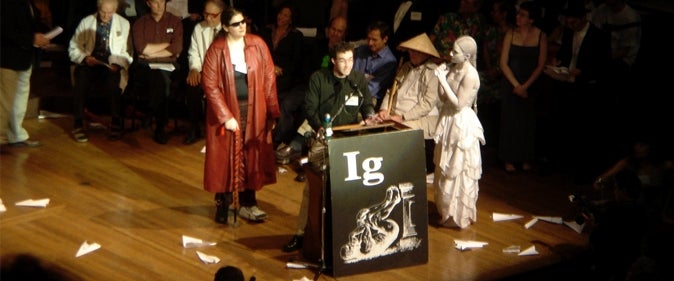
If the MacArthur “Genius” Grants announced earlier this week were too staid for you, the Ig Nobel Prize (now in its 20th year–here’s last year’s coverage) might be the scientific awards presentation for you. The Ig Nobels aren’t a joke; every winning study has a legitimate scientific purpose and execution, making real discoveries and solving real problems. But they’re also all chosen for their ability to “make you laugh and then make you think.” This year’s winners include remote-controlled whale snot retrieval, the benefits of roller coaster riding on asthma sufferers, and our own personal favorite which you may remember: transit planning by slime mold
Ten Ig Nobel awards were handed out in categories including public health, biology, transportation planning, medicine, and physics. The prize for transportation planning went to one of our favorite studies of the year: Slime mold mapping. In this study, a map of the United States is created out of agar gel, with nutrients for mold placed throughout the map. The concentration of nutrients depends on the population in that area, so big cities get lots of nutrients, and open land gets little. The mold is then started in the “New York” area of the map, and ventures outward in the most direct path to other nutrients, forming a peculiarly organic method of transit planning. Here’s our exclusive video on the slime mold map:
Other highlights include the Engineering Prize, awarded for outstanding achievement in the field of whale snot removal. The “novel non-invasive tool” mentioned in the title of that study just happens to be a remote-controlled helicopter. The Medicine Prize was awarded for a study showing that symptoms of asthma can be treated with “positive emotional stress,” in this case a roller-coaster ride. The Biology Prize was awarded for the official scientific documentation of fellatio in fruit bats. The title of that study? “Fellatio by Fruit Bats Prolongs Copulation Time.” Does it ever!
Perhaps my favorite study is the winner of the cheekily named Peace Prize, some experimental research indicating that swearing reduces pain. The researchers aren’t sure of the precise biological reason for the finding, but it seems that swearing, unlike the use of other language, activates the amygdala’s fight-or-flight instinct, triggering a rise in heart rate and a reduced sensitivity to pain. From an evolutionary standpoint, it’s suggested that swearing is a slightly more conscious version of a defensive outburst–a sort of controlled or channeled shriek–that’s compared to a car’s horn.
You can check out the rest of the winners at the Ig Nobel site.