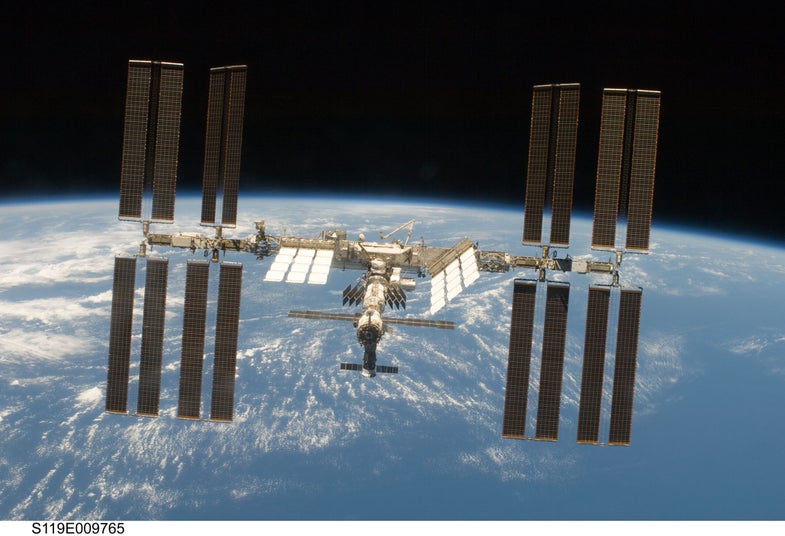
The world’s leading space agencies are reportedly discussing the use of the International Space Station as a launch pad for a manned trip around the moon. The goal would be to test whether the station could be a base camp for missions to asteroids and Mars, the BBC reports today.
Officials at NASA, the ESA and the Russian space agency Roscosmos have circulated letters discussing the possibility of an Apollo 8-style lunar orbit mission. “We need the courage of starting a new era,” Europe's director of human spaceflight, Simonetta Di Pippo, told BBC News.
The idea is to assemble a small spacecraft on-site at the ISS and use it to ferry a team of astronauts around the moon. The mission would resemble Apollo 8, the first mission to carry humans around another celestial body. The spacecraft would likely go straight back to Earth, rather than returning to the ISS.
President Obama is expected to sign NASA’s budget bill this afternoon, which calls in part for continuing space station experiments through 2020. But beyond that, unless the station’s partner nations extend its life, the ISS will become a huge piece of space junk.To avoid that fate, the five ISS partners — the US, Europe, Russia, Japan and Canada — are already mulling how to reuse or repurpose the orbiting outpost. One proposal calls for using Node 3, the cupola-equipped new room, as crew quarters for a long-distance spaceflight. A moon mission is just one more possibility.
A new study will examine how the ISS could be used for a space-based moon shot, as well as which existing systems could be adapted for new goals. As the BBC notes, any new moon mission would need some kind of command module and a departure stage, something to propel the astronauts out of low-Earth orbit and toward the moon.
ISS-based moon missions are of course a long way from reality. But the fact that it’s been discussed, apparently at high levels, is a sign that spacefaring nations can still see beyond politics and policy to dream big.
[BBC News]
Five amazing, clean technologies that will set us free, in this month's energy-focused issue. Also: how to build a better bomb detector, the robotic toys that are raising your children, a human catapult, the world's smallest arcade, and much more.


Online Content Director: Suzanne LaBarre | Email
Senior Editor: Paul Adams | Email
Associate Editor: Dan Nosowitz | Email
Assistant Editor: Colin Lecher | Email
Assistant Editor: Rose Pastore | Email
Contributing Writers:
Rebecca Boyle | Email
Kelsey D. Atherton | Email
Francie Diep | Email
Shaunacy Ferro | Email
Well, they pretty much need to figure out what to do with this thing after 2020. They can't shut scuttle it into the atmosphere without there being a lot of political backlash due to the cost overruns.
I wonder if it would be possible to overhaul it and put it in orbit around the moon? If we ever get to the point where trips between the moon and earth is more cost effective the ISS could be the first manned lunar science station. I bet some space agency could figure out how to attach an ion drive like the Hayabusa probe used. Maybe we could just crash it into the moon and analyze what gets thrown up like what's been done before. There's gotta be something better to do with all that then just burn it in the atomosphere.
what they should really do is start heavily exploring a space elevator to the ISS. Maintenance would be so much easier and cheaper and it could be used as a launch platform then
Utter nonsense, in my opinion. Why bother orbiting the Moon if you're not going to land? Lunar Reconnaissance Orbiter is doing a spectacular job taking pictures as is, so what would a manned Lunar Orbit mission do that an unmanned orbiter can't?
If you're going to all the trouble of:
Reconfiguring the ISS as an assembly station
Testing a reentry capsule (unless you intend to only ship 2 or 3 guys in a Soyuz)
And putting all the rocket stages together (or building a new, huge one, in which case, why use the ISS?)
You ought to go that extra mile and land.
Besides, the ISS is horribly suited for the job of actually assembling something. Its orbit is all wrong, for example.
Re: Maersikai. It can't be done. The ISS is basically held together by lightweight power cables and plumbing. While each individual component can take a lot of thrust, put together, it would fall apart when any more power than that needed for station-keeping is applied. Besides, the fuel load necessary would be prohibitive. Using even Franklin Chang-Diaz's optimistic estimates, we'd need about 200 tonnes of fuel, or 10 Shuttle/Proton launches worth.
Re: GTO. That's not possible. The ISS is far too low for a space elevator to make sense. A space elevator in LEO would be subject to massive amounts of force trying to rip it to shreds, as the top part is trying to move at orbital velocity (almost 10 km/s) relative to the surface. And if you make the top half move at the same velocity as the end on the ground, it wouldn't support its own weight unless you make it out of nanotubes lashed together many kilometers thick.
I think the best use for the ISS is to start pulling modules off and finding new homes for them. Node 1 or 2 can be sold to Bigelow Aerospace as a docking hub for his space hotel. Node 3 can be a crew habitat for an asteroid mission. DESTINY, Kibo, and Columbus can be sold to any private corporation that can bolt solar panels and maneuvering rockets to them.
The iss is not positioned in an orbit suitable for supporting lunar missions, and it would take an incredibly large amount of fuel to move it; unless you used in ion engine but such an engine would need either a huge array of solar panels or a nuclear power station and a large array of radiators.
RE: spacenut. I doubt the assembled station could handle it but all the individual *modules* were built to handle launch forces in one piece. 3g from the surface. You said "components" makes it sound like only single bolts or panels could handle the thrust. As for the fuel bill, why not use a cis-lunar cycler to ferry the individual modules? Then 'voltron' them back together...sorry I couldn't resist the reference.
RE: GTO. Forget elevators. Look up "Launch fountain." It sounds so crazy you might not believe me if I described it. Its very interesting. Supposed to be better (more efficient) AND actually easier (cheaper)than a space elevator. Best of all it allegedly wouldn't need any materials we don't have. Just an odd implementation, a new combination way beyond previous scales. Still pretty darn expensive, just not Iraq War expensive...
i am just brainstorming. the ISS was a good experiment, but long term it is near useless. they basically over-engineered parts bolts onto parts bolted onto more parts.
start over with a large, long term station in the correct orbit.
the space fountain concept is good in theory, but practicality leaves some to be desired.
another thing that I do not think many people really consider is security. a truly massive structure like a space fountain would be near impossible to keep secure unless it was guarded by military.
we truly are in a time of great advances though. I hope I am alive long enough to see a true space faring human race
we need a new Sir Francis Bacon to pull us out of this out space dark ages. I have heard lots of talk in the past 15 years. but not much doing.
The ISS needs to be used as a cornerstone to building other orbiting platforms and spacecraft. Irrespective of the fact that the ISS is currently not configured to build a craft in orbit is fairly irrelevant, because that capability can be given to the ISS by creating a new module(s) for that dedicated purpose.
In short, the ISS is a stepping stone, whether it's a wobbly one or not.
When and if a moon colony is built, there will be detectors there along with it (radar, telescopes etc) watching the skies and tracking any objects that would appear to be on a collision course with the moon or the base.
http://renadexsite.com
I hear ya GTO. Of course the only 'quick' way to take down a launch fountain is to knock the top-end magnet completely off. Otherwise it would fail in slow-motion almost like a deflating balloon. To a point anyway. There would be plenty of time to fix anything else before a point-of-no-return is reached.
With $20+ Billion invested in something, I'd insist the military guard it. Just like fort Knox. Maybe even at fort Knox. Even the top-end vulnerability is manageable if you bundle 2 or more structure's together. Sure a Nuke could take it out, that goes for anything though. Plus the idea of *actual* sky scrapers going all the way to geosynchronous orbit is just too amazing. Very long term certainly.
I have never read such a wonderful article and I am coming back tomorrow to continue reading.
http://pandawaindonesia.blogspot.com/2010/10/mobil-keluarga-ideal-terbaik-indonesia_17.html
http://pandawaindonesia.blogspot.com/
http://tanamanobatalamiah.blogspot.com
Great! Thanks for sharing this useful post to us! Looking forward to reading more.http://pandawaindonesia.blogspot.com/2011/08/top-1-oli-sintetik-mobil-motor.html