As evidenced by NASA’s confirmation last week of an asteroid collision observed by Hubble, there are plenty of objects careening around the solar system that we don’t know about. Some of these space rocks could do some serious damage if the Earth’s gravitational field ever pulls them in.
Apollo 9 astronaut Rusty Schweickart has some ideas about how to deflect them: Smash into them with kamikaze probes and tug them away using gravity tractors.
In an interview with the Space Fellowship, Schweickart describes two types of asteroid deflection campaigns: fast kinetic impacts to push them into a different orbit, and slow gravitational tugboats of a sort that would change the asteroid’s trajectory.
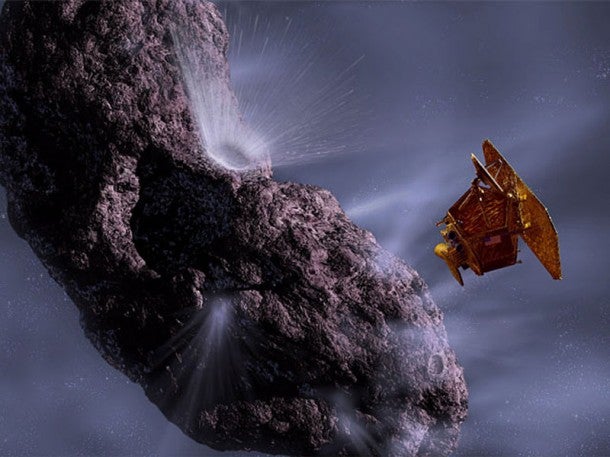
Odds are, if an asteroid is headed for Earth, NASA and its partner agencies will be able to see it a while before it gets too close for comfort. A 10- to 15-year window is plenty of time to send up a tracking probe to fly in formation with the asteroid, Schweickart says. This would help scientists pinpoint its exact location and determine its trajectory, which would help them decide if they need to knock it away. A NASA team based at Ames Research Center proposed just such a project to follow the asteroid Apophis, but it hasn’t been funded.Schweickart suggests sending an impactor probe, not unlike NASA’s own Deep Impact, to crash into a threatening asteroid and move it away. NASA could use a Delta-sized rocket, but the space agency will probably need a heavy-lift rocket to reach far-off threats, he says. Incidentally, NASA's budget bill includes funding for developing a heavy lift rocket, but it's not clear what for — an asteroid hunt seems like as good a mission as any.
Schweickart says NASA should test this out to see if it would actually work. “We need to learn what you find out when you do something for the first time,” he says. Read the full interview here:
Five amazing, clean technologies that will set us free, in this month's energy-focused issue. Also: how to build a better bomb detector, the robotic toys that are raising your children, a human catapult, the world's smallest arcade, and much more.


Online Content Director: Suzanne LaBarre | Email
Senior Editor: Paul Adams | Email
Associate Editor: Dan Nosowitz | Email
Assistant Editor: Colin Lecher | Email
Assistant Editor: Rose Pastore | Email
Contributing Writers:
Rebecca Boyle | Email
Kelsey D. Atherton | Email
Francie Diep | Email
Shaunacy Ferro | Email
If we have a few decades, all that is needed to change an asteroid's trajectory is to change its albedo. The heat an asteroid absorbs from the sun, combined with its rotation, affects the trajectory of an asteroid. Not much, but enough over time.
A coat of paint would do this. Actually, I'd suggest a micron thick layer of either aluminium - to make it more reflective, or carbon to make it darker. Whichever was needed to make the asteroid collide with Iran... oops I mean miss the earth.
lnwolf41
Instead of knocking it out of a collision, why not slow it down and put it in orbit to be used as building material for stations,ships,and fuel. This would reduce the need to send stuff up into orbit.
i think its time we stop hitting asteroids, what if they decide to hit back?
NOM, forget about Iran for god sake, let's crush it into the Moon! We gonna catch lots of peaces from both the asteroid and the moon and the view should be spectacular.
Whatever happened to blowing the thing to hell with nukes?
I was thinking something along the lines of NOMs idea. But with Japan's recent success with solar sails I'd think we could with tether one to it or land one on it and un fold it. Even if it only was making a difference once every rotation I would think it would at least make some kind of course change.
I can visualize landing a sail onto a rock, I have problems seeing how we could effectively coat a several mile wide rock in paint/aluminum at some -200C.
Asteroids are one thing...at least we can study them, work technologies and experiment and tweak them till we get it right, since time may be on our side(note that I deliberately use the word "maybe") but the real villains are those that might appear "out of the blue" due to asteroidal collisions as witnessed by Hubble, those that make sudden and drastic changes in trajectory caused by a variety of reasons as well as those extrasolar visitors that pack much more energy and come in hyperbolic trajectories with bullseye precision, leaving us absolutely no time to take action.
Can we continue to hide under statistics that predict rare occurrence of such events or is it wise to prepare with whatever our combined arsenal offers at the present time ? (You know, humanity has never had rocket weapons in any other era or civilization, as we know.)
What might the world of nations do when confronted with such a threat if we do not have the skills and reliable end to end system capabilities, even though we might have the assets for the first time in human history ?
Is it high time to organize and conduct full dress rehearsals on test targets ?
In th worst case scenario, can we protect large populations in shelters deep underground, utilizing technologies we now possess ?
These are the questions that need dialog and debate, perhaps even black and white solutions.
Rusty had commented on this article below I wrote for Space News a while ago. Here it is again, for those who like to ponder...
http://www.spacenews.com/commentaries/1004712-putting-surplus-nukes-good-use.html
Asteroids are one thing...at least we can study them, work technologies and experiment and tweak them till we get it right, since time may be on our side(note that I deliberately use the word "maybe") but the real villains are those that might appear "out of the blue" due to asteroidal collisions as witnessed by Hubble, those that make sudden and drastic changes in trajectory caused by a variety of reasons as well as those extrasolar visitors that pack much more energy and come in hyperbolic trajectories with bullseye precision, leaving us absolutely no time to take action.
Can we continue to hide under statistics that predict rare occurrence of such events or is it wise to prepare with whatever our combined arsenal offers at the present time ? (You know, humanity has never had rocket weapons in any other era or civilization, as we know.)
What might the world of nations do when confronted with such a threat if we do not have the skills and reliable end to end system capabilities, even though we might have the assets for the first time in human history ?
Is it high time to organize and conduct full dress rehearsals on test targets ?
In th worst case scenario, can we protect large populations in shelters deep underground, utilizing technologies we now possess ?
These are the questions that need dialog and debate, perhaps even black and white solutions.
Rusty had commented on this article below I wrote for Space News a while ago. Here it is again, for those who like to ponder...
http://www.spacenews.com/commentaries/1004712-putting-surplus-nukes-good-use.html
So, why was the recent near miss (a week or so ago) only observed a day or so earlier? Did I misunderstand that? Or, does it have to do with the size of the asteroid, regarding being able to 'see' it decades in advance of arrival?
What about planting a solar powered rover equipped with a rotating electro-magnet...or even maybe an electric drill and a caterpault...that could seriously altar both the heat and trajectory in a manor way