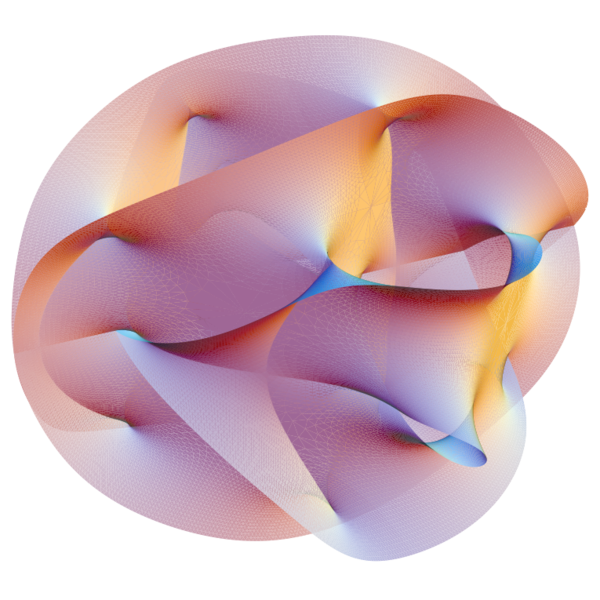
Testing the Theory of Everything This is a 2-D visualization of a Calabi-Yau manifold. Some string theorists think the extra dimensions of space-time, which are predicted in string theory, may take this shape. A new study says string theory can be tested by observing the behavior of entangled quantum particles. Wikipedia

Is everything in the universe made up of vibrating one-dimensional strings? For the first time, scientists think they can concretely test string theory, the mind-blowing “theory of everything” that has dominated physics for the past two decades. It turns out that string theory predicts the behavior of entangled quantum particles, which can be tested in a lab — therefore testing string theory.

String theory elegantly reconciles the otherwise competing rules of quantum mechanics and general relativity. It’s the most widely accepted unified field theory, but it remains controversial. It basically posits that electrons and quarks are not objects, but one-dimensional strings, whose oscillation gives them their observed qualities. The most fun element of string theory is the requirement that the universe has about a dozen dimensions, rather than the usual four (length, width, height and time).

M-theory, the dominant version of string theory, holds that the universe is made up of unfathomably small slices of a 2-dimensional membrane, wriggling in 11-dimensional space.

These bizarre ideas are widely accepted by many theoretical physicists, but the problem is that they can’t be tested — how do you examine an 11th dimension? The field has suffered a backlash in recent years partly for this reason, as some scientists say a theory is not a theory if its predictions can’t be studied in a lab.

Well, now they can, according to professor Mike Duff of the theoretical physics department at Imperial College London. He is lead author of a paper to be published tomorrow in Physical Review Letters, which explains how string theory math can be used to predict quantum entanglement.

Duff said he was at a conference in Tasmania when a colleague presented some mathematical formulas describing entanglement of multiple quantum bits. The equations looked familiar. Upon returning home, Duff checked his notebooks from a few years earlier, and realized the formulas were the same as those he developed to use string theory to describe black holes.

This is completely unexpected, he said. There is no obvious reason why the insanely complex mathematics underlying string theory can also be used to predict the behavior of entangled quantum systems.

“This may be telling us something very deep about the world we live in, or it may be no more than a quirky coincidence,” he said.

Either way, it’s useful, he added. Using string theory math, Duff predicted the pattern that would occur when four quantum bits are entangled with each other. This can be measured in a lab, and the results will demonstrate whether string theory actually works.

Right now, the best hope for string theory tests comes from CERN’s Large Hadron Collider, which is designed to find the tiniest elementary particles that make up matter. It’s theoretically possible that LHC experiments will uncover supersymmetric particles — one element of string theory — or bounce a graviton into a higher dimension, which could help prove M-theory. But testing the fuzzy math that predicts these behaviors will be much easier.

24 Comments

wat.

wat?

Huh?

one of the oldest particle experiments might show proof of string thiery.
when counting particles in a tank looking for new particles they regularly find particle tracks that are intermitant, it's like watching a car pass in the dark with a flashing light, it's there then it vanishes then it's back over and over.

if no one has ever developed an explanation for this then could it be a particle rotating into and out of this dimension?

Warp drive here we come!

Until testing can substantiate String / M Theory I have to say I’m with the people in doubt that this is a valid theory at all. I am anxiously awaiting the test results. Even then I will be very skeptical of the findings. It seems too many people with too much fuzzy math are trying to tie too many things together.

i agree with TXSam. it seems to be an overly complicated solution. an easier solution...i have no idea, but this seems a bit much.

According to this very PopSci post, Mike Duff's paper "explains how string theory *math* can be used to predict quantum entanglement." How PopSci makes the leap that this is a test of a theory of everything is perplexing. But, not unexpected from PopSci -- A.K.A, "Science-Like Magazine" whose articles are science-like as opposed to actual science.

Freeman Dyson predicted several years ago that string theory research would produce useful mathematical tools that may be used to study physics. But, he did not feel that string theory itself could stand up as a theory of everything. I don't know if he's ever had a change of heart since that statement in a documentary whose title eludes me.

The experiment is set up to test a prediction using this math -- not to test string theory itself. There is no string theory -- at least, according to this well written review of Smolin's "Trouble with Physics" book by Doug Brown:

www.powells.com/review/2006_10_28.html

Some of my favorite quotes from the review:

"...there actually isn't a string theory; there's a bunch of separate theories, each of which isn't a theory itself. What I mean is, all we have now are approximations that suggest there might be an actual theory called string theory (a.k.a. "M-Theory"), but we're too stupid to figure out the math. None of the approximations agree with each other."

"...what does it have going for it? In the adjective of a popular book title, it is elegant. Well, elegant if you think heinously complicated mathematics that don't actually describe the known universe is elegant, that is."

"It is worth emphasizing that Smolin is not stating that string theory is wrong; after all, he has contributed to it himself. He is simply asking that the rules of science be applied to it more than they have."

So, among the many approximations that "don't agree with each other", there might be a subset that may predict quantum entanglement. This appears to me, what is to be tested in an experiment.

@TXSam: "I have to say I’m with the people in doubt that this is a valid theory at all."

your kidding right? are you a theoretical physicist? a physicist at all? are you even a science teacher? We are talking about physics that Einstein couldn't begin to wrap his head around they are so far advanced. I don_'t think anyone opinion on this websites it worth 1/0000 of a cent. You can hope they are right. Or hope they are wrong. buy you can't think they are wrong or right because you couldn't even a single equation from their theory's, so its kinda pointless to so say don't think it is true.

@ TXsam:
Of course the math is complicated cuz your pea-sized brain can't understand the complexities involved. It takes complicated math to explain complicated systems. How do you think people reacted when newton devised calculus? They all looked at it as a bunch of jibbery joo and was too complicated for their time to understand but it was need to describe the physical processes around them... now that we have come to understand them, calculus ain't so difficult now is it? Their isn't going to be no simple explanation of the world around us.. it is far to complex for us even to comprehend I mean shit the fact that space and time are intertwined and that space can be manipulated bent, shaped and curved was way out of anyone's league back when Einstein developed relativity and they all though it was just too complex to understand. Just because you don't understand something doesn't make it not true, your a$$ just ain't smart enough to comprehend it. There might be just a "one inch" equation out their to describe the world around us and how it works and in its self that is simple.. but the MATH is not by any means... just my .02 cents

I think the first 3 comments pretty much sum the article up :D

That said, if they really have come up with an experiment to test string theory, I wonder what it would mean for the physicists involved with trying to find a unified theory?

Physicist Bob- Well, we've done it....we've finally done it, we've made a unifying theory of everything.

Physicist CoolBroCool - Awesome! What do we do now?

Physicist Bob- I dont know, I never expected this day to come? Maybe we should finally unveil that Stargate we built a while back for the government?

Physicist CoolbroCool - No, that seems really hard. Screw it, I hear Amsterdam is pretty crazy....how about we do what all theoretical physicists dream of doing and go crazy in Amsterdam?

If they can finally test the string theory, THEN WHAT ARE THEY WAITING FOR?

I'm tired of calling it a theory.

DOIT.

At the skeptics, how can you possibly say it is overly complicated? Whether or not the math explaining reality is complicated, string theory's physical implications are simple. If we're going for "Occam's razor" approach what is simpler? Everything in the universe is made up of x number of different atoms which themselves are made of smaller particles or everything in the universe is simply vibrating energy whose only difference is frequency?

Nosebleed!

Aren't some theories just not testable, like the theory that what you observes determines the results of the test? The whole point of the scientific method is that we can conduct experiments and experiments are the end-all and be-all of everything, but what if we live in an universe where the scientific method is a flawed way of determining truth? Science acts on a basic assumption, and we should keep our mind open. -AznHisoka of www.candidablog.com

Since we're talking about science here (I think...) shouldn't it be "string hypothesis"?

See, now everyone spews on about "the complex mathematical equations" etc etc....but doesn't anyone pay attention to the basic concept behind the String Theory. I mean, hey, don't get me wrong, I certainly had my moments of "HUH!" but even so, I found a large amount of simple, rational ideas when reading about the theory. It's really quite interesting, though, it'd certainly help if I had a Ph.D. in theoretical physics! Greene's 'The Elegant Universe' was a help with explaining things to a simpleton like me.

Wow...got a few poeple here with their panties in a bunch over someone posting their opinion on a topic.

Never once saying the theory was right or wrong...just that he would wait for the results and still be skeptical

Doubt is a requirement for true scientific research.
Apparently, they dont know the difference between doubt and flat out religious denial.

Talk about sad.

I wish that people, who are seemingly interested in honest science, would educate themselves on the definitions of the terms used in scientific parlance.

Example: Theory

Would someone here care to provide a definition for the term above, as it applies to the scientific examination of reality, and the conclusions drawn from the observations?

@ podboq

I absolutely would

Theory:A scientific theory summarizes a hypothesis or group of hypotheses that have been supported with repeated testing. A theory is valid as long as there is no evidence to dispute it. Therefore, theories can be disproven. Basically, if evidence accumulates to support a hypothesis, then the hypothesis can become accepted as a good explanation of a phenomenon. One definition of a theory is to say it's an accepted hypothesis.(chemistry.about.com)

Perhaps you're thinking of the definition of a hypothesis?

Are you about to say that the theory of relativity is incorrect? Maybe because the math is too complex??

T_Hirdina: "Perhaps you're thinking of the definition of a hypothesis?
Are you about to say that the theory of relativity is incorrect? Maybe because the math is too complex??"

reply: The only definition I was concerned with in my last post was the definition for "Theory" as it is used by scientists, in contrast to lay-people.

I have no doubts about relativity, I experience it every waking moment of my life.

T_Hirdina: "A theory is valid as long as there is no evidence to dispute it."

reply: So, in every day usage, the general population could interchangeably use the word 'fact' where they might also use 'theory'? Would that be the correct conclusion?

Where, may I ask, did you get your definition for 'Theory'?

I cited my source...

Second we're not talking about everyday usage, colloquially the definition defers;however, the article is about a scientific theory and therefore the scientific definition of the word is appropriate.

Words have precise meanings in science. For example, 'theory', 'law', and 'hypothesis' don't all mean the same thing. Outside of science, you might say something is 'just a theory', meaning it's supposition that may or may not be true. In science, a theory is an explanation that generally is accepted to be true. Here's a closer look at these important, commonly misused terms.
Hypothesis

A hypothesis is an educated guess, based on observation. Usually, a hypothesis can be supported or refuted through experimentation or more observation. A hypothesis can be disproven, but not proven to be true.

Example: If you see no difference in the cleaning ability of various laundry detergents, you might hypothesize that cleaning effectiveness is not affected by which detergent you use. You can see this hypothesis can be disproven if a stain is removed by one detergent and not another. On the other hand, you cannot prove the hypothesis. Even if you never see a difference in the cleanliness of your clothes after trying a thousand detergents, there might be one you haven't tried that could be different.

Theory

A scientific theory summarizes a hypothesis or group of hypotheses that have been supported with repeated testing. A theory is valid as long as there is no evidence to dispute it. Therefore, theories can be disproven. Basically, if evidence accumulates to support a hypothesis, then the hypothesis can become accepted as a good explanation of a phenomenon. One definition of a theory is to say it's an accepted hypothesis.

Example: It is known that on June 30, 1908 in Tunguska, Siberia, there was an explosion equivalent to the detonation of about 15 million tons of TNT. Many hypotheses have been proposed for what caused the explosion. It is theorized that the explosion was caused by a natural extraterrestrial phenomenon, and was not caused by man. Is this theory a fact? No. The event is a recorded fact. Is this this theory generally accepted to be true, based on evidence to-date? Yes. Can this theory be shown to be false and be discarded? Yes.

http://chemistry.about.com/od/chemistry101/a/lawtheory.htm


June 2013: American Energy Independence

Five amazing, clean technologies that will set us free, in this month's energy-focused issue. Also: how to build a better bomb detector, the robotic toys that are raising your children, a human catapult, the world's smallest arcade, and much more.


Online Content Director: Suzanne LaBarre | Email
Senior Editor: Paul Adams | Email
Associate Editor: Dan Nosowitz | Email
Assistant Editor: Colin Lecher | Email
Assistant Editor: Rose Pastore | Email

Contributing Writers:

Kelsey D. Atherton | Email
Francie Diep | Email
Shaunacy Ferro | Email

circ-top-header.gif
circ-cover.gif