Plants are extremely efficient converters of light into energy, more or less setting the bar for researchers creating photovoltaic cells that convert sunlight into electricity. As such, researchers are constantly trying to mimic the tricks that millions of years of evolution and development have taught to plant biology. Now, a team of MIT scientists believe they’ve done it, creating a synthetic, self-assembling chloroplast that can be broken down and reassembled repeatedly, restoring solar cells that are damaged by the sun.
While the leaves on a tree appear to be as static as the PV cells on a solar panel, they’re not; sunlight is actually quite destructive, and to counter this effect leaves rapidly recycle their proteins as often as every 45 minutes when in direct summer sunlight. This rapid repair mechanism allows plants to take full advantage of the sun’s bountiful energy without losing efficiency over time.
To recreate this unique regenerative ability, the MIT team devised a novel set of self-assembling molecules that use photons to shake electrons loose in the form of electricity. The system contains seven different compounds, including carbon nanotubes that provide structure and a means to conduct the electricity away from the cells, synthetic phospholipids that form discs that also provide structural support, and other molecules that self-assemble into “reaction centers” that actually interact with the incoming photons to release electrons.Under certain conditions, the compounds assemble themselves into uniform structures suitable for harvesting solar energy. But in the presence of a surfactant (similar to the stuff used to disperse oil during oil spills) the structures break down into a solution of nanotubes, phospholipids, and other constituent molecules. By pushing the solution through a membrane to remove the surfactant, the elements once again assemble into working, rejuvenated solar cells undamaged by their prior exposure to the sun.
The cells are work at 40 percent efficiency, and researchers think with some tweaks they could push that efficiency much higher. And because they don’t degrade over time – just give ‘em a quick shake with the surfactant and they're essentially brand new – the tech could be the next big step forward for solar technology.
Five amazing, clean technologies that will set us free, in this month's energy-focused issue. Also: how to build a better bomb detector, the robotic toys that are raising your children, a human catapult, the world's smallest arcade, and much more.


Online Content Director: Suzanne LaBarre | Email
Senior Editor: Paul Adams | Email
Associate Editor: Dan Nosowitz | Email
Assistant Editor: Colin Lecher | Email
Assistant Editor: Rose Pastore | Email
Contributing Writers:
Rebecca Boyle | Email
Kelsey D. Atherton | Email
Francie Diep | Email
Shaunacy Ferro | Email
i like it but why cant they be 99% were are we losing 60 percent
Probably because we can't convert the heat energy thats created when light strikes something very easily. Were using the photoelectric effect which only uses part of the spectrum and only absorbs part of the energy.
So...how efficient are plants are converting sunlight into energy? If we can get it up to the same level as plants, that'd be awesome (as I don't think we can best mother nature in that department--maybe equal but not surpass). It took her millions of years to get to this point...so I don't think we'll be able to do it in a few years, though.
Believe it or not but plants are only able to convert about 45% of TOTAL solar energy during photosynthesis to energy. So were right at the level already the highest being 42% that I know of. I'm sure there are higher too. It's not so much the efficiency as the cost of that energy via expensive materials. But then what do I know ha.
Solar power has it's issues but as the different techs start coming together I become more interested in it all the time.
The road ways as solar panels described below:
http://www.popsci.com/scitech/article/2009-08/solar-panels-built-roads-could-be-future-energy
The ability to convert not just light energy but heat as well:
http://www.popsci.com/scitech/article/2009-08/solar-panels-built-roads-could-be-future-energy
I also remember reading somewhere about advances in super conductive material that would help make the transportation of energy easier and more efficient. I'm skeptical but my interest is peeked.
"i like it but why cant they be 99% were are we losing 60 percent"
Photons with less energy than the bandgap cannot be absorbed. Photons with more energy than the bandgap can be absorbed, but all energy in excess of the bandgap becomes waste heat.
Sunlight has a broad distribition of energy into different frequencies of electromagnetic radiation; stretching from near IR to UV. If you only have a single junction the bandgap that provides the best trade off between capturing many photons and getting the most energy for each photon is a band gap of ~1.4 eV; theoretically you could achive a conversion efficiency of ~30% with only a single junction.
In practice some of the light will be reflected away from the solar panel, some will be absorbed by dust and junk on the panels, some energy will be lost due to internal resistance, some energy will be lost due to recombination of holes and electrons(grows worse with temperature).
You can stack multiple materials with different bandgaps(a multijunction cell) to achieve higher efficiency, but this is problematic. When crystal structures differ too much, strain damages the crystals. No material is perfectly translucent; the high-bandgap junctions capture some of the less energetic light, turning it to heat, instead of letting it through to the next junction.
In theory, being able to convert more thant 45% or 60% or even higher percentage of light into energy would be great, but there's always a cost.
The practical consideration is the payback you get from the cost of making the darn thing. If you spend $1M to make a 99% efficient solar cell, but it takes 1000 years to get your $1M of electricity out of it it's a losing sum gain --the thing will most likely die well beforehand.
If you can get 13% efficiency for a few dollars and generate energy for "free" after a year, it starts to make sense...wait 5 years to get your return and people don't want ot talk to you...
The biggest question is what's the best value at the least impact to the environment--not for a given technology, but for an actual product that works and lasts long enough to be an asset in the long run.
Matt
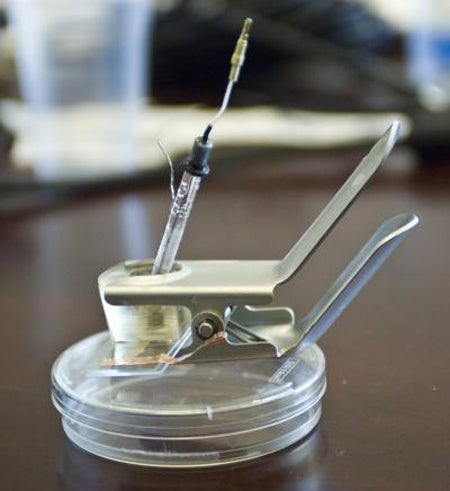
The picture is confusing, looks like a electrochemistry reference electrode on a paper clip on a petri dish.
I was shocked when I read the intro paragraph to this article. Plants are terrible at converting solar energy. That's why biomass will only ever be a very small or very temporary part of the solution. I had heard 7%, but upon checking my facts Wikipedia quotes 11% and the Encyclopedia Brittanica has 26% as the theoretical max with the actuality usually being closer to 1%
http://www.britannica.com/EBchecked/topic/458172/photosynthesis/60563/Energy-efficiency-of-photosynthesis
The fact that they've managed to the the efficiency up at or above 40% is already pretty impressive, considering the other new tech involved. It indicates that it's probably a triple-layer cell meant to be used in a concentrator system. It's great research, but I'm also wary of the cost...
OK....Get it to production...WE NEED THIS NOW!! Get off coal, oil whatever and create extra revenue for the working person to generate their OWN electricity. This is SOOOOOOOO important to get us off all resources that are created out of our country and the revenue doesn't help the local individual. This is what stimulus money should be doing...not 10 years, 20 years...WE NEED THIS NOW. Big energy companies are KILLING us!!!
Why can't we all just dig a hole 5 feet wide by 500 yard's deep and place a pound of uranium inside a sphere of water that collect's the heat? sorta like the mechanism used by nuclear submarines? have some heat exchange system using radiators so you don't get the contaminated water. this would work wonders along with natural geothermal activity that takes place at these depths. The government could keep record's of when the uranium rod's will expire and regulate the replacement and disposal so people can't sell them to terrorist's.
thr's a way to utilize a heat energy as well it goes as follows , m guessing that d rise in the temperature would be around 20 degree celsius , so we can submerge the heat producing elements in liquids like diethyl ether(bp of 34.7)
ether(bp of 35)and Ethyl bromide C2H3Br (bp of 38)or benzene can b used to absorb this energy and rotate turbines to provide electrical energy
, this already being done with ammonium compounds and heat from diffrent levels of sea water
wow this is an interesting place to learn a lot about solar cells, after building my first solar panel, I just know the basics, but all this new knowledge has taken me to a whole new level.
So I wonder, does this mean these cells will last forever or just longer than your typical photovoltaic cells?
jonathan hannsson
www.solarpanellessons.com