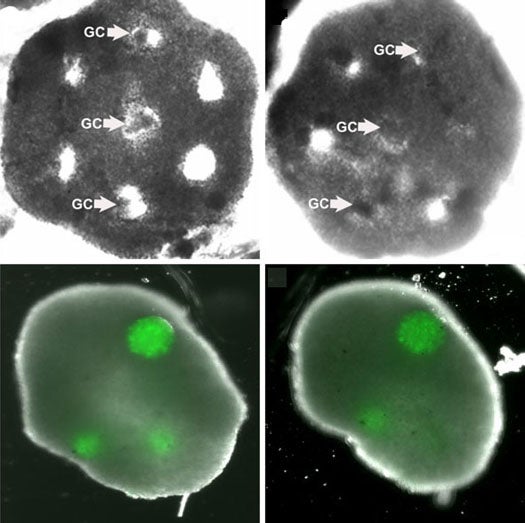
While trying to create a better synthetic environment in which to study how ovarian cells develop and interact, a Brown University researcher and her colleagues have created the first working artificial ovary. Using special “3-D Petri dishes” and samples of donor cells, the team has already created an artificial organ that has carried human eggs through to maturity.
To do so, they had to coax the three main cell types found in the human ovary into particular three-dimensional structures. The means for doing so were found in a special moldable agarose gel, dubbed 3-D Petri dishes, that encourage cells to grow into certain shapes and structures.
The researchers first created honeycomb-like structures out of donated theca cells, one of the main cell types found in the ovary. Once in a honeycomb arrangement, the voids in the structures were filled in with granulosa cells along with human oocytes (those are the eggs, you’ll recall from biology class). In just a few days, the artificial cellular structures had enveloped the egg cells, essentially becoming a functioning ovary.The eggs then matured from a young state to full maturity, demonstrating that the structures aren’t only good for experimenting with ovarian cells but also for clinical use. So while the artificial organ can be used as a living laboratory for research on egg development and ovarian function, it could also be used clinically to bring immature eggs to term outside the bodies of women facing cancer treatments or other fertility-hindering treatments.
Five amazing, clean technologies that will set us free, in this month's energy-focused issue. Also: how to build a better bomb detector, the robotic toys that are raising your children, a human catapult, the world's smallest arcade, and much more.


Online Content Director: Suzanne LaBarre | Email
Senior Editor: Paul Adams | Email
Associate Editor: Dan Nosowitz | Email
Assistant Editor: Colin Lecher | Email
Assistant Editor: Rose Pastore | Email
Contributing Writers:
Kelsey D. Atherton | Email
Francie Diep | Email
Shaunacy Ferro | Email
So when will non-artificial baby makin be made "obsolete"?
We already got invitro fertilization and now ovaries... whats next?
@thor0997, Have you considered that some of us enjoy the process of making babies naturally? :)
I know. I was just saying that it looks like we are heading in that direction. :}
So lets forget about any way to help women who can't have babies naturally because that might make other people uncomfortable.
Would you say the same thing to the people developing bypass surgery, grafting, transplants, or creating artificial hearts?
"Have you considered that some of us enjoy our hearts beating naturally?"
I doubt it because that would sound callous and ignorant of what's trying to be done. It's not for regular people but for research and to possibly help those who need it.
AH! I know people need it too I was just concerned about the other implications besides the other ones ALREADY TALKED ABOUT IN THE ARTICLE!
@zajhein, your silly overreaction only works if my comment is taken out of context. Thor0997, asserted that this discovery would render sexual reproduction obsolete. I responded saying that it won't be the case because most consider such experiences enjoyable. Stop taking yourself too seriously.
"It's not for regular people but for research and to possibly help those who need it.
Well, since we all live in an ideal world we know that only the people who really need procedures are the ones who use them.
A woman who wants a baby but doesn't want her body to be altered through pregnancy would never, ever use this technology is she had the money and opportunity. (I'm being sarcastic folks.)
As long as people have the means and opportunity they will use and misuse technology however they see fit. Someone like an actress or model would jump at this technology especially since their careers depend on their physical appearance. "If" is out of the question, "when" is the only thing you need to consider. It's only a matter of time...
@thor0997
VIRGIN ALERT, wait this is Pop-Sci.com
nevermind
Dude, I cant wait to knock up a petri dish
The cost of going from egg and sperm to baby would be prohibitively exspensive.
Possible? Yes. Useful? No.
It is simply much cheaper to do it naturally - and by naturally I mean renting a uterous for your test tube inseminated eggs.
Even on an industrial scale (ala Brave New World), it would still be cheaper to do it naturally. After all, making babies the old fashioned way is practically free.
Still, this is an interesting process for research with many potential benefits for thsoe couples with difficulties well beyond the norm.
skeet ... skeet
@friedguy
Wow really?